As another series of RuPaul’s Drag Race draws to a close (with its highest viewers yet), RuPaul’s position as a titan of queer culture is cemented.
It can’t be easy being the best known drag queen in the world, and fans of Drag Race will be familiar, by now, with Ru’s very Zen way of handling the spotlight, as well as handling other people.
Which is why this candid interview with Joan Rivers is so very refreshing. Ru really spills the T, from his often-overlooked background as a punk rocker and a go-go dancer, to his long term relationship and its “open” status, his mother (who sounds great!), his make-up tips, and his musings on gay culture and its relationship with the mainstream, which makes for some of the most interesting, and insightful, conversation here. You also get to find out RuPaul’s real name, which may come as a bit of a surprise if you don’t already know.
Of course, Joan Rivers is no minnow in the sea of gay culture herself, so it shouldn’t be surprising that when these too get together it’s a real treat. Both are fountains of knowledge, both queer and straight, and to see them kiki with so much mutual admiration is great. There’s simply no way they couldn’t be fans of each others’ work, which probably explains the openness and ease of this interview.
RuPaul in bed with Joan Rivers really is worth a watch:
Rock and Roll taught John Waters how to annoy his parents, but it was the nuns from his local church, who inadvertently encouraged his interest in cheap, exploitation films:
‘The first thing I can remember rebelling about really, was when I was about 8-years-old and every Sunday we’d go to church. Once a year they’d read us this pledge that we had to take for the Legion of Decency, which was the Catholic Church rating the movies—what you could see and what you couldn’t—and the condemned ones were the ones they’d tell us you’d go to Hell if you saw these movies.
Well, I remember refusing to do this pledge and my mother was kind of shocked, but I was just a child, and she didn’t make a big deal out of it. And on Sundays, the nuns would read us this list, with this voice like the Devil, and you know, seeing this nun stand there saying, “Love Is My Profession, Mom and Dad, The Naked Night.” I thought “What are these movies?” I’d never heard of them—they didn’t play at my neighborhood, believe me—but I would go and see them, or read about them, and clip the little list and keep a record of all these condemned movies. The Mom and Dad poster is hanging right in my hall—it’s still that much of an influence. But it made me want to see these movies I’d never, ever heard of. So, in fact they encouraged me, [the nuns] encouraged my interest, without ever knowing it completely.’
Growing Up With John Waters is a fabulous Channel 4 documentary from 1993, where the notorious director of Pink Flamingos, Multiple Maniacs, Female Trouble and Hairspray talks about the childhood events that shaped his life.
If you took THE NUMBER OF SUB-ATOMIC PARTICLES IN THE UNIVERSE and multiplied that number times itself THAT MANY TIMES; and then added the total number of MICRO-SECONDS since the beginning of time, times itself; and then added 803—you would STILL have only the tiniest fraction of A BILLION-BILLIONTH PER CENT of the amount of love I HAVE FOR YOU.
Love,
your candle partner,
the romantic Mr Carlin,
your eternal flame.
And of course there are those times when so much is happening—the emails to be read, the dog to be walked, the work to be done, the ‘toothpaste to be squeezed’—that a story occasionally slips by unnoticed, unacknowledged. So, it was with this piece from the Tampa Bay Times that was posted in March.
..visited several times with Jack Kerouac at Kerouac’s home on 10th Avenue N for this story, which was published Oct. 12, 1969. Kerouac died nine days later, on Oct. 21, at St. Anthony’s Hospital.
According to Kevin Hayes, author of the book Conversations With Jack Kerouac, McClintock’s interviews were Kerouac’s last.
Kerouac was unlike the imaginary Beat writer that millions venerated. He was a maudlin drunk, who clung to his childhood beliefs, spoiled by drink, a bitter Republican, who was dismissive of the hedonistic culture his work had inspired. It’s sometimes inevitable that the youthful firebrand will evolve into the tweedy curmudgeon. Often this phase of an artist’s life is dismissed or edited out (look how Allen Ginsberg tirelessly ignored or defended, as somehow ironic, his friend’s homophobia and anti-semitism). Still, I find such phases as interesting and as valid as the sunny, glory days—in the same way “fat Elvis” is as compelling a narrative as “Sun Records Elvis,” but for wholly different reasons.
McClintock went looking for Kerouac wanting to know what happened to the Beats in the “Age of Aquarius?” After a week of no-shows, McClintock at last saw a recognizable face with “grizzled jowls and red-rimmed eyes under spikey, dark tousled hair.”
Kerouac? The face said, “Yeah,” and then: “You want to come in?”
Although the sun was two hours from taking its evening dip into the gulf 10 miles to the west, the house was dim inside. A television set in the corner was on, soundless. The sound you heard was Handel’s Messiah blaring from speakers in the next room.
“I like to watch television like that,” Kerouac said.
“You ain’t going to take my photo are you? You better not try to take my photo or I’ll kick your ass.” A threatening leer, then a laugh.
“Stella. Hey! Turn the music up!” Stella went and turned the music up. Her feet were silent on the floor.
Kerouac dragged up a rocking chair for the reporter, then slumped into another one in the corner.
He was wearing unpressed brown pants, a yellow-and-brown striped sport shirt with the sleeves rolled to the elbow. The shirt was unbuttoned and beneath it the T-shirt was inside out. He pointed to his belly, large and round.
“I got a goddam hernia, you know that? My goddam belly-button is popping out. That’s why I’m dressed like this … I got no place to go, anyway. You want a beer? Hah?” He picked up a pack of Camels in a green plastic case. “Some whiskey then?”
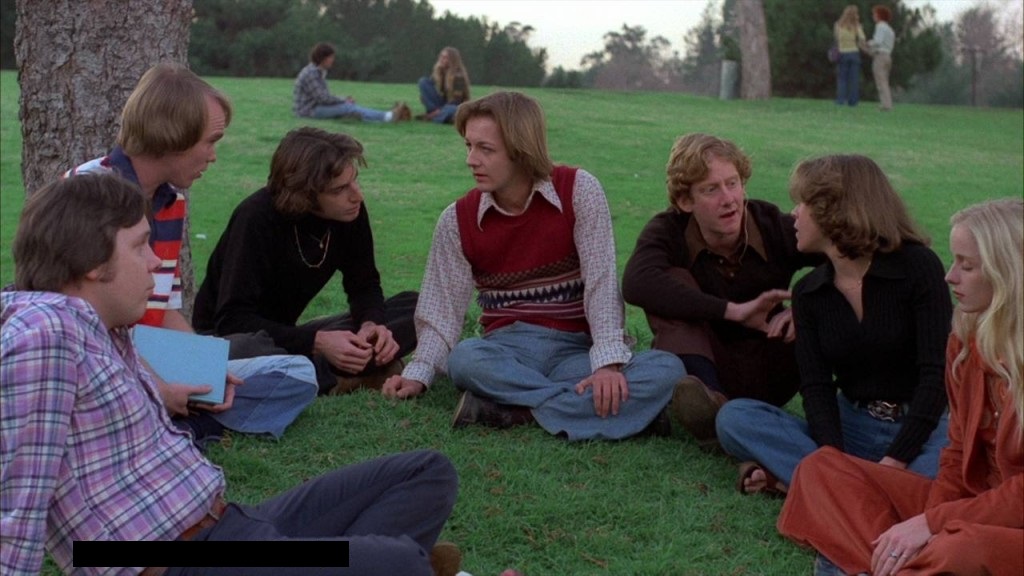
Kerouac has a hernia, his gut swollen over his pants, “My belly-button is popping out,” he said. McClintock wanted to know what Kerouac was working on:
“Well, I wrote that article,” he said, a trifle belligerently. His agent was busy selling a piece Kerouac had written, entitled “After Me, the Deluge,” his reflections on today’s world and what he might have contributed to it.
Anything else?
“Well, I’m going to write a novel about the last 10 years of my life …
The conversation moved onto the Beats, Ginsberg, Neal Cassady and Ken Kesey (“I don’t like Ken Kesey…He ruined Cassady”) before Kerouac began his drunken ramblings about the Mafia, the Communists and “the Jew,” and talking about his experiences with drugs:
“I smoked more grass than anyone you ever knew in your life,” Kerouac snorts. “I came across the Mexican border one time with 2½ pounds of grass around my waist in a silk scarf. I had one of those wide Mexican belts around me over it. I had a big bottle of tequila and I went up to the border guard and offered him some, and he said, No, go on through, senor.”
Kerouac laughed, remembering how that was.
“It should be legalized and taxed. Taxed. Yeah, ‘Gimme a pack of marijuana!’ But this other stuff is poison; acid’s poison, speed is poison, STP is poison, it’s all poison. But grass is nothing.”
By the end of the interview, Kerouac revealed a spark of his old self, his essence, his enthusiasm for writing:
“Stories of the past,” said Jack Kerouac. “My story is endless. I put in a teletype roll, you know, you know what they are, you have them in newspapers, and run it through there and fix the margins and just go, go – just go, go, go.”
McClintock has written a powerful and memorable portrait and the whole article can be read here.
Animated version of a 1985 interview the Beastie Boys did with Rocci Fisch for ABC News Radio in Washington, D.C. Topics include touring as Madonna’s opening act, nearly being arrested for saying “motherfucker” and “being stupid” in general.
“The few own the many because they possess the means of livelihood of all ... The country is governed for the richest, for the corporations, the bankers, the land speculators, and for the exploiters of labor. The majority of mankind are working people. So long as their fair demands - the ownership and control of their livelihoods - are set at naught, we can have neither men’s rights nor women’s rights. The majority of mankind is ground down by industrial oppression in order that the small remnant may live in ease.” — Helen Keller, 1911
This is taken from a short essay about Helen Keller’s political activism found at Dorian Cope’s On This Deity blog. It focuses on the parts of her life story that they didn’t teach us about when we learned about Helen Keller in school… the chick in The Miracle Worker was a Commie!
But what the endless accolades and history books almost always fail to mention is that Helen Keller was a militant radical activist. Her views mirrored the likes of the era’s most notorious dissidents – Emma Goldman and Eugene Debs – who were respectively deported and imprisoned for ten years. “I don’t give a damn about semi-radicals,” she infamously proclaimed; indeed, she leaned so far to the left that the FBI kept a file on her for un-American activities. She was a co-founder of the American Civil Liberties Union; a lifelong socialist who campaigned for Eugene Debs’ presidential candidacy; a member of the revolutionary Industrial Workers of the World; a suffragist and crusader for birth control; an anti-fascist (the Nazis publicly burned her books); and a pacifist, who condemned America’s imperialistic motives in both world wars. Having benefited from a privileged background, Helen recognised the social injustices facing those denied the same opportunities – and blamed industrialism and capitalism not only as the root of poverty but also disability-inducing disease. Her anti-capitalist and pro-worker stance was such that at the 1919 Hollywood premiere of a silent film about her own life, she refused to cross an Actors Equity Union picket line and joined the striking workers on their march.
I have to interrupt here. Ponder that last sentence for a moment. THAT is what you call a hero.
In her lifetime, Helen Keller was one of the most recognisable women in the world, and those who flocked to bask in the radiance of her fame were positively scandalised by her beliefs. After publicly supporting the National Association for the Advancement of Colored People, admiring the Russian Revolution, and fearlessly lambasting the powerful John D Rockefeller for his role in the Ludlow Mine Massacre (“Mr Rockefeller is a monster of capitalism”), Helen’s radicalism became a source of extreme embarrassment to those who required her to be true to The Myth in order that they might gain:
“So long as I confine my activities to social service and the blind, they compliment me extravagantly, calling me ‘archpriestess of the sightless’, ‘wonder woman’, and ‘a modern miracle,’” Helen bemoaned. “But when it comes to a discussion of poverty, and I maintain that it is the result of wrong economics – that the industrial system under which we live is at the root of much of the physical deafness and blindness in the world – that is a different matter!”
Read the entire essay at On This Deity and watch this amazing footage:
Don’t mess with Keith Richards: The Stones legendary guitarist doesn’t hesitate or flinch when dealing with a “rogue” fan during a concert. Mick Jagger meanwhile…
Patti Smith’s advice to the young (and not-so-young) artists:
“Build a good name. Keep your name clean. Don’t make compromises, don’t worry about making a bunch of money or being successful. Be concerned about doing good work. Protect your work and if you build a good name, eventually that name will be its own currency. Life is like a roller coaster ride, it is never going to be perfect. It is going to have perfect moments and rough spots, but it’s all worth it”
After posting that P-Funk documentary the other week, I’ve decided that Dangerous Minds needs more P-Funk. A LOT more P-Funk. I’ve said it before but it’s worth repeating: Parliament-Funkadelic are the most psychedelic, progressive, and downright funky band that have ever stomped the Earth.
So here is today’s shot of P-Funk, the perfect start to this, or any, weekend. It’s an entire Parilament-Funkadelic live show recorded live in Houston in 1976. Hardcore fans will probably have seen this show already. This set has been commercially available on DVD for quite a few years, under different guises (and is a highly recommended addition to any library) and as there is such a shameful lack of vintage P-Funk footage in the world, if you’ve seen any doc about the band, you’ll have seen parts of this show. I’m also sure I’ve seen bits of the Mothership landing/Glenn Goins getting a blowback footage in some Dr Dre videos before.
Either way, this film is a treat for both fans and newcomers alike. The camerawork is actually pretty rubbish (there are only two, mainly static, cameras, and all we see of Bootsy’s dramatic on-stage arrival is a silvery blur), but what really makes this special is the completely remastered soundtrack, now delivered in 5.1 Dolby Surround. Though I have to admit that I don’t know if YouTube audio fidelity can deliver that. It still sounds FUCKING GREAT though.
My personal fave moment is this show is the medley (from 21:40 onwards) of “Standing On The Verge Of Getting It On” with Fuzzy Haskins on lead vocals, into a radically re-worked “The Undisco Kidd”, where George Clinton gives keyboard ace Bernie Worrell an extended solo.
THIS IS THE REAL DEAL. Funk on brothers and sisters!