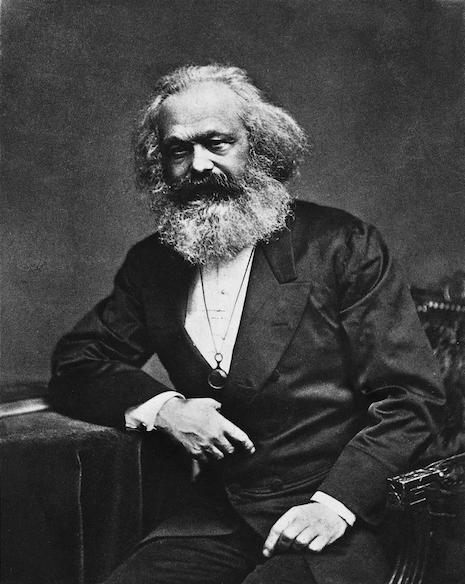
Albert Einstein was a Socialist
05.01.2013
06:55 am

Topics:
Class War
Politics
Thinkers

Tags:
Albert Einstein
socialism

image
 
Happy May Day, comrades!

Albert Einstein’s famous essay on socialism was originally published in the first issue of Monthly Review in May 1949. It’s as relevant in 2013 as it was then, perhaps more so.

Is it advisable for one who is not an expert on economic and social issues to express views on the subject of socialism? I believe for a number of reasons that it is.

Let us first consider the question from the point of view of scientific knowledge. It might appear that there are no essential methodological differences between astronomy and economics: scientists in both fields attempt to discover laws of general acceptability for a circumscribed group of phenomena in order to make the interconnection of these phenomena as clearly understandable as possible. But in reality such methodological differences do exist. The discovery of general laws in the field of economics is made difficult by the circumstance that observed economic phenomena are often affected by many factors which are very hard to evaluate separately. In addition, the experience which has accumulated since the beginning of the so-called civilized period of human history has—as is well known—been largely influenced and limited by causes which are by no means exclusively economic in nature. For example, most of the major states of history owed their existence to conquest. The conquering peoples established themselves, legally and economically, as the privileged class of the conquered country. They seized for themselves a monopoly of the land ownership and appointed a priesthood from among their own ranks. The priests, in control of education, made the class division of society into a permanent institution and created a system of values by which the people were thenceforth, to a large extent unconsciously, guided in their social behavior.

But historic tradition is, so to speak, of yesterday; nowhere have we really overcome what Thorstein Veblen called “the predatory phase” of human development. The observable economic facts belong to that phase and even such laws as we can derive from them are not applicable to other phases. Since the real purpose of socialism is precisely to overcome and advance beyond the predatory phase of human development, economic science in its present state can throw little light on the socialist society of the future.

Second, socialism is directed towards a social-ethical end. Science, however, cannot create ends and, even less, instill them in human beings; science, at most, can supply the means by which to attain certain ends. But the ends themselves are conceived by personalities with lofty ethical ideals and—if these ends are not stillborn, but vital and vigorous—are adopted and carried forward by those many human beings who, half unconsciously, determine the slow evolution of society.

For these reasons, we should be on our guard not to overestimate science and scientific methods when it is a question of human problems; and we should not assume that experts are the only ones who have a right to express themselves on questions affecting the organization of society.

Innumerable voices have been asserting for some time now that human society is passing through a crisis, that its stability has been gravely shattered. It is characteristic of such a situation that individuals feel indifferent or even hostile toward the group, small or large, to which they belong. In order to illustrate my meaning, let me record here a personal experience. I recently discussed with an intelligent and well-disposed man the threat of another war, which in my opinion would seriously endanger the existence of mankind, and I remarked that only a supra-national organization would offer protection from that danger. Thereupon my visitor, very calmly and coolly, said to me: “Why are you so deeply opposed to the disappearance of the human race?”

I am sure that as little as a century ago no one would have so lightly made a statement of this kind. It is the statement of a man who has striven in vain to attain an equilibrium within himself and has more or less lost hope of succeeding. It is the expression of a painful solitude and isolation from which so many people are suffering in these days. What is the cause? Is there a way out?

It is easy to raise such questions, but difficult to answer them with any degree of assurance. I must try, however, as best I can, although I am very conscious of the fact that our feelings and strivings are often contradictory and obscure and that they cannot be expressed in easy and simple formulas.

Man is, at one and the same time, a solitary being and a social being. As a solitary being, he attempts to protect his own existence and that of those who are closest to him, to satisfy his personal desires, and to develop his innate abilities. As a social being, he seeks to gain the recognition and affection of his fellow human beings, to share in their pleasures, to comfort them in their sorrows, and to improve their conditions of life. Only the existence of these varied, frequently conflicting, strivings accounts for the special character of a man, and their specific combination determines the extent to which an individual can achieve an inner equilibrium and can contribute to the well-being of society. It is quite possible that the relative strength of these two drives is, in the main, fixed by inheritance. But the personality that finally emerges is largely formed by the environment in which a man happens to find himself during his development, by the structure of the society in which he grows up, by the tradition of that society, and by its appraisal of particular types of behavior. The abstract concept “society” means to the individual human being the sum total of his direct and indirect relations to his contemporaries and to all the people of earlier generations. The individual is able to think, feel, strive, and work by himself; but he depends so much upon society—in his physical, intellectual, and emotional existence—that it is impossible to think of him, or to understand him, outside the framework of society. It is “society” which provides man with food, clothing, a home, the tools of work, language, the forms of thought, and most of the content of thought; his life is made possible through the labor and the accomplishments of the many millions past and present who are all hidden behind the small word “society.”

It is evident, therefore, that the dependence of the individual upon society is a fact of nature which cannot be abolished—just as in the case of ants and bees. However, while the whole life process of ants and bees is fixed down to the smallest detail by rigid, hereditary instincts, the social pattern and interrelationships of human beings are very variable and susceptible to change. Memory, the capacity to make new combinations, the gift of oral communication have made possible developments among human being which are not dictated by biological necessities. Such developments manifest themselves in traditions, institutions, and organizations; in literature; in scientific and engineering accomplishments; in works of art. This explains how it happens that, in a certain sense, man can influence his life through his own conduct, and that in this process conscious thinking and wanting can play a part.

Man acquires at birth, through heredity, a biological constitution which we must consider fixed and unalterable, including the natural urges which are characteristic of the human species. In addition, during his lifetime, he acquires a cultural constitution which he adopts from society through communication and through many other types of influences. It is this cultural constitution which, with the passage of time, is subject to change and which determines to a very large extent the relationship between the individual and society. Modern anthropology has taught us, through comparative investigation of so-called primitive cultures, that the social behavior of human beings may differ greatly, depending upon prevailing cultural patterns and the types of organization which predominate in society. It is on this that those who are striving to improve the lot of man may ground their hopes: human beings are not condemned, because of their biological constitution, to annihilate each other or to be at the mercy of a cruel, self-inflicted fate.

If we ask ourselves how the structure of society and the cultural attitude of man should be changed in order to make human life as satisfying as possible, we should constantly be conscious of the fact that there are certain conditions which we are unable to modify. As mentioned before, the biological nature of man is, for all practical purposes, not subject to change. Furthermore, technological and demographic developments of the last few centuries have created conditions which are here to stay. In relatively densely settled populations with the goods which are indispensable to their continued existence, an extreme division of labor and a highly-centralized productive apparatus are absolutely necessary. The time—which, looking back, seems so idyllic—is gone forever when individuals or relatively small groups could be completely self-sufficient. It is only a slight exaggeration to say that mankind constitutes even now a planetary community of production and consumption.

I have now reached the point where I may indicate briefly what to me constitutes the essence of the crisis of our time. It concerns the relationship of the individual to society. The individual has become more conscious than ever of his dependence upon society. But he does not experience this dependence as a positive asset, as an organic tie, as a protective force, but rather as a threat to his natural rights, or even to his economic existence. Moreover, his position in society is such that the egotistical drives of his make-up are constantly being accentuated, while his social drives, which are by nature weaker, progressively deteriorate. All human beings, whatever their position in society, are suffering from this process of deterioration. Unknowingly prisoners of their own egotism, they feel insecure, lonely, and deprived of the naive, simple, and unsophisticated enjoyment of life. Man can find meaning in life, short and perilous as it is, only through devoting himself to society.

The economic anarchy of capitalist society as it exists today is, in my opinion, the real source of the evil. We see before us a huge community of producers the members of which are unceasingly striving to deprive each other of the fruits of their collective labor—not by force, but on the whole in faithful compliance with legally established rules. In this respect, it is important to realize that the means of production—that is to say, the entire productive capacity that is needed for producing consumer goods as well as additional capital goods—may legally be, and for the most part are, the private property of individuals.

For the sake of simplicity, in the discussion that follows I shall call “workers” all those who do not share in the ownership of the means of production—although this does not quite correspond to the customary use of the term. The owner of the means of production is in a position to purchase the labor power of the worker. By using the means of production, the worker produces new goods which become the property of the capitalist. The essential point about this process is the relation between what the worker produces and what he is paid, both measured in terms of real value. Insofar as the labor contract is “free,” what the worker receives is determined not by the real value of the goods he produces, but by his minimum needs and by the capitalists’ requirements for labor power in relation to the number of workers competing for jobs. It is important to understand that even in theory the payment of the worker is not determined by the value of his product.

Production is carried on for profit, not for use. There is no provision that all those able and willing to work will always be in a position to find employment; an “army of unemployed” almost always exists. The worker is constantly in fear of losing his job.

Private capital tends to become concentrated in few hands, partly because of competition among the capitalists, and partly because technological development and the increasing division of labor encourage the formation of larger units of production at the expense of smaller ones. The result of these developments is an oligarchy of private capital the enormous power of which cannot be effectively checked even by a democratically organized political society. This is true since the members of legislative bodies are selected by political parties, largely financed or otherwise influenced by private capitalists who, for all practical purposes, separate the electorate from the legislature. The consequence is that the representatives of the people do not in fact sufficiently protect the interests of the underprivileged sections of the population. Moreover, under existing conditions, private capitalists inevitably control, directly or indirectly, the main sources of information (press, radio, education). It is thus extremely difficult, and indeed in most cases quite impossible, for the individual citizen to come to objective conclusions and to make intelligent use of his political rights.

The situation prevailing in an economy based on the private ownership of capital is thus characterized by two main principles: first, means of production (capital) are privately owned and the owners dispose of them as they see fit; second, the labor contract is free. Of course, there is no such thing as a pure capitalist society in this sense. In particular, it should be noted that the workers, through long and bitter political struggles, have succeeded in securing a somewhat improved form of the “free labor contract” for certain categories of workers. But taken as a whole, the present day economy does not differ much from “pure” capitalism.

Production is carried on for profit, not for use. There is no provision that all those able and willing to work will always be in a position to find employment; an “army of unemployed” almost always exists. The worker is constantly in fear of losing his job. Since unemployed and poorly paid workers do not provide a profitable market, the production of consumers’ goods is restricted, and great hardship is the consequence. Technological progress frequently results in more unemployment rather than in an easing of the burden of work for all. The profit motive, in conjunction with competition among capitalists, is responsible for an instability in the accumulation and utilization of capital which leads to increasingly severe depressions. Unlimited competition leads to a huge waste of labor, and to that crippling of the social consciousness of individuals which I mentioned before.

This crippling of individuals I consider the worst evil of capitalism. Our whole educational system suffers from this evil. An exaggerated competitive attitude is inculcated into the student, who is trained to worship acquisitive success as a preparation for his future career.

I am convinced there is only one way to eliminate these grave evils, namely through the establishment of a socialist economy, accompanied by an educational system which would be oriented toward social goals. In such an economy, the means of production are owned by society itself and are utilized in a planned fashion. A planned economy, which adjusts production to the needs of the community, would distribute the work to be done among all those able to work and would guarantee a livelihood to every man, woman, and child. The education of the individual, in addition to promoting his own innate abilities, would attempt to develop in him a sense of responsibility for his fellow men in place of the glorification of power and success in our present society.

Nevertheless, it is necessary to remember that a planned economy is not yet socialism. A planned economy as such may be accompanied by the complete enslavement of the individual. The achievement of socialism requires the solution of some extremely difficult socio-political problems: how is it possible, in view of the far-reaching centralization of political and economic power, to prevent bureaucracy from becoming all-powerful and overweening? How can the rights of the individual be protected and therewith a democratic counterweight to the power of bureaucracy be assured?

Clarity about the aims and problems of socialism is of greatest significance in our age of transition. Since, under present circumstances, free and unhindered discussion of these problems has come under a powerful taboo, I consider the foundation of this magazine to be an important public service.

—Albert Einstein

See also:
Why Socialism? This Guy Einstein is an Idiot (a rebuttal)

The Question of Socialism (and Beyond!) Is About to Open Up in These United States

Posted by Richard Metzger | Discussion
Republican leader’s daughter marrying a foreign-born ‘pothead’?
04.26.2013
08:58 am

Topics:
Amusing
Drugs
Politics

Tags:
cannabis
John Boehner


Look who’s coming to dinner at John Boehner’s house… a foreigner! With waist-length dreads? SHOCK HORROR… he’s a pothead!

Lindsay Boehner, the 35-year-old daughter of the GOP Speaker of the House, is set to be married in May to Dominic Lakan, a 38-year-old Jamaican-born immigrant. Lakan was arrested in 2006 in Florida in possession of less than two grams of pot. Previously, Lakan was arrested for having an open beer in his vehicle.

The National Enquirer dug up Lakan’s arrest report—they say he resembles Bob Marley—and now the right wingers are having a field day with it.

Check out the, uh, considered reactions from the folks at Free America:

Deformed America, the new abnormal.

He looks like a total filthy uneducated bum who’s latching on to a rich white girl. Holy cow, I wouldn’t let that thing come within 50 yards of me! Let’s all chip in and buy her a case of Frontline as a wedding present…

Not only the fleas, but there’s a wife beater if ever there was one! I bet he’s mean, angry & violent when he’s on drugs or booze, as well as when he’s not high. Then he’s just surly mean! I also think he is hoping & praying to his voodoo witch doctor, that he will get some portion of inheritance from Boner!

Bet he’s an Obama voter!

She’s marrying a Rastafarian? She must REALLY hate her dad.

My Lord—If I saw something like that coming out from under the sink I’d step on it.

He looks Middle Eastern to me!

This daughter is seriously out to get her parents. The Jamaican clearly does not fit with the country club and/or congressional set. The halls of power are in need of cleaning? Or what?

he looks like death sucking a life saver…

You haven’t a ball nor a dick if you let that thing get NEAR your daughter. Dear GOD, America ... what kind of person (I CAN"T say man .. ) are we putting into positions of high power? It’s time to clean house.

One Freeper decided to look on the bright side:

Better a Rastarfarian than a muzzie. But seriously, what’s with the Dr. Seuss hat?

Surprisingly—or not so surprising—this story has thus far gotten very little play in the left-wing blogsphere, as if the information itself (HE’S JAMAICAN AND SMOKES POT!) is somehow “racist” instead of merely neutral.

I wish the couple the very best. I hope they’re laughing like hell about this. Fact is, this minor brouhaha has simply got nothing whatsoever to do with either Dominic Lakan or Lindsay Boehner and everything to do with her idiot father…

I cannot wait to see wedding photos. I wonder if the father of the bride will cry?

Posted by Richard Metzger | Discussion
Rachel Maddow eviscerates conspiracy theorist Alex Jones


About ten years ago, whoever was managing Alex Jones at the time would have DVDs of Jones’ shouty “documentaries” messengered over to me at the Disinformation office.

I was already well aware of Alex Jones and sight-unseen, I already knew that this was not going to be something that I was going to be interested in, and especially not interested in investing any money into (the idea was that we would have manufactured it and distributed it on DVD).

Aside from the fact that they were obviously the products of a ranting and raving unhinged paranoiac lunatic with access to someone who knew Final Cut Pro, Jones used footage that there was no way he could have gotten the rights to use.

They were these long, like, messy video collages of fact, conjecture, crappy pixelated news footage and the jumbled-up logic, red-faced, bulging vein exhortations Jones is famous for. I will admit to watching them on the treadmill but they were always binned immediately afterwards.

In the intervening years, Jones has become a household name in some of America’s more gullible households, mostly due to Glenn Beck disgracefully elevating his profile on Fox News. Beck ultimately decided to cut out the middleman and unashamedly ripped off Alex Jones’ shtick. Oh yeah, Beck stole his act lock, stock and fucking barrel, went to the bank with it and then kicked Jones to the curb to distance himself from his hot-headed, foaming at the mouth mentor (and lesser showman). Jones does have a legitimate gripe with Glenn Beck, if you ask me, but it is Beck who deserves the blame for mainstreaming a kook like Alex fucking Jones in the first place.

Of late, Mr. Jones has been his own worst enemy, making himself into a laughingstock, first with his infamously berserk Piers Morgan interview on CNN and then again with his “false flag” accusations about the Boston bombing.

Jones makes outrageous predictions constantly. Is he ever right?

Nathaniel Downes at Addicting Info thinks Alex Jones is a fraud. That might be more than a little unfair to Jones—I think he believes what he says, he’s just fucking nuts—but he’s amassed an impressive list of some of Alex Jones’ greatest misses from 2012:

Worldwide shortage of rare earth metals – Didn’t happen
Food supply disruptions hit western nations – Didn’t happen
Deadly superbug mutation goes wild – Didn’t happen
New evidence links vaccines and neurological disorders – The opposite happened
U.S. power grid suffers catastrophic failure – Didn’t happen
Satellite breakdown – Didn’t happen
GM crop contamination leads to crisis – Didn’t happen
Honeybee population collapse spreads to other species – Didn’t happen
Weather patterns become increasingly radicalized – Debatable
Nuclear power sees global resurgence – The Fukushima incident discredited this
Nuclear weapons unleashed in the Middle East – Didn’t happen
New exotic superfood from South America emerges in western markets – Didn’t happen
A high-tech, portable vitamin D sensor device is invented – Didn’t happen
U.S. debt gets downgraded while world investors slash purchases of U.S. debt instruments – The debt was downgraded, but investors still flock to it
U.S. nearly comes to military conflict with China over natural resources – Didn’t happen
Huge new scandal implicates major pharmaceutical company in scientific fraud – Nothing out of the ordinary here
China unleashes armies of corporate espionage hackers onto western nations – Some debate on this is ongoing
Medical imaging scandal unfolds as older patients begin to show serious health damage from radiation via mammograms, CT scans and more – Didn’t happen
Another 9/11 false flag incident – Didn’t happen
The world won’t end on December 21, 2012 – Hey, a stopped clock is right twice a day!
EPA pressured to regulate pharmaceuticals in the water supply – Can’t even contemplate this one without the brain hurting
Nursing home drugging scandal exposed – Didn’t happen
The psychiatric industry will declare more normal behaviors to be “disorders” – Didn’t happen
Vaccine industry goes crazy with new vaccines for all sorts of “diseases” – Didn’t happen
War on health freedom ramps up, targeting raw milk, homeopathy, herbs and supplements – Didn’t happen
The world becomes a far more dangerous place for honest citizens – So open-ended you cannot even evaluate
New attempts are made to destroy internet freedom – SOPA and PIPA have been discussed for awhile, so not a real argument
China’s boom will bust, sending ripples through global economy – Didn’t happen
Central and South America will drop the U.S. dollar as a currency – Didn’t happen
Local currencies emerge following the collapse of the dollar – As the dollar didn’t collapse, this didn’t happen
TSA suspends full body scanners after celeb photo scandal – No, was suspended due to dangerous exposure to radiation
Cell phone brain tumors start to appear in younger users – Didn’t happen
Medical industry claims to find cause of autism – Didn’t happen, although some hope has been raised
Terrorist strike on the U.S. water supply – Didn’t happen
Sperm count drops, infertility rates rise – Fertility is increasing, not decreasing, across the United States
“Stealth personal recorders” go mainstream – We call them Cell Phones, although Alex Jones is quick to claim that they cause cancer

Good times!


Rachel Maddow’s epic Alex Jones takedown from last night is quite amusing. She starts off all serious, but wait until the clips of feverishly ranting Alex Jone start. After that she riffs on him like the fool he is and annihilates him, but with her typical good-natured wryness. Jones is perfect fodder for her wit. Good stuff.
 

Visit NBCNews.com for breaking news, world news, and news about the economy

 
Previously on Dangerous Minds
Alex Jones: DMT elves want the elites to kill us all!

Posted by Richard Metzger | Discussion
Fourth-grader’s adorable essay on marriage equality
04.24.2013
09:05 am

Topics:
Current Events
Politics
Queer

Tags:
marriage equality


Redditor rafa3l2 posted this rather adorable short essay. He/she said:

One of my 4th grade students chose gay marriage as his topic for a persuasive essay. This is the result. More sense than some adults.

You can click here to read larger image.

Via Copyranter

Posted by Tara McGinley | Discussion
A terrific 1989 cable TV interview with Joni Mitchell
04.19.2013
01:17 pm

Topics:
Music
Politics
Pop Culture

Tags:
Joni Mitchell


Photo: M. Getz.
  
Here’s Joni Mitchell doing a 35-minute interview on cable TV in 1989. I think it’s lovely the way Mitchell gives it her all despite being seen by only a few hundred people somewhere out in the ether. A great communicator with a high regard for her audience, no matter how small.

She speaks with great specificity about her recent LP release, 1988’s Chalk Mark in a Rain Storm, the Lakota people, political activism, film making and modern American culture.

The TV show originated in Covina, California. The interview is thoughtfully conducted by Jeff Plummer. Produced by Marty Getz.


Part two after the jump…

Posted by Marc Campbell | Discussion
Season of the Witch: Dangerous Minds goes to Mrs. Thatcher’s funeral


About half my earliest memories consist of being buggied about London by my mum on anti-Thatcher demos. The witch stuff, to me, ain’t even a metaphor. When I was a kid, the boundary between fairytale and contemporary history simply didn’t exist—it was as if an evil witch was in charge of our United Kingdom, and the only way happiness could be restored was if she could be killed… or voted out.

This was the weird thing. Every election, she’d win, and my mother would literally weep with hatred and disappointment. People obviously voted Wicked Witch Party. I didn’t get it.

It was partly this childhood mystification that saw me attend Margaret Thatcher’s funeral procession in London yesterday…

I arrived at St Clement Danes Church about the same time as Thatcher’s coffin, which was shortly to make its way to St Paul’s along disappointingly busy streets. Heavily decorated paratroopers stood trembling with psychopathic rigidity outside the entrance to the church, and an additional police presence to those lining the road patrolled the pavement—portly, distinguished old coppers in white-gloves.

Besides these various showings of Establishment muscle, the streets were filling up with the Establishment’s biggest admirers—flag-waving patriots thronging the pavements, plus significant amounts of tourists, and the odd gutsy protester, planted right in the midst of a hostile crowd.


I stopped to listen to one of these, a Welsh ex-miner with a conspicuous banner, as he conducted an interview with the BBC. He was asked if he thought a funeral an “appropriate” place to protest. “When is the time to protest?” he responded, “Where is the place in this country where they say, come along, protest, and we’ll listen to what you’ve got to say.” It was a good point, and passionately made, but as I stood scribbling his answer into my notebook I felt something push against an elbow.

Looking up, I saw a giant copper peering skeptically down at me. The thing touching me was his rigid, vast belly. I stared back, rather surprised. His message was clear. The television crew was welcome to interview this political subhuman—they could be relied upon to edit his measured responses into banality (or worse)—but a writer, unaffiliated with any obvious outfit, was suspect.

I took the policeman’s tacit advice and moved on, leaving the ex-miner to the milling wolves. I heard someone say that most of the protesters were gathered at Ludgate Circus further up, and decided to check it out. En route, the military procession began, countless gleaming platoons blasting out great slabs of murder muzak—rolling drums and hyperactive brass augmented with the heavy tread of boots.

They all seemed to express the same message: the Establishment possessed the power, and the firepower; it always did exactly what it wanted and it honored whoever it wished to.


Up ahead I could begin to make out the protesters, a dense scrum of them on one side of the junction, the rest of which thronged with Witch fans. Even in these more significant numbers (there must have been a few hundred crammed together) these protesters’ gumption was noteworthy. A snarling line of police stood right in front of them; veterans on the other side of the junction jeered at them, and occasionally a fresh platoon arrived via Blackfriars, so that a hundred gun barrels and twice as many gimlet eyes swept across them.

Meanwhile, the mass media swarmed around, the journalists wearing the gleeful expressions of vultures come upon carrion, all busily ripping off the crowd’s rottener strips to present to their audiences.

I went around the back of the protesters, up a little further and came to a halt. From the last quarter mile or so to St Paul’s the pavement looked too busy to bother trying to squeeze through.

Around me, there were local bankers and lawyers, retired servicemen, frail and wholly likable old ladies, sporty closet fascists, and entire suburban family units.

Most intriguing, however, was a large but seemingly disparate contingent of middle-aged Essex women, all of them with long blond hair, massive moles, and tight smiles. Many of these were very bellicose concerning the protesters. One of them kept telling her friend that it was only the possibility of arrest that stopped her going over and attacking one dawdling nearby. I thought she was full of shit, but perhaps not, because when Thatcher’s coffin finally approached, and the only thing that could be heard was booing and chanting, she raised herself on a bollard and screamed, “YOU BUNCH OF FACKIN SCUMBAGS,” sparking a storm of applause and cheering.


As the coffin passed through all this noise, draped in the Union Jack and surrounded by soldiers and police on horseback and on foot, my thoughts turned to Thatcher’s close friendship with Jimmy Savile.

What does being fantastic pals with a man who was perhaps history’s most prolific child rapist say about someone?

As I noted in a DM article last year, Savile claimed to have spent “eleven consecutive Christmases at Chequers” with the Thatcher family: “Denis, me and her, shoes off in front of the fire.” Cute.

Sir Jimmy, of course, was buried with similar military pomp.

The average right-winger, you’ve got to say, couldn’t spot a psychopath if one was stabbing them repeatedly in the face.
 

Posted by Thomas McGrath | Discussion
America’s top spies look at Michele Bachmann like she’s crazy (for a LONG time)


Put yourself in the shoes of poor John Brennan, the newly installed CIA director as he is lobbed one batshit crazy question after another by GOP Congresswoman Michele Bachmann. He’s trying very hard to be respectful, but it’s obviously very difficult to do that with such a self-important uninformed dingbat confronting him.

Bachmann’s first question, of course, was about Benghazi and it just goes downhill from there. At the end of the clip there is a full ten seconds of WTF looks exchanged as Brennan and his top men try to make sense of the Republican pol’s inane word salad.

It’s bust-a-gut-funny until you consider that she’s asking this question as a member of the House Intelligence Committee! Michele Bachmann could scarcely be considered “high functioning” let along intelligent!

Christian McCarthyite Bachmann will be attending the funeral of Margaret Thatcher in London this week. I simply can’t wait to hear what she will have to say about all of the anti-Thatcher protests. She’s probably going to be extra befuddled. I wonder if she’s ever been abroad before? She doesn’t act like it (Canada doesn’t count).
 

Posted by Richard Metzger | Discussion
‘Private Eye’: Vintage documentary on the ‘thorn in the side’ of the British Establishment

0000eyeetavirp.jpg
 
1976 was a difficult year for the satirical and current affairs magazine Private Eye.

This was the year its then editor, Richard Ingrams received over 60 writs from disgruntled billionaire businessman Sir James Goldsmith (aka Sir Jams Fishpaste, as the Eye called him). Goldsmith had objected to 3 stories the Eye had published about him—one in particular that suggested Fishpaste had helped his friend, Lord Lucan escape Britain from a murder charge.

Goldsmith and Lucan were bonded by several things, one in particular was a belief Communists had infiltrated western media, and Britain was on the verge of a Communist revolution. It led Fishpaste and Lucan to discuss the pros and cons of a Fascist military coup over “smoked salmon and lamb cutlets.” Their conversation reflected the paranoid, Boy’s Own fantasies of a very privileged and ruthless class.

But “Goldsmith was angry, as well as rich,” as one of Private Eye‘s lawyers, Geoffrey Bindman later explained:

“[Goldsmith] set out to destroy the little magazine that had presumed to offend him. He sued….But he spread the net far beyond Private Eye. In a novel exercise in overkill, he issued separate writs against all the distributors and wholesalers of the magazine. There were over 60 writs. Private Eye faced a huge financial burden. It was liable to indemnify all those whom Goldsmith had chosen to sue.

The first task was to reassure the recipients of these writs that the indemnity would be honoured. Private Eye lacked the resources but had a lot of supporters. A drive to raise money began, inspirationally named the Goldenballs Fund.

 
000eyeetavirpkoocsmargni.jpg
Peter Cook and Richard Ingrams check an early edition of ‘Private Eye’
 
The legal action brought considerable media attention, and in October, the BBC made a documentary about Ingrams and Private Eye:

“Richard Ingrams’ offices are at 34 Greek Street. A former haunt of prostitutes and drug addicts. Now the main problem is writ service. Rented at sixty-pounds-a-week, the building is small and dilapidated, but it’s all that Private Eye can afford. The magazine runs on a shoe-string budget. It comes out once a fortnight, price 20 pence, and has a circulation of 90,000.”

Ingrams may have looked like an unassuming university lecturer—dressed in a corduroy jacket, with a Viyella shirt and tie, but he was (surprisingly) a reformed drinker and smoker, who believed in God and played the organ at the local church. He was, more importantly, a superb and strongly principled editor, who understood Private Eye‘s role:

“It has to be anarchic. It has to be prepared to hit everyone—even its friends. As long as you attack everybody indiscriminately, completely indiscriminately you are safe. Immediately you start taking sides, or sticking-up for somebody, or keeping quiet, then you get into difficulties.”

Under his editorship, Private Eye had a golden decade in the seventies. It attracted some of the very best writers, journalists and artists, who brought an excellence other magazines (Punch) could only dream about. There was Auberon Waugh who produced an hilarious and corruscating diary; Paul Foot who delivered brilliant investigative reports; Peter Cook offered memorable comic contributions; and “Grovel” the Eye‘s (in)famous gossip column written by the late, Daily Mail diarist, Nigel Dempster, who claimed:

“We live in a banana peel society, where it gives no-one greater pleasure than to see someone trip up.”

Not all of the Eye writers were happy with Dempster’s column, Christopher Booker thought it edged too close to exaggeration, without thought of the damage done.

This lack of thought had led a 100 people to sue Private Eye by ‘76, which had depleted much of the magazine’s profits. But then the Eye was never really that interested in profits—it was a product of those patrician attitudes Public Schools can afford to inspire.

The magazine’s original quartet Richard Ingrams, Christopher Booker, Paul Foot and William Rushton had all met at Shrewsbury School, where they had produced their own teenage satirical magazine—a first issue was covered with hessian and embedded with free seeds. After school, university, where Ingrams hoped to become a leading comic actor. It didn’t happen, and the Famous 4 regrouped to produce the very first Private Eye in 1961, from typescript, Letra-set and cow-gum. It is interesting to note how this amateur, home-made style has remained very much the template for the Eye ever since.

This new magazine chimed with the so-called satire boom, in which Peter Cook, Dudley Moore, Alan Bennett and Jonathan Miller conquered the world with Beyond the Fringe, and producer Ned Sherrin made a star of David Frost (who Booker later described as a man with “..a peculiar ambition to be world-famous simply for the sake of being world-famous”) on the highly successful That Was The Week That Was—which proved so successful it was canceled after 2 series.

The Eye continued long after both these shows and the satire boom had run out of laughs, in part much aided by the backing of Peter Cook, who helped finance the magazine until his death in 1995.

What makes Private Eye essential is the ephemeral nature of its exceedingly good journalism. As Auberon Waugh once wrote (in the introduction to Another Voice—his essential collection of writing for The Spectator), “Timeless journalism is bad journalism”:

“The essence of journalism is that it should stimulate its readers for a moment, possibly open their minds to some alternative perception of events, and then be thrown away, with all its clever conundrums, its prophecies and comminations, in the great wastepaper basket of history.”

Though it has been occasionally wrong (MMR comes to mind) and wrong-headed (comic attitudes towards race, women, and gays have been questionable), Private Eye is indispensable and essential reading for those with an interest in the follies of politics and business of contemporary life, or the strong tradition of good investigation journalism, which most newspapers appear to have abandoned long ago. This is what made, and still makes Private Eye truly great.

Sir Jams Fishpaste launched his own magazine Talbot!, which soon disappeared without trace, before forming the I Can’t Believe It’s Not Margarine Party, a popular movement that failed to be..er..popular. He died in 1997.

Richard Ingrams quit Private Eye in 1986, and appointed alleged schoolboy Ian Hislop as Editor, who has managed the magazine with great success ever since.

Ingrams started a new magazine The Oldie in 1992, which has been described as “the new Punch and the new New Yorker,” which he continues to successfully edit today. Richard Ingrams is 94.

Check Private Eye online here.


With thanks to NellyM
 

Posted by Paul Gallagher | Discussion
Glenda Jackson denounces ‘heinous’ Thatcherism in House of Commons tirade

adnelgghjkbvhj.jpg
 
For a moment, I thought I was watching a film—perhaps a re-make of Peter Barnes’ The Ruling Class? You know the scene where a demented Jack Gurney, 14th Earl of Gurney (Peter O’Toole) gives an insane speech in favor of the death penalty to a parliamentary chamber that is received with the most rapturous applause from his decrepit audience, the literal-living dead—the rotten, skeletal, cobweb-covered corpses of the House of Lords?

This was the only way I could make sense of what I was watching, as the British House of Commons gathered at a specially convened session to eulogize the evil dead—Margaret Thatcher.

By turn, all three leaders (Cameron, Clegg, Miliband) of the main electoral parties (Conservative, Liberal, Labour) praised the politician whose policies callously attacked the poorest, the weakest and least able, destroyed families, communities and industries, divided a country, and created mass unemployment for generations of Brits.

The vile stench of greed, hypocrisy and fear was almost palpable, as each bland politician paid homage to evils of Thatcher and Thatcherism.

I suffered through more than 3 years of unemployment during the Thatcher era—and know first hand, the evil Thatcherism inflicted on the UK. And yet today the faceless, forgettable MPs came to sing her highest praises.

Thank goodness then, to Glenda Jackson, the former actress-turned-politician (MP for Hampstead and Kilburn, London), who did not follow the sheep, but stood up and told the British Parliament the truth about Margaret Thatcher and her evil policies.

“There was a heinous social, economic and spiritual damage wreaked upon this country, upon my constituency and my constituents.”

“I tremble to think what the death rate for pensioners would have been this week if that version of Thatcherism had been fully up and running this year.”

“By far the most dramatic and heinous demonstration of Thatcherism was not only in London but across the whole country in metropolitan areas, where every single shop doorway, every single night, became the bedroom, the living room, the bathroom for the homeless.”

Ms. Jackson went on to explain how Thatcherism promoted the vices of greed and selfishness as virtues.

“That everything I had been taught was a as vice, and I still regard them as vices, under Thatcherism was a virtue.”

“Greed, selfishness, no care for the weaker. Sharp elbows and sharp knees, this was the way forward.”

“People saw the price of everything and the value of nothing.”

“What concerns me is that I am beginning to see possibly the re-emergence of that total traducing of what I regard as the basic spiritual nature of this country—where we do care about society, where we do believe in communities, where we do not leave people to walk by on the other side.”

If only more Members of Parliament, these so-called elected representatives of the people, were as honest and as courageous as Glenda Jackson was today, then there would be genuine hope for a better tomorrow.


Posted by Paul Gallagher | Discussion
‘Let’s privatize her funeral’: Film Director Ken Loach on plans for Thatcher’s send-off

xxgnodgniddaedsihctiweht.jpg
 
Film director Ken Loach gives his assessment of Margaret Thatcher, and offers a suggestion for her funeral.

Margaret Thatcher was the most divisive and destructive Prime Minister of modern times.

Mass Unemployment, factory closures, communities destroyed – this is her legacy. She was a fighter and her enemy was the British working class. Her victories were aided by the politically corrupt leaders of the Labour Party and of many Trades Unions. It is because of policies begun by her that we are in this mess today.

Other prime ministers have followed her path, notably Tony Blair. She was the organ grinder, he was the monkey.

Remember she called Mandela a terrorist and took tea with the torturer and murderer Pinochet.

How should we honor her? Let’s privatize her funeral. Put it out to competitive tender and accept the cheapest bid. It’s what she would have wanted.

Ding-Dong the Witch is Dead T-shirts are available from Jetpace Industries.
 
hcaolnek.jpg
 
H/T The Guardian and Michael Rosen blog
 

Posted by Paul Gallagher | Discussion
Page 2 of 118  < 1 2 3 4 >  Last ›