


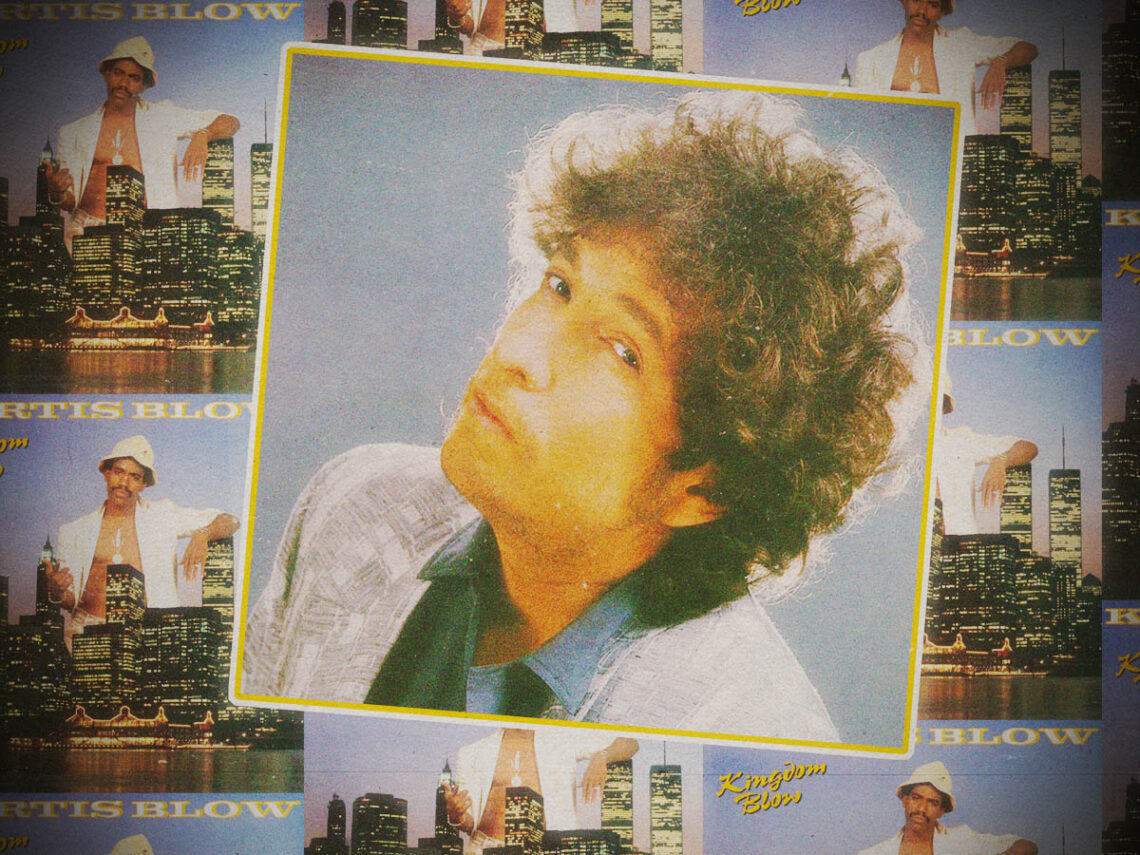
Bob Dylan’s frankly surreal rap on a Kurtis Blow album, 1986
It’s a cliché by now that Bob Dylan’s singular 1965 track ‘Subterranean Homesick Blues’ qualifies as one of the building blocks of hip-hop. What is possibly not quite as well known is that Dylan himself made a brief appearance on a track by one of the founding fathers of rap, Kurtis Blow.
Between the magisterial high points of, say, Blood on the Tracks and Time Out of Mind lie the yawning 1980s and most of the 1990s, a period marked by Dylan’s Christian period, the Traveling Wilburys, and ‘We Are the World’. As Dylan himself conceded later, it was a time when he was feeling out of step with the world, with Ronald Reagan in the White House, MTV on cable television, and his Boomer cohort veering into suspect activities like junk bonds and jazzercise.
In 1986, Kurtis Blow released his eighth album, Kingdom Blow. The album’s opening track, ‘Street Rock’, is a nearly nine-minute composition featuring a single quatrain in Dylan’s voice that is used multiple times on the track, first as the intro and later as a full verse on its own on the track’s seventh minute. The album also featured vocals by George Clinton on a song called ‘Magilla Gorilla’.
According to The Rough Guide to Bob Dylan 2, “In late March [1986], Dylan was back in America [after some gigs in Australia], oddly rapping a verse on Kurtis Blow’s release Street Rock. ‘He raps, he really raps’, an excited Blow was quoted as saying”.
Blow was right; the tentative verse on ‘Street Rock’ certainly qualifies as rap of some variety. Dylan has always had a distinctive singing style—understatement of the year—but in ‘Subterranean Homesick Blues’, he indulged in a form of Sprechgesang.
“Kids starve in Ethiopia / And we are gettin’ greedier / The rich are gettin’ richer / And the needy’s gettin’ needier.”
Bob Dylan’s rap
Here, Dylan raps (one must use the verb) that he’s “indulged in high knowledge”, including an “encyclopedia” as well as “reports in news media”, and is in despair because there are “kids starving in Ethiopia and we are getting greedier, the rich are getting richer”. It’s not terrible by any stretch, but it is surely slight; the track’s true virtues all flow from Blow.
In Chronicles, Volume 1, Dylan refers to the mid-1980s as a time when he had lost “power and dominion over the spirits”, stating that he “had done it once, and once was enough”.
In the very next paragraph, Dylan signals that it is the masters of the new form of rap music who have taken on that dominion, stating: “Danny [Lanois] asked me who I’d been listening to recently, and I told him Ice-T. He was surprised, but he shouldn’t have been. A few years earlier, Kurtis Blow, a rapper from Brooklyn who had a hit out called ‘The Breaks’, had asked me to be on one of his records and he familiarized me with that stuff, Ice-T, Public Enemy, NWA, Run-DMC. These guys definitely weren’t standing around bullshitting. They were beating drums, tearing it up, hurling horses over cliffs. They were all poets, and they knew what was going on”.
Blow never released ‘Street Rock’ as a single, it seems, although Discogs does list an acetate version of a single.