


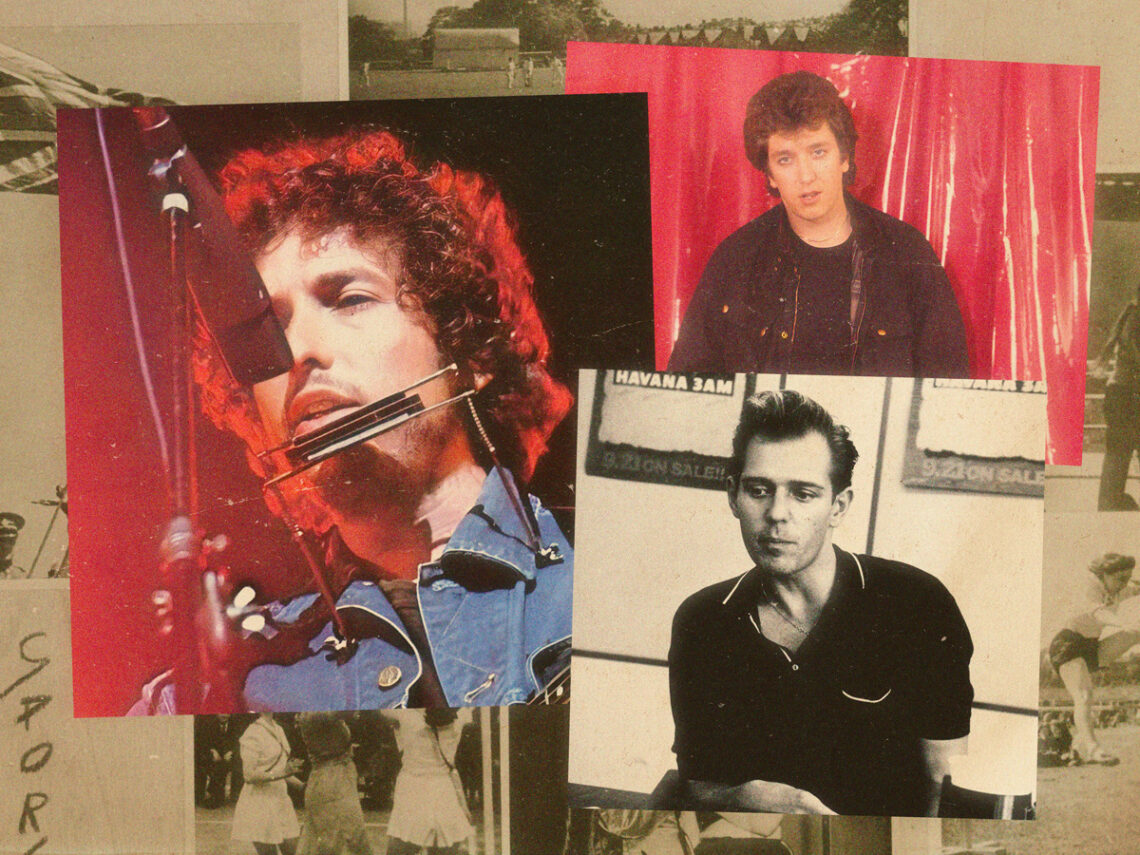
When Bob Dylan sat down to record with The Clash and Sex Pistols: “Fucking surreal”
There aren’t many people in the world of music with the imposing gravitas of Bob Dylan. He is like a solar sonic monolith that it is almost impossible for thousands upon thousands of swirling entities to circle around. Most are small meteorites, being helplessly flung in an ellipses as the huge pull of Dylan entraps them with his gigantic influence; others are larger moons equally as entranced by his creative control. On some occasions, Dylan would also capture the planets that make up the rest of rock’s solar system.
During the 1960s, as Dylan became known as one of the voices of a generation, arguably the most influential man to have only released a couple of albums, he would gather up fans such as Johnny Cash and The Beatles. Some of the biggest names in the music industry would be swallowed up by his presence in the 1970s, too, with an even larger range of incredible talent eager to be in the presence of his greatness. But, as the 1980s arrived, Dylan’s days as one of the most fashionable songwriters began to wane.
It would seem fitting, then, as his time at the top appeared to be finite, he would call on the plethora of musical friends he had made along the way as an opportunity to add ballast to his apparently sinking career.
Bob Dylan played with just about everybody on his 1988 album Down in the Groove: Sly and Robbie, Eric Clapton, Ron Wood, Mark Knopfler, most of the Grateful Dead, and, yes, Kip Winger all appear on this record. Why, your dear old dad probably blew a little harp on it, too. The album is not one of Dylan’s best, but its cover of Arthur Alexander’s first single, ‘Sally Sue Brown’, is notable because it features Steve Jones of the Sex Pistols on guitar and Paul Simonon of The Clash on bass.
When Bob Dylan teamed up with Sex Pistols and The Clash
It seems pretty fitting that the punks who had fought so tirelessly in the previous decade to burn down the rock architecture would, in the very next decade, hold up one of the crumbling pillars in an attempt to give him new life, just as he was falling out of fashion as they had hoped.
If you’re expecting rebel rock on the order of ‘God Save the Queen’ or ‘The Guns of Brixton,’ you will certainly be disappointed—let’s call this version of ‘Sally Sue Brown’ a historical curiosity. Jones described the session to Dylan biographer Howard Sounes in Down the Highway: The Life of Bob Dylan: “He called me up and said can I put a band together to do some sessions in the studio? I said, Yeah. Paul Simonon was in town at the time, from The Clash. So was the guitar player I was working with [and] a drummer from Pat Benatar’s band.”
Meeting in Hollywood, Jones, the powerhouse chord puncher of Sex Pistols, and not someone you might associate with the glamour of LA, even if he had been in the spotlight for a decade by then went on to explain: “It was a strange, fucking surreal day”. Dylan was used to simply keeping the tape running and jumping from song to song. His recording process had become infamous for its long hours and indeterminable starting points.
Jones continued: “It was like that all night, basically just fucking about”, at the end of their time the only track that mad it out alive was ‘Sally Sue Brown’.
According to the exhaustive Dylan “session chronology” at Punk Hart, the band recorded six songs on that night in March of ’87: in addition to ‘Sally Sue Brown’, they played ‘Wood In Steel’, ‘Heaven’, ‘Shake Your Money’, ‘Chain Gang’ and ‘If You Need Me’. So far as I know, none of the five unreleased songs has yet surfaced on any medium, bootleg or legit.
So, while we wait for those to arise from the cutting room floor, the only track worth listening to remains an odd collaboration between Sex Pistols, The Clash and Bob Dylan.