


‘Household Objects’: When Pink Floyd made an album without any musical instruments
In late 1973, the members of Pink Floyd, probably somewhat perplexed by the massive, massive worldwide sales of The Dark Side of the Moon, not to mention creatively intimidated to have to come up with a sequel to that monster, went back into the studio with the notion of recording something entirely avant-garde for the album’s follow-up.
Follow-up records are always a trifling thing and have been the pitfall of many a great band that hadn’t quite achieved the status yet. To deliver a top-notch album was one thing, but to match it once more with another hit was an altogether more difficult task.
What was decided upon was to record an album of musique concrète using only sounds produced by common household items. The ‘Household Objects’ sessions were known to yield just two, and perhaps three, recordings, before the band decided it would be easier to just use, say, a bass, instead of rubber bands attached to two tables, to get a bass guitar sound.
In A Rambling Conversation with Roger Waters Concerning All This and That, an interview by Nick Sedgewick, Waters confessed to the band’s decision to take their next record into a completely new space. As Sedgewick notes his own memories of “recording stuff with bottles and rubber bands” in 1974, though the Pink Floyd Encyclopaedia would date those sessions in late 1973, Waters has “a great intake of breath” and begins yet another story of Pink Floyd being true pioneers.
“Well, Nick… there was an abortive attempt to make an album not using any musical instruments,” explained Waters. “It seemed like a good idea at the time, but it didn’t come together. Probably because we needed to stop for a bit,” he continued, sharing that the band had become “tired and bored”. It’s the sort of affliction that affects only the best.
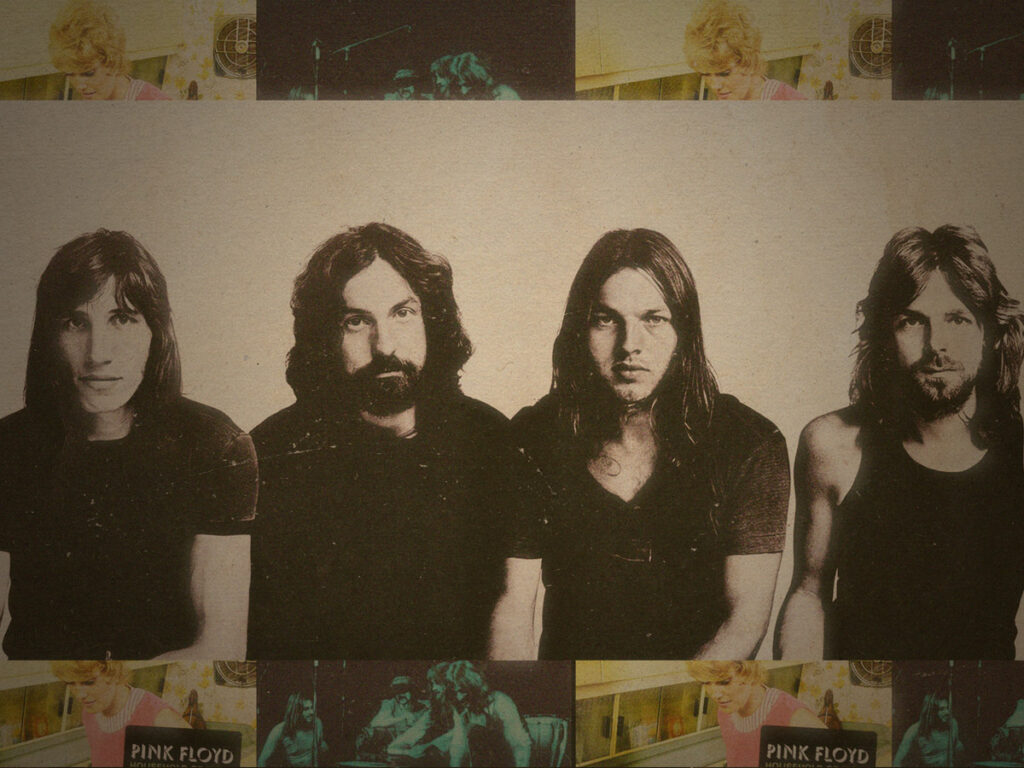
Sedgewick suggests it might have been to avoid touring, and while Waters confirms, he also proclaims, “I don’t think it was as conscious as that really. I think it was that when Dark Side of the Moon was so successful, it was the end. It was the end of the road. We’d reached the point we’d all been aiming for ever since we were teenagers, and there was really nothing more to do in terms of rock ’n’ roll.”
For Waters and the band, the two pillars of rock music had been achieved: “money and adulation” and the money-spinning brilliance of the massive-selling record had been achieved, “every rock’n roll band’s dream. Some bands pretend they’re not, of course.” In classic Waters style, he also threw a barb out at a fellow musician.
“Recently I was reading an article,” Waters continued, “Or an interview, by one of the guys who’s in Genesis, now that Peter Gabriel’s left, and he mentioned Pink Floyd in it. There was a whole bunch of stuff about how if you’re listening to a Genesis album, you really have to sit down and LISTEN, it’s not just wallpaper, not just high-class Muzak like Pink Floyd or Tubular Bells, and I thought, yeah, I remember all those years ago when nobody was buying what we were doing. We were all heavily into the notion that it was good music, good with a capital G, and of course, people weren’t buying it because people don’t buy good music.”
He finished, “I may be quite wrong but my theory is that if Genesis ever start selling large quantities of albums now that Peter Gabriel, their Syd Barrett, if you like, has left, the young man who gave this interview will realize he’s reached some kind of end in terms of whatever he was striving for and all that stuff about good music is a load of fucking bollocks. That’s my feeling anyway”.
“Wish You Were Here came about by us going on in spite of the fact that we’d finished.”
Roger Waters
Oi, talk about being brutally honest, there, Roger!
In his book, Inside Out: A Personal History of Pink Floyd
“No such recordings exist of the ‘Household Objects’ tapes,” Mason explained. But it wasn’t for nefarious reasons, but “For the simple reason that we never managed to produce any actual music. All the time we devoted to the project was spent exploring the non-musical sounds, and the most we ever achieved was a small number of tentative rhythm tracks.”
These tapes, two of them at least, were released on The Dark Side Of The Moon

‘The Hard Way’ sounds much more realised to me than just a mere rhythm track. It has a brooding immersion that is hard to ignore, and should be enjoyed with your deepest, darkest red wine.
The “singing bowl” sound of ‘Wine Glasses’ was used two years after it was recorded for the opening of ‘Shine On You Crazy Diamond’. One would have assumed that the shimmering, ethereal sound that starts that number was a keyboard, but no, it was a manipulated recording of a gently rubbed wine glass!