


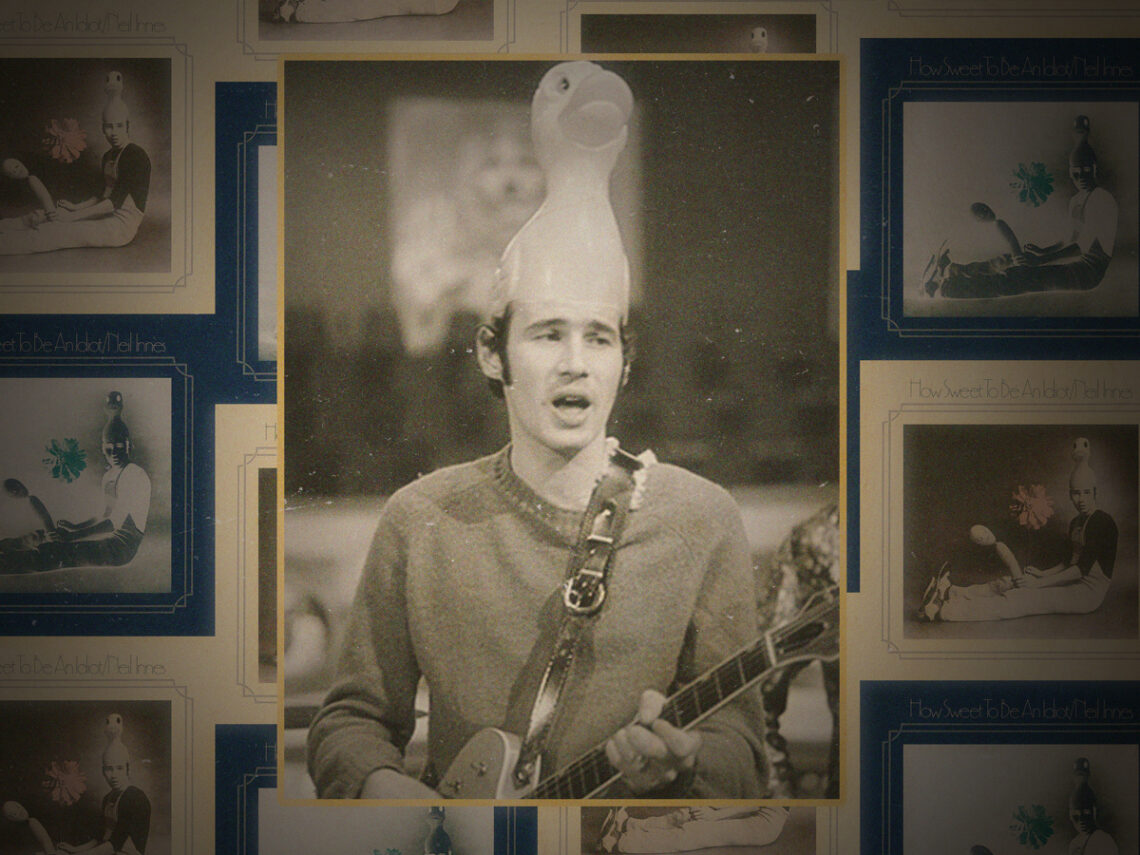
Neil Innes, the ‘Seventh Python’, and his brilliant ode to idiocy
I’ve been listening to the music of Neil Innes a lot this week as I’ve been writing, and as always, enjoying his work immensely. It’s a feast. Truly, he was one of the best pop songwriters we’ve ever had, a chameleon of musical styles from the earliest stages of his career.
Tin Pan Alley, vaudeville, psychedelic rock, Beatles pastiches, even reggae, there’s nothing he couldn’t do. As Innes grew older, his genre-hopping songwriting became even better, something that can’t be said of all—or even many—of his 1960s contemporaries. Sadly, although he is undeniably a musician’s musician, Innes was never properly recognised as such. Why? Because he’s funny, too.
Since I was a wee lad, I’ve been a fanatical fan of the Bonzo Dog Doo-Dah Band, the wonderfully zany group of Dada art school rejects featuring Innes and “ginger geezer” front man Vivian Stanshall. I discovered them listening to the Dr Demento radio show when he played their cover of ‘Hunting Tigers Out in “Indiah”‘. (I heard Noel Coward and The Mothers of Invention for the first time during that same show, three life-long obsessions launched that fateful evening). I ran right out and spent my birthday money on The History of the Bonzos, a two-LP set with a glossy booklet filled with insane photographs and a history of the group. I loved every single song on it. Still do.
The Bonzos were much beloved of all the really heavy rock groups of the ’60s, and they opened for The Who, Led Zeppelin and The Kinks. Eric Clapton was a huge fan. Paul McCartney produced their only hit, ‘I’m The Urban Spaceman’ under the name “Apollo C. Vermouth”, and they made a guest appearance in The Beatles’ TV special Magical Mystery Tour as the band in the strip joint playing ‘Death Cab for Cutie’, and yes, this is where the band got their name. If you’ve never heard their seminal albums Gorilla, The Doughnut in Granny’s Greenhouse, Tadpoles or Keynsham (my favourite), you really don’t know as much about ’60s music as you think you do; it’s just that simple.
It’s like never hearing Captain Beefheart or The Velvet Underground and thinking you’re all clever, a glaring and unforgivable cultural blind spot, sez me.
I’ve gone out of my way for three decades now, hunting down Bonzo Dog Band-related bootlegs, especially video. There wasn’t a lot of it about until a few years ago when the DVD of Do Not Adjust Your Set was released. DNAYS was a hip ’60s tea-time kids show, beloved of children and parents (think Pee-wee’s Playhouse from an earlier era). It starred pre-Python Eric Idle, Terry Jones and Michael Palin. To help out, Terry Gilliam did animations for the show, too.

The Bonzos were primarily musical performers, and members of the group appeared as extras in the comedy sketches. DNAYS was thought lost for many years when the ones that were released on DVD were rediscovered. Now there is a terrific amount of “new” Bonzo material for fans like me to feast on, much of which has been uploaded to YouTube.
After the breakup of the Bonzos, Neil Innes continued his association with his former DNAYS co-stars by appearing and writing material for the final 1974 series of Monty Python’s Flying Circus, the series after John Cleese left. In fact, only Innes and Douglas Adams were ever given writing credits outside of the six Pythons during the show’s history. Innes also appears in Monty Python and the Holy Grail as the annoying minstrel and sings his memorable Dylan parody, ‘Protest Song’ (“I’ve suffered for my music and now it’s your turn…”) in Monty Python Live at the Hollywood Bowl.
Neil Innes didn’t fade into obscurity after the Bonzos and the Pythons, he became a sort of national secret, like the recipe to HP Sauce or where Prince Philip buried his UFO files. The Innes Book of Records—God, what a title—was his late-night séance with the British psyche. It aired when most people were falling asleep, but if you caught it, it stayed lodged in your skull like a nursery rhyme written by Kafka. There he was, deadpanning next to a piano in a graveyard, singing like Noël Coward after an ayahuasca retreat.
When Innes died in 2019, it barely even made the nightly news. No candlelit vigils. No mural on the side of a brick wall in Camden. Just a ripple in the collective unconscious of weird Britain. Like someone turned down the volume on the part of your brain that still believed in silly walks and papier-mâché monsters. But if you’re reading this, you felt it. Innes was never after fame. He was after something purer—truth through nonsense, subversion through melody, prankster wisdom you could hum in the bath. Without Innes, Monty Python doesn’t stick the landing. The Rutles never exist. Half of what’s good in British pop culture withers on the vine.
We don’t get Neil Inneses anymore. The algorithm doesn’t know what to do with them. Too silly for the snobs, too smart for the suits. But he saw it all coming – the plasticisation of art, the commodification of irony, the extinction of whimsy. And he kept going. Kept making beautiful, bonkers, unfashionable things for people who still believed in joy with a punchline. If you’re weird enough, heartbroken enough, or stoned enough, you’d tune into what Innes was doing. And when you do, you’ll hear him giggling just out of sight, probably wearing a fake moustache and playing kazoo in a bowler hat. As it should be.