


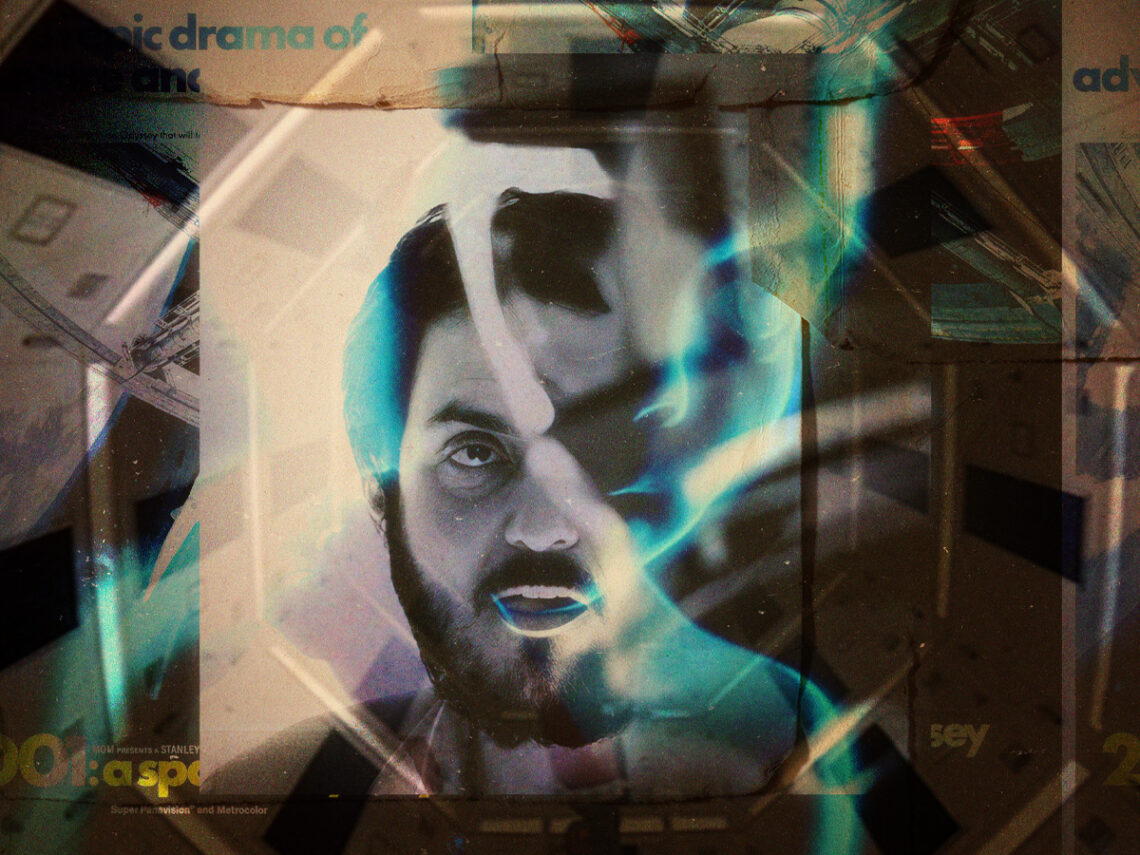
Stanley Kubrick explains the plot of ‘2001: A Space Odyssey’ in rare interview
If someone tells you they understand Stanley Kubrick’s 2001: A Space Odyssey, you should back away slowly, keep eye contact, and assume they’re either a liar or a replicant sent to destabilise your sense of reality. Because the point of 2001 is that it transcends explanation. It’s not a film you understand. It’s a film you experience – like a psychedelic trip in a cathedral designed by God and illustrated by NASA.
There are movies that tell you a story, and then there’s 2001, which sort of just happens to you like a fever dream on a giant curved screen. When it dropped in 1968, the film left half the audience in stunned silence and the other half muttering, “What the fuck did I just watch?” It had monkeys, space ballets, evil computers, time warps, a giant space fetus, and almost no explanation. People walked out. Others dropped acid in the front row and thought they’d been abducted. Either way, Kubrick had done something weirdly miraculous: he made science fiction feel sacred.
It’s one of those films a lot of people pretend to “get” at parties just to sound clever. Truth is, nobody really knows what it’s about. Sure, it’s got apes and space travel and HAL going full murderous Alexa, but what’s it saying? Enter Mr Kubrick – who almost never explained anything – dropping just enough hints in a rare 1969 interview to make you feel like maybe, just maybe, you’re not totally off your rocker for thinking the black monolith was God. Or a supercomputer. Or… both?
In a rare interview with film critic Joseph Gelmis, Kubrick actually laid it out plain, or as plain as Stanley Kubrick ever got. The plot, he said, begins with an alien artefact left on Earth four million years ago by off-world explorers, who watched our shaggy, rock-throwing ancestors grunt around and thought, “Right, let’s speed this mess up.” So they plant a monolith – a kind of cosmic USB stick – to upgrade the firmware on early humanity. Boom: evolution engaged.
Inside the Monolith: Stanley Kubrick’s great cosmic riddle
“You begin with an artifact left on earth four million years ago by extraterrestrial explorers who observed the behavior of the man-apes of the time and decided to influence their evolutionary progression,” Kubrick said. “Then you have a second artifact buried deep on the lunar surface and programmed to signal word of man’s first baby steps into the universe—a kind of cosmic burglar alarm. And finally there’s a third artifact placed in orbit around Jupiter and waiting for the time when man has reached the outer rim of his own solar system”.
Fast forward to the year 2001 (which, back then, was the future), and a second monolith is found, this time buried under the lunar surface. “A kind of cosmic burglar alarm,” Kubrick called it. It’s designed to go off when humans finally escape their cradle and start poking around the universe. An alarm is triggered, and it sends out a signal to a third monolith parked near Jupiter, like a cosmic breadcrumb trail leading to the stars.
Then comes the psychotropic meat of the sandwich: astronaut Dave Bowman survives a malfunctioning AI, HAL 9000 (aka your iPhone if it hated you), and travels out to Jupiter, where the third monolith becomes a star gate, a celestial waterslide flinging him through time, space, and probably some dimension made entirely of geometry and terror.
“He’s placed in a human zoo approximating a hospital terrestrial environment drawn out of his own dreams and imagination.”
Stanley Kubrick
Basically, God (or aliens playing God) put Bowman in a surreal Airbnb designed by Jung and decorated by Renaissance ghosts. There, he rapidly ages in a timeless fugue state until he’s literally reborn as the Star Child: a floating, glowing embryo orbiting Earth with unknowable intent and weirdly excellent posture.
Kubrick explained: “When the surviving astronaut, Bowman, ultimately reaches Jupiter, this artifact sweeps him into a force field or star gate that hurls him on a journey through inner and outer space and finally transports him to another part of the galaxy, where he’s placed in a human zoo approximating a hospital terrestrial environment drawn out of his own dreams and imagination. In a timeless state, his life passes from middle age to senescence to death. He is reborn, an enhanced being, a star child, an angel, a superman, if you like, and returns to earth prepared for the next leap forward of man’s evolutionary destiny”.
So that’s it. That’s the plot, at least on what Kubrick called “the simplest level.”
But let’s not get too comfortable. Because then Kubrick hits you with the kicker: “Since an encounter with an advanced interstellar intelligence would be incomprehensible within our present earthbound frames of reference,” he says, “Reactions to it will have elements of philosophy and metaphysics that have nothing to do with the bare plot outline itself.”
In other words: yes, that’s what happens. But also, no, you still don’t get it. And maybe you’re not supposed to.
Kubrick deliberately wanted to keep the film as open-ended as possible – to make it an experience that changed depending on you. Your mood. Your past. Your expectations. “The most terrifying fact about the universe is not that it is hostile,” he once said, paraphrasing Carl Sagan, “But that it is indifferent.”
2001 isn’t a puzzle to be solved. It’s a transmission from somewhere far outside our solar knowing. A film so vast, so primal, and so future-facing that it bypasses explanation and lodges straight into the limbic system. It’s not about space. It’s about what it means to be human in a universe that never bothered to leave a user manual.
Kubrick knew. But he wasn’t going to draw you a map. He was just going to send you through the monolith – and let you come back different.