‘Half a motherfucker’: The Legend of Pee Wee Marquette
05.03.2013
06:17 am

Topics:
Music

Tags:
Jazz
Pee Wee Marquette


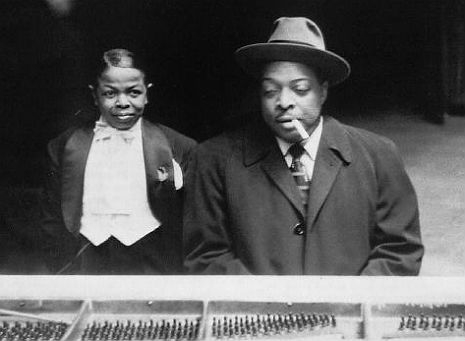
Pee Wee Marquette and Count Basie

Pee Wee Marquette is another of those characters who, like Moondog, found a niche in New York’s cultural ecosystem and carved out a life for himself “back in the day.”

It was not probably what you’d call a very good life, but, what the hell, he’ll remain a sort of Jazz legend long after we’re all forgotten. Pee Wee was the 3 foot 9 inch announcer and MC at Birdland, the famous NYC nightclub, and can be heard on the intros to countless classic live Jazz records from the 50s and 60s. 

There’s even a complete CD that came out in 2008 consisting of nothing by Pee Wee’s intros, which are made all the more entertaining by Pee Wee’s deliberate mispronunciation of the names of key acts. You see, Pee Wee would pretty much make life miserable for Jazz acts at Birdland unless they paid him a “tip.” Thus, Horace Silver was “Whore Ass Silber” until Silver relented and paid ($5 in the later years, which was a lot for that time).

The diminutive, but cantankerous, Pee Wee would elbow a non-payer in the groin, blow cigar smoke in their faces, and do even less pleasant things (like telling Bobby Hutcherson to “pack your stuff and get on out of here, we don’t need you”). For this and other reasons he was dubbed by his “pal” Lester “Prez” Young as “half a motherfucker.”

According to legend (and I don’t think this story is on the Internet anywhere), trombonist Bill Watrous once caught up with Pee Wee, who was working the door of the Hawaii Kai restaurant on Broadway in his later years (dressed in a turban and a Nehru jacket, he’d stand outside and try to rustle up paying customers). Watrous saw Pee Wee getting dressed down by some tough guy, claiming that all sorts of harm would befall Pee Wee unless Pee Wee repaid the money he owed or whatever that matter entailed. Watrous saw the tough guy turn to leave and make for the stairs and then saw Marquette run over and stab the toughie in the ass several times with a switch blade before returning to his post, acting as if nothing had happened.

In the book Take Five: The Public and Private Lives of Paul Desmond, Mort Lewis, one-time manager of the Dave Brubeck Quartet recalled Marquette:

There was a black midget, Pee Wee Marquette, who was the master of ceremonies at Birdland. And every act that played there, the musicians had to give him fifty cents and he would announce their names as he introduced the band. Dave Brubeck gave him fifty cents, Joe Dodge gave him fifty cents, and Norman Bates gave him fifty cents. Paul Desmond refused to pay one cent. And when Pee Wee Marquette would introduce the band, he’d always say, in that real high-pitched voice, “Now the world famous Dave Brubeck Quartet, featuring Joe Dodge on drums, Norman Bates on bass,” and then he’d put his hand over the microphone and turn back to Joe or Norman and say, “What’s that cat’s name?” referring to Paul. Then he would take his hand off the microphone and say, ‘On alto sax, Bud Esmond.’ Paul loved that.

Some have questioned whether Marquette was actually female, and just passed as a male, but I’m pretty sure that, had that been the case, it would have made it into the legend somehow or another. Plus, his voice sounds distinctly male to my ears. Interestingly, Pee Wee was interviewed in the mid-80s by David Letterman, so somewhere out there there’s video of William Crayton “Pee Wee” Marquette, telling stories of the old Birdland from his point of view, but (Internet scrub that I am) I wasn’t able to find it.

A compilation of Pee Wee Marquette’s exuberant Birdland intros:
 

Written by Em | Discussion
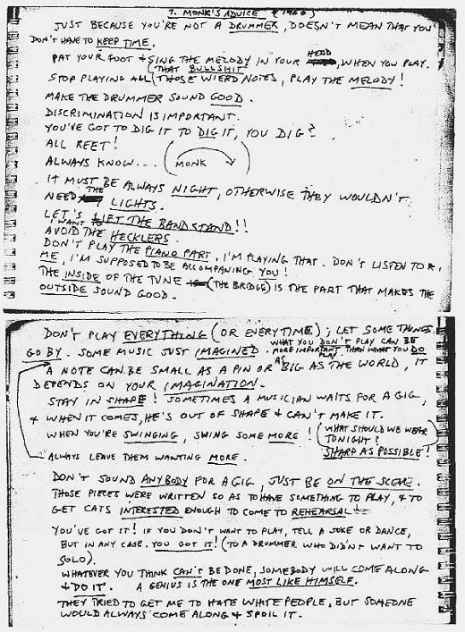
‘When you’re Swinging, Swing Some More!’: Thelonious Monk’s advice to musicians

knomthkjhuwelka.jpg
 
Thelonious Monk’s incredible advice for musicians, as compiled by saxophonist, Steve Lacy in 1960.

T.MONK’S ADVICE (1960)

JUST BECAUSE YOU’RE NOT A DRUMMER, DOESN’T MEAN YOU DON’T HAVE TO KEEP TIME.

PAT YOUR FOOT & SING THE MELODY IN YOUR HEAD, WHEN YOU PLAY.

STOP PLAYING ALL THOSE WEIRD NOTES (THAT BULLSHIT), PLAY THE MELODY!

MAKE THE DRUMMER SOUND GOOD.

DISCRIMINATION IS IMPORTANT.

YOU’VE GOT TO DIG IT TO DIG IT, YOU DIG?

ALL REET!

ALWAYS KNOW… (MONK)

IT MUST BE ALWAYS NIGHT, OTHERWISE THEY WOULDN’T NEED THE LIGHTS.

LET’S LIFT THE BAND STAND!!

I WANT TO AVOID THE HECKLERS.

DON’T PLAY THE PIANO PART, I’M PLAYING THAT. DON’T LISTEN TO ME. I’M SUPPOSED TO BE ACCOMPANYING YOU!

THE INSIDE OF THE TUNE (THE BRIDGE) IS THE PART THAT MAKES THE OUTSIDE SOUND GOOD.

DON’T PLAY EVERYTHING (OR EVERY TIME); LET SOME THINGS GO BY. SOME MUSIC JUST IMAGINED. WHAT YOU DON’T PLAY CAN BE MORE IMPORTANT THAT WHAT YOU DO.

ALWAYS LEAVE THEM WANTING MORE.

A NOTE CAN BE SMALL AS A PIN OR AS BIG AS THE WORLD, IT DEPENDS ON YOUR IMAGINATION.

STAY IN SHAPE! SOMETIMES A MUSICIAN WAITS FOR A GIG, & WHEN IT COMES, HE’S OUT OF SHAPE & CAN’T MAKE IT.

WHEN YOU’RE SWINGING, SWING SOME MORE!

(WHAT SHOULD WE WEAR TONIGHT? SHARP AS POSSIBLE!)

DON’T SOUND ANYBODY FOR A GIG, JUST BE ON THE SCENE. THESE PIECES WERE WRITTEN SO AS TO HAVE SOMETHING TO PLAY, & TO GET CATS INTERESTED ENOUGH TO COME TO REHEARSAL.

YOU’VE GOT IT! IF YOU DON’T WANT TO PLAY, TELL A JOKE OR DANCE, BUT IN ANY CASE, YOU GOT IT! (TO A DRUMMER WHO DIDN’T WANT TO SOLO).

WHATEVER YOU THINK CAN’T BE DONE, SOMEBODY WILL COME ALONG & DO IT. A GENIUS IS THE ONE MOST LIKE HIMSELF.

THEY TRIED TO GET ME TO HATE WHITE PEOPLE, BUT SOMEONE WOULD ALWAYS COME ALONG & SPOIL IT.

 
hkjhiuhlkbluuuuuwsajk.jpg


Via Letters of Note
 

Written by Paul Gallagher | Discussion
Outer Spaceways Inc: Killer footage of Sun Ra and His Arkestra from 1969
01.10.2013
10:55 am

Topics:
Heroes
Music
Thinkers

Tags:
Sun Ra
Jazz


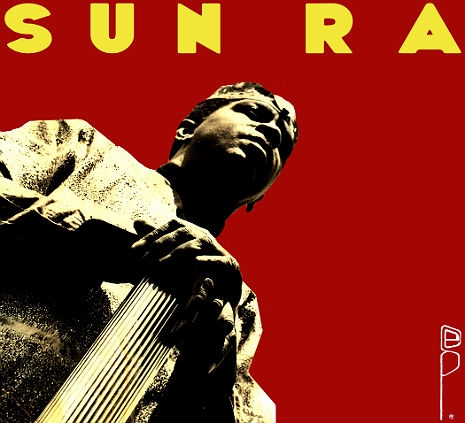
“I never wanted to be a part of planet Earth, but I am compelled to be here, so anything I do for this planet is because the Master-Creator of the Universe is making me do it. I am of another dimension. I am on this planet because people need me”—Sun Ra

Dazzling short documentary film from French television of Sun Ra and His Arkestra, with the great June Tyson, circa 1969. Killer takes on “Enlightenment” (from his 1958 masterpiece Jazz in Silhouette and “Outer Spaceways Incorporated.”


Via Bedazzled.tv (Beddazzled’s head honcho Spike Priggen will be DJ’ing at Sidecar in Brooklyn every other Thursday starting January 10th)

Written by Richard Metzger | Discussion
Cry Of Jazz: Only known footage of Sun Ra and his original Arkestra, Chicago, 1950s
12.17.2012
09:38 am

Topics:
History
Movies
Music

Tags:
Sun Ra
Jazz
The Arkestra


Composer/arranger Edward O. Bland’s 1958 quasi-documentary short, Cry of Jazz was one of the first films to examine Black culture. Made during the Eisenhower era when that concept hardly had a meaning to the general public, it was also perhaps the first time that assumptions of white cultural supremacy were challenged by an African-American director in cinema history.

Today the little-known film is considered a lost classic and was selected for preservation in the United States National Film Registry by the Library of Congress in 2010:

“[N]ow recognized as an early and influential example of African-American independent film-making. Director Ed Bland, with the help of more than 60 volunteer crew members, intercuts scenes of life in Chicago’s black neighborhoods with interviews of interracial artists and intellectuals. “Cry of Jazz” argues that black life in America shares a structural identity with jazz music. With performance clips by the jazz composer, bandleader and pianist Sun Ra and his Arkestra, the film demonstrates the unifying tension between rehearsed and improvised jazz. “Cry of Jazz” is a historic and fascinating film that comments on racism and the appropriation of jazz by those who fail to understand its artistic and cultural origins.”

Scenes of the Arkestra were filmed at 5 or 6 club gigs between 1956 and 1958. This was before the band and its leader began wearing the distinctive Egyptian and science fiction-styled headdresses and costumes they would later become known for.


The great revolutionary poet, John Sinclair, had this to say about Cry of Jazz on his blog in 2004:

The Arkestra performances that provide the soundtrack for The Cry of Jazz underline and accent Bland’s relentlessly didactic story line and offer vivid visual contrast to the extended narrative scenes which depict a group of collegiate jazz enthusiasts heatedly engaged in a profound intellectual discussion centered on the politics of music and race and the definition, meaning and future of jazz.

Bland’s passionate, well-ordered polemic extremely advanced for the late 50s presents a systematic economic analysis of the social forces which produced and shaped the music called jazz, carefully relates them to the shape and form of the music then prevalent, and boldly forecasts what he calls the death of jazz that will be administered by a new experimental movement led by creative artists and composers (here typified by Sun Ra) who are dedicated to freeing the music from its historical strictures, reflecting the social conditions of the present, and projecting and interpreting the world of the future.

At first the story proceeds with excruciating slowness: A college jazz society meeting breaks up, leaving behind a group of stragglers a pair of white women, a white man and two black men who continue the discussion among themselves and soon reach sharp disagreement on the issues of where jazz originated, what forces shaped its development and why it sounded the way it did. Then one of the black men seizes center stage and carefully unfolds his increasingly radical analysis until his listeners are left virtually stupefied and without coherent response.

Sun Ra & the Arkestra lay down a pulsating track of sound under the narration and serve to punctuate the protagonist’s long, engrossing lecture with appropriate segments of performance footage and musical counterpoint. It’s easy to picture Sun Ra enthusiasts editing together these Arkestral appearances and eliminating the talking parts altogether, but inquisitive viewers may gain immensely from exposure to Bland’s fiercely iconoclastic exposition on the state of African American creative music on the historical cusp of the modern jazz era and the free jazz,  avant garde,  New Black Music movement of the 1960s.


A young Herman Poole “Sonny” Blount, before he properly understood his intergalactic roots and legally changed his name to Le Sony’r Ra

Read more:
From Sonny Blount to Sun Ra: The Chicago Years

Sounds from Tomorrow’s World: Sun Ra and the Chicago Years, 1946-1961

Purchase the DVD of Cry of Jazz at Amazon.
 

Written by Richard Metzger | Discussion
Dave Brubeck Quartet: In Concert, Germany 1966

dave_brubeck_quartet
 
Dave Brubeck claimed he had 2 ambitions when he first started out as a Jazz musician - “to play polytonally and polyrhythmically.”

He also said his inspiration for rhythm was the heart beat, for this was what we heard first, and last.

Brubeck was a giant of Jazz, whose passing at the age of 91, brings an end to one of the greatest eras of American Jazz.

He popularized Jazz like few other composers/musicians of his day, becoming a household name and the first million-selling Jazz musician, who also made the cover of Time magazine in 1954. The purists didn’t like him, and many classed his brand of Jazz as “easy listening”, but this is to do him and his music a great disservice.

Take a listen to the Dave Brubeck Quartet (Brubeck - Piano, Paul Desmond - Alto Saxophone, Joe Morello - Drums, Gene Wright - Bass), filmed in concert in Germany, November 6th, 1966.

Track LIsting:

01. “Take the ‘A’ Train”
02. “Forty Days”
03. “I’m in a Dancing Mood”
04. “Koto Song”
05. “Take Five”

R.I.P. Dave Brubeck 1920-2012


Written by Paul Gallagher | Discussion
The Genius of Thelonious Monk: Live in Oslo and Copenhagen from 1966

thelonious_monk_1966
 
Thelonious Monk is 1 of only 5 Jazz Musicians who have made the cover of Time magazine. The others were Armstrong, Ellington, Marsalis and Brubeck.

Monk was always special. His wife Nellie once remarked, he “was never like ordinary people, not even as a child.” He dressed differently, thought differently and was said to even have smaller hands than most piano players, which gave him his very distinctive style. What made him special was the Monk knew who he was and what he wanted to be. How this great, genius talent later came undone is a sad and tragic tale.

Here is Monk performing alongside along with Charlie Rouse (Tenor Sax), Larry Gales (Bass), and Ben Riley (Drums) in 2 television concerts in Norway and Denmark, from 1966.

Thelonious Monk Live in Oslo

Track Listing:

01. “Lulu’s Back In Town”
02. “Blue Monk”
03. “‘Round Midnight”

Thelonious Monk Live in Copenhagen

Tracks Listing:

01. “Lulu’s Back In Town”
02. “Don’t Blame Me”
03. “Epistrophy”


Written by Paul Gallagher | Discussion
Genius, Hustler, Superstar: ‘The Miles Davis Story’

miles_davis_smoking
 
Miles Davis was one of the most influential musicians of the 20th century. He was at the forefront of various Jazz movements, including Be Bop, Cool, Modal and Fusion. He lived a life that was a complex mix of genius, superstar, pimp and street hustler. Duke Ellington nailed it when he described Davis as “the Picasso of Jazz”.

The Miles Davis Story is an Emmy-winning documentary that gives a fairly good overview of the man and his incredible career and controversial life, mixing interviews together with some amazing footage (including rare concerts from the 1960s and 1970s). There is a good selection of interviews, but occasionally I wanted to hear more from Davis and his music and less from the contributors. This small quibble aside, The Miles Davis Story is compelling viewing.


Previously on Dangerous Minds

Like A Spiritual Orgasm: Miles Davis plays the Isle of Wight Festival


Impressions of John Coltrane: 3 vintage TV performances


Written by Paul Gallagher | Discussion
‘Impressions of John Coltrane’: 3 vintage TV performances

john+coltrane
 
Impressions of John Coltrane is an excellent trio of television performances featuring John Coltrane,  with his own quartet, the Miles Davis Quintet and alongside Eric Dolphy. Filmed between 1959 and 1963, each performance reveals the quality and range of the great man’s playing.

The first comes from the series The Jazz Casual, originally aired in 1963. Here you’ll find the perfect line-up of Coltrane (tenor sax/soprano sax), McCoy Tyner (piano), Jimmy Garrison (bass), and Elvin Jones (drums). This is said to be the only time Coltrane’s “classic” quartet was caught on camera. Together they give great versions of “Impressions” and “Afro Blue”.

The second is from 1959, and has Coltrane playing with the Miles David Quintet - Davis (flügelhorn/trumpet), Coltrane (tenor sax/alto sax), Wynton Kelly (piano), Paul Chambers (bass), and Jimmy Cobb (drums). They are accompanied by Gil Evans and a 15-piece orchestra. And certainly get going on “So What”, “The Duke”, “Blues for Pablo” and “New Rumba”.

The third is from West German TV in 1961, which shows Coltrane playing with Eric Dolphy (alto sax/flute), McCoy Tyner (piano), Reggie Workman (bass), and Elvin Jones (drums), who hit the spot with “My Favorite Things” and “Impressions”.

Track list:

01. “Alabama”
02. “Impressions”
03. “Afro Blue”
04. “So What” (with Miles Davis)
05. “The Duke” (with Miles Davis)
06. “Blues For Pablo” (with Miles Davis)
07. “New Rumba” (with Miles Davis)
08. “My Favorite Things” (with Eric Dolphy)
09. “Impressions” (with Eric Dolphy)


Thanks to Jazztification
 

Written by Paul Gallagher | Discussion
‘Like A Spiritual Orgasm’: Miles Davis plays the Isle of Wight Festival

miles_electric_miles_davis
 
When Billy Eckstine came to St. Louis, with Dizzy Gillespie and Charlie Parker, Miles Davis went to see them play.

Davis was playing trumpet with Eddie Randle’s Rhumboogie Orchestra, and one day, after rehearsal, he went round to the theater to see Gillespie and Parker perform.

Davis arrived with his trumpet slung over his shoulder, dreaming of how one day he might be up there playing along with the likes of his idols Clark Terry, Dizzy Gillespie or Charlie Parker. Just as he reached the theater, Gillespie appeared, noted Davis’ trumpet and rushed over to the young musician.

‘You play?’ Gillespie asked.

Davis told him he did.

‘We lost our trumpeter, and we need one fast. You got a card?’

Davis nodded ‘Yes’.

‘Then you’re in.’

Davis played with Gillespie and Parker for the next 2 weeks, and this was the start of Mile Davis’ incredible career.

In 1970, Miles Davis played to a 600,000 audience at the Isle of Wight Festival. It was the largest pop festival in history. At the time, many questioned why Davis had agreed to perform at it, as man of his success and talent was middle of the bill, sandwiched between Tiny Tim and Ten Years After.

Davis had just released his double album, Bitches Brew, which proved to be a game-changing moment in Modern Jazz. The album divided critics. Some reviled it, claiming Davis had sold out, and was no longer relevant. But the audience loved it. And Bitches Brew became Davis’ biggest success, going gold within weeks.

In August 1970, Davis decided to play Bitches Brew at the Isle of Wight Festival. It was a myth-making appearance, where Davis improvised much of his performance.

That festival, and Davis’ role in it, are revisited here in Murray Lerner’s documentary Miles Electric: A Different Kind of Blue, which inter-cuts Miles’ astounding performance together with members of his band and those who knew the great man.


Written by Paul Gallagher | Discussion
‘A Voodoo Christmas In South Norwood’ - an alternative Xmas mix


If, like me, you find the constant barrage of the same old shitty Christmas music in shops and restaurants at this time of year mind-numbing - excruciating even - then this is the perfect antidote. I mean, I’m not being Scrooge here, I do like Christmas and all but I could die happily without ever hearing the fucking “Frog Chorus” ever again. As if Christmas shopping wasn’t stressful enough!

So praise be for dj, writer and Voodoo practitioner Stephen Grasso, who has put together a mix of tunes guaranteed to warm even the most humbugging of your icy cockles. A Voodoo Christmas in South Norwood features mostly ragtime and swing jazz versions of some well-known Christmas standards, along with a smattering of funk, soul and reggae, with some rarities and classics thrown into the mix. “Beatnik’s Wish” by The Beat Generation, “Christmas Time” by Horace Andy and “What WIll Santa Claus Say (When He FInds Everyone Swinging?)” by Louis Prima & His New Orleans Gang being personal favourites, and you will also find tracks here by Louis Armstrong, Celia Cruz, Charlie Parker, the Aggrovators, James Brown, New Birth Brass Band and many more. The full tracklist is on the Soundcloud page, and here is the 76 minute mix:


For more info on Stephen Grasso, visit his blog Clean Living In Difficult Circumstances, and be sure to check out “Smoke And Mirrors - All Cities Have Magic”, his excellent, ongoing psycho-geographical tour of London for the Bang The Bore blog.

Via Shallow Rave.

Written by Niall O'Conghaile | Discussion
Happy Birthday John Coltrane
09.23.2011
01:26 pm

Topics:
Heroes
Music

Tags:
Jazz
John Coltrane
Free Jazz
Be Bop

image
 
Happy Birthday John Coltrane, musician, composer, innovator, artist and space traveler, who rocketed “off the surface of the earth towards more specialized, little explored, and potentially dangerous atmospheres”.

Born today in 1926, Coltrane has been described as “the last great figure in the evolution of jazz”, who opened jazz up into a language of possibilities. He progressed from Be-Bop to Hard Bop to Free Style, and brought a spiritual sense to his music the culminated in his genius work Love Supreme.

Coltrane didn’t question his innate talent or technical brilliance, he allowed it to develop organically, seeing himself as part of a larger creative community as he descibed in a letter to Don DeMichael, in 1962:

The “jazz” musician (you can have this term along with others that have been foisted on us) does not have to worry about a lack of positive or affirmative philosophy. It’s built in us. The phrasing, the sound of the music attests this fact. We are naturally endowed with it. You can believe all of us would have perished long ago if it had not been so. As to community, the whole face of the globe is our community. You see, it is really easy for us to create. We are born with this feeling that just comes out no matter what conditions exist.

...

Truth is indestructible. It seems history shows (and it’s the same today) that the innovator is more often than not met with some degree of condemnation.; usually according to the degree of departure from the prevailing modes of expression or what have you. Change is always hard to accept. We also see these innovators always seek to revitalize, extend and reconstruct the status quo in their given fields, whatever is needed. Quite often they are rejects, outcasts, sub-citizens etc. of the very societies to which they bring so much sustenance. Often they are people who endure great personal tragedy in their lives. Whatever the case, whether accepted or rejected, rich or poor, they are forever guided by that great eternal constant - the creative urge.

Here’s Coltrane playing “My Favorite Things” - the crossover track that broke free of Be Bop, brought him a mainstream audience, and demonstrated complex harmonies and repetitions into “a hypnotic eastern dervish dance”. 


Written by Paul Gallagher | Discussion
The Crazy World of M. A. Numminen

image
 
The Finnish artist M. A. Numminen has been a pioneer of avant-garde, underground and electronic music for almost fifty years. He first came to prominence at the Jyväskylä Summer Festival, in 1966, when he performed a series of provocative songs including Nuoren aviomiehen on syytä muistaa (“What a Young Husband Should Remember”), which used lyrics taken directly from guides to newly-married couples and legislative texts concerning the distribution of pornography.

Numminen followed this with his controversial interpretations of Franz Schubert’s lieds, before moving on to writing a series of musical compositions based on the philosophical writings of Wittgenstein.  During this time he also devised a singing machine, and became a pioneer of electronic music - something he returned to with his Techno album in the 1990s. 

Numminen is currently touring Finland, and to get an idea of his work, here’s his interpretation of Baccara’s No. 1 Euro hit ‘Yes Sir, I Can Boogie’.


With thanks to Paul Darling
 
More from M. A. Numminen and the original Euro hit by Baccara after the jump…
 

Written by Paul Gallagher | Discussion
Taschen’s Jazz Covers
08.11.2009
01:11 pm

Topics:
Art

Tags:
Miles Davis
Jazz
Taschen
Archie Shepp
Blue Note

image
 
Miles DavisSorcerer and Archie Shepp’s The Magic of Ju-Ju are just two of the nearly 700 jazz albums getting their deluxe due in Taschen’s newly released (and assuredly hefty) book, Jazz Covers.

This volume features a broad selection of jazz record covers, from the 1940s through the decline of LP production in the early 1990s.  Each cover is accompanied with a fact sheet listing performer and album name, art director, photographer, illustrator, year, label, and more.

But it’s not all psychedelic skulls and Cicely Tyson.  The folks at Taschen fleshed the project out with contributors ranging from John Coltrane authority, Ashley Kahn, to famed Blue Note producer, Michael Cuscuna.
 
image
 
Taschen Books: Jazz Covers

Prince of Darkness: Essential Audio Only Track Off Miles Davis’ Sorcerer

Written by Bradley Novicoff | Discussion