Happy Birthday Kenneth Anger!
02.03.2012
05:18 pm

Topics:
Art
Heroes
Movies
Occult

Tags:
Kenneth Anger


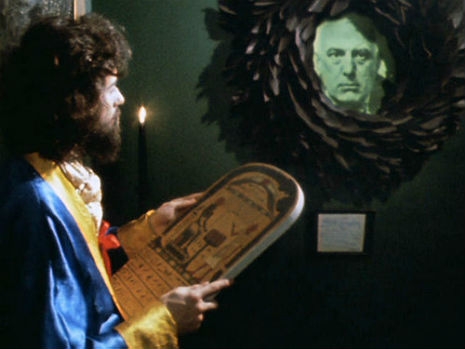
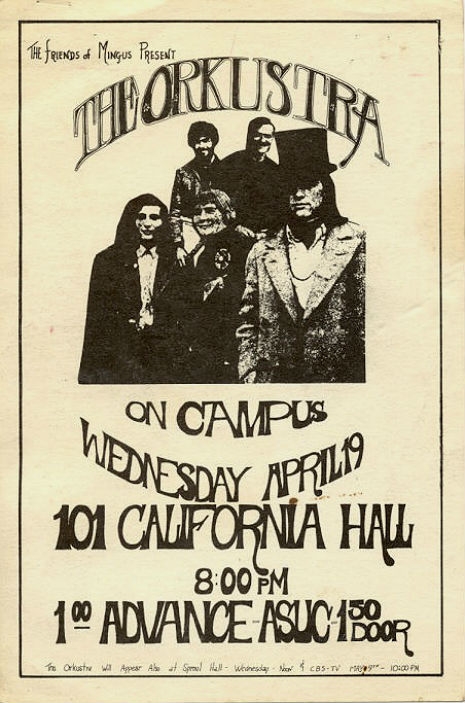
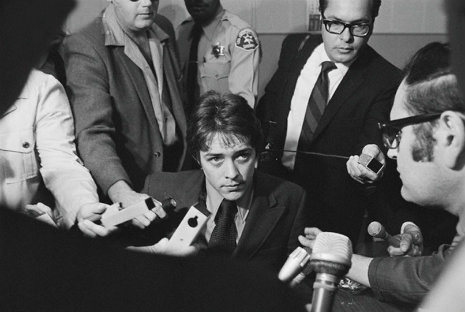
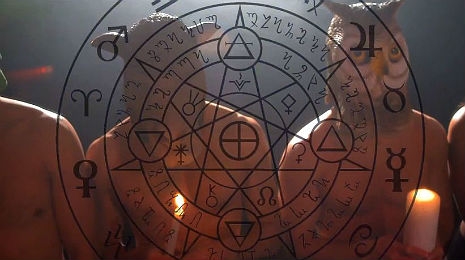
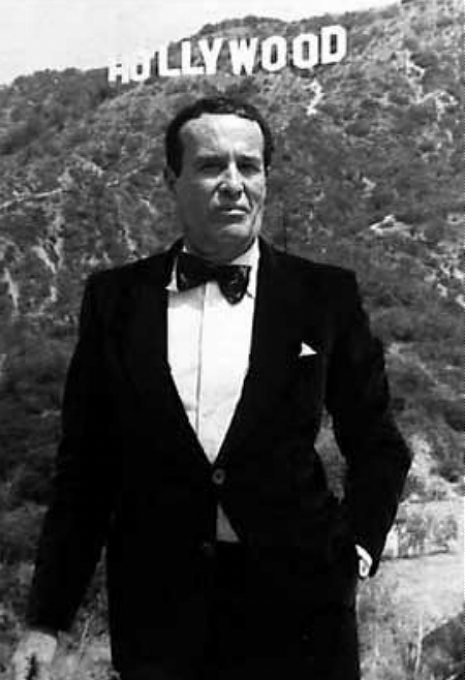
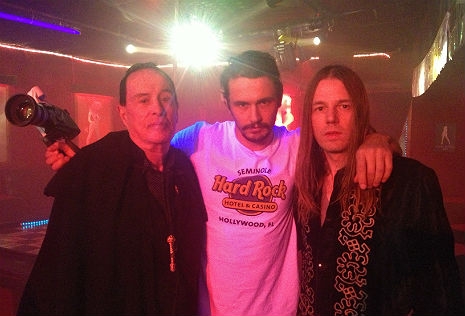
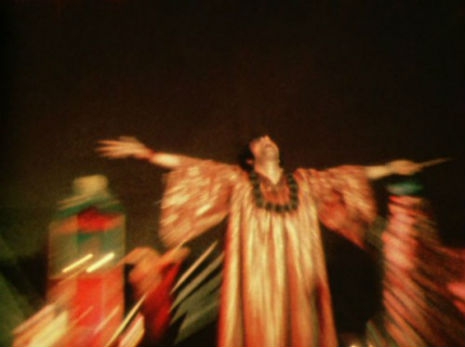
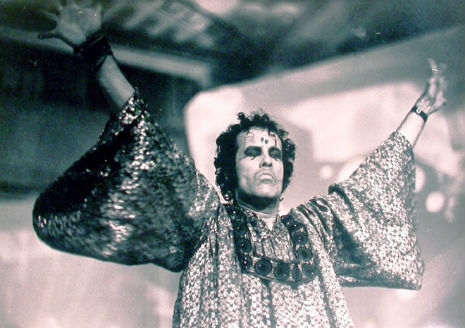
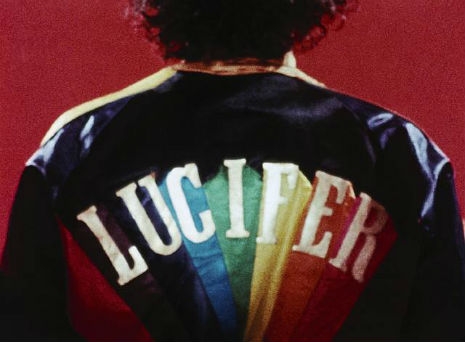
The magus of American cinema turns 85 today. I had the good fortune to see Kenneth recently at his MOCA opening and he’s looking rather hale and hearty for a man his age, I must say.

Anger’s musical collaboration with Brian Butler, Technicolor Skull, has recently produced a limited edition blood red vinyl album available only at the Technicolor Skull website (I have one, it’s a cool looking object).

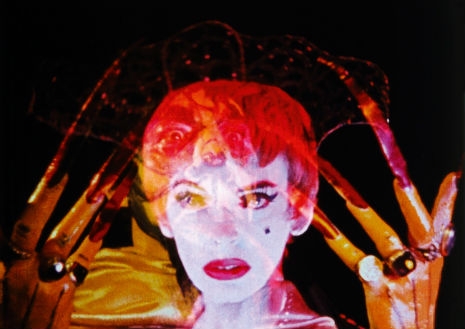
Below, Anger’s short film made for the 2010 fall/winter collection of the house of Missoni:
 

Written by Richard Metzger | Discussion
Night Life in Chicago from 1947

chicago_pump_room_1947
 
One of Metro-Goldwyn-Mayer’s Travel Talks, with “Voice of the Globe” James A Fitzpatrick, who takes the viewer on a trip along Chicago’s Loop, from 1947.

‘Night descends on Chicago, the heart of the city, or the Loop as it is generally known, is brilliantly aglow with the glimmering lights that lure us to its many attractions.’

These include the Bismarck, where we will see Don Julian and Marjorie do “their fantastic cape dance”; and Chez Paree, “where internationally famous artists have entertained the public for a quarter of a century or more”; to the Ambassador Hotel’s “renowned Pump Room, where food and drink are served with all the formalities of a Royal banquet”; and on to the Edgewater Beach Hotel, which served such famous guests as Marilyn Monroe, Frank Sinatra, Judy Garland, Charlie Chaplin, Bette Davis, Tallulah Bankhead, and Nat King Cole, and U.S. Presidents Franklin D. Roosevelt and Dwight D. Eisenhower.

The men look old, their hair sleek, their suits formal. The women younger, framed by jackets and skirts in blues and reds, smile, smoke, wear hats. Everyone looks as if they are on show, pretending to have fun. It’s a different landscape, far away, and slightly out of focus, the images seem hand-painted, water-colored.

Hard to imagine this is the same year that began with the murder of Elizabeth Short (aka the Black Dahlia) in Leimert Park, Los Angeles; while Jack Kerouac traveled across country, an experience that formed the basis for On the Road, and worked on The Town and The City; and in Conroe, Texas, Joan Vollmer gave birth to her son named after the father, William S Burroughs; Marilyn Monroe made her film debut as a telephone operator; and back in LA, Kenneth Anger shot his dream-film Fireworks over a weekend, while his parents were away. And all of this happening, bubbling out-of-frame, of these streets fireflied with lights, and Julian and Marjorie cape-danced; gold lame draped girls kicked heels; and a cowboy turned rope tricks on a hay scattered dance floor.


Written by Paul Gallagher | Discussion
Ingenuity in Action: Documentary on Hot Rods from 1959

hot-rod-1959
 
In 1959, a few years before Kenneth Anger filmed young men buffing their aluminum hubcaps in Kustom Kar Kommandos, Sid Davies and Haile Chace made this evocative roadster documentary, Ingenuity in Action for Hot Rod Magazine. Sid Davies was the master of the shock doc, whose educational films about Stranger Danger, or at-risk teenagers in Age 13; or the side-effects of LSD, formed the source material for John Waters’ movies on juvenile delinquents, psychotic killers and cry babies.

Ingenuity in Action is perhaps best seen at a fifties Drive-In, as there is a lack of close-ups and mid-shots to create a necessary sense of pace and dramatic tension for small screen viewing. Even so, the film captures a delightful sense of those seemingly innocent, by-gone days, when people celebrated their enjoyment of sleek, speedy racing cars, under wide, blue, cloud-freckled skies.


Previously on Dangerous Minds

Rusty Rat Rods from Hell


With thanks to Iya Vinogradova
 

Written by Paul Gallagher | Discussion
Kenneth Anger & Brian Butler’s Technicolor Skull


A reminder about the Kenneth Anger opening party (which is confusingly being held a week after the exhibit actually opened to the public) tomorrow night at MOCA. Featured will be a live musical interlude via Anger and Brian Butler’s Technicolor Skull project.

Technicolor Skull performs their first West Coast appearance at the Museum of Contemporary Art (MOCA) in Los Angeles on November 19, 2011, as part of the opening reception for Kenneth Anger: ICONS. This exhibition will showcase the films, books, and artwork of one of the most original and enigmatic filmmakers of post-war American cinema. This coincides with the release of Technicolor Skull’s self-titled recorded debut, a one-sided, bloodred 180 gram 12” vinyl LP limited to 666 copies.

Technicolor Skull is an experiment in light and sound, exploring the psychic impact of a magick ritual in the context of an improvised performance. With Brian Butler on guitar and electronic instruments, and Kenneth Anger on theremin, their collaboration is a performance contained inside a ritual of unknown origin, tapping into occult stories that extend musical language into initiation. Hidden messages escape through gesture and light, manifesting as a one-time-only event.


The record will be available directly from www.technicolorskull.com and at the MOCA store.
 

Written by Richard Metzger | Discussion
Kenneth Anger at the Museum of Contemporary Art


Yet another reason why I love the City of… Angels(!) so very, very much…

MOCA presents Kenneth Anger: ICONS, a showcase of the films, archives, and vision of one of the most original filmmakers of American cinema, on view at MOCA Grand Avenue from November 13, 2011, through February 27, 2012. A defining presence of underground art and culture and a major influence on generations of filmmakers, musicians, and artists, Anger’s films evoke the power of spells or incantations, combining experimental technique with popular song, rich color, and subject matter drawn equally from personal obsession, myth, and the occult.

MOCA’s exhibition centers on Anger’s Magick Lantern Cycle of films—Fireworks (1947), Puce Moment (1949), Rabbit’s Moon (1950/1979), Eaux d’artifice (1953), Inauguration of the Pleasure Dome (1954/66), Scorpio Rising (1963), Kustom Kar Kommandos (1965), Invocation of My Demon Brother (1969), and Lucifer Rising (1970-81)—presenting the work across multiple projections in a unique gallery installation of red vinyl, designed in close consultation with Anger.

Complementing the films is an archive of photographs, scrapbooks, and memorabilia from Anger’s personal collection that illustrates the filmmaker’s unique vision of Hollywood’s golden era. The inspiration and source material for the filmmaker’s infamous celebrity “gossip” books Hollywood Babylon, (1975) and Hollywood Babylon II (1984), the collection centers on stars such as Rudolph Valentino and Greta Garbo, as well as now lesser-known icons like silent-film actress Billie Dove. Anger grew up in Hollywood. His grandmother was a costume mistress, and he is claimed to have appeared as a child actor in the Warner Brothers production of A Midsummer Night’s Dream (1935). The world of the classic studios and the mystique of its major figures radiates throughout the photographs, press clippings, letters, and memorabilia on display, which Anger has gathered across many decades.

Technicolor Skull, a multimedia collaboration featuring Kenneth Anger on Theremin and Los Angeles artist Brian Butler on guitar and electronic instruments, will perform for the first time in Los Angeles at the exhibition opening on November 19. Technicolor Skull is a magick ritual of light and sound in the context of a live performance. The project premiered at Donaufestival in Austria, in April 2008, and has subsequently toured throughout Europe, performing at the National Museum of Art, Copenhagen, and the Serralves Museum, Portugal, and recently at the Hiro Ballroom, New York, for the Anthology Film Archives benefit.

Opening: Saturday, November 19, 7–10pm, Technicolor Skull will perform at 8pm.


Written by Richard Metzger | Discussion
James Bidgood’s sumptuous and subversive ‘Pink Narcissus’, 1971

image
 
The film was credited to ‘Anonymous’, which led some to think it was by Andy Warhol, and others, Kenneth Anger. The mix of kitsch and beautiful imagery pointed to both, however, they were wrong. For years no one knew who had made Pink Narcissus, that was until the writer Bruce Benderson became obsessed with this subversively erotic film and decided to track down its director - James Bidgood.

Shot on Super-8, Pink Narcissus is a sumptuous film that depicts the erotic fantasies of a gay male prostitute (Bobby Kendall), as he visualizes himself in various homage to “gay whack-off fantasies”.

Bidgood arrived in New York in 1951, where he worked as a female impersonator, hairdresser, set designer and then photographer. Bidgood started taking pix for Adonis and Muscleboy, but was at first disappointed with the results, as he told the New York Times:

“There was no art,” Bidgood laments. “They were badly lit and uninteresting. Playboy had girls in furs, feathers and lights. They had faces like beautiful angels. I didn’t understand why boy pictures weren’t like that.”

So, Bidgood made his own erotic tableaux, which mixed beauty and kitsch. His first Watercolors presented a young man swimming through a fabulous, shimmering grotto - all of which he built and photographed in his cramped apartment, as he explained to Butt magazine:

“Models were not that easy to find especially for the kind of work I was doing which called for more of the subject’s time than a pose or two wearing less than two square inches of jersey and some elastic and leaning against some fagelas elaborate mantelpiece. In the time I needed to do one shot they could turn ten tricks. And there weren’t all that many great beauties around willing to be photographed nude or semi nude in homoerotic situations. Remember this was before being gay and/or being a ‘male escort’ or pornography, quasi or otherwise, were as acceptable or mainstream as they are now.”

Bidgood had his own distinct style, which later inspired the careers of Pierre et Giles, and David La Chappelle.

From this Bidgood started work on Pink Narcissus, which he shot in his Hell’s Kitchen apartment, between 1963 and 1971. Again, Bidgood designed and made the sets, provided the make-up and costume, and used the neighborhood hustlers as his cast. It was an incredible undertaking, and one that eventually led his frustrated backers to take the film from Bidgood and finish it themselves. And this was why Bidgood took his name off the finished film.  

“See, why I took my name off of it was that I was protesting, which I’d heard at the time that’s what you did…. I’d take my name off and then they’d go “Mr. Bidgood took his name off because…” But it turns out they kept me in the closet, and all you had to do was ask anybody who’s been in it and they’d say, you know, “Jim did this.” It wasn’t like a big mystery, but you would have thought, and then years later I was ‘outed’.”


Previously on DM

Early Gay Cinema: Jean Genet’s ‘Un Chant d’Amour’


Written by Paul Gallagher | Discussion
Kenneth Anger on Aleister Crowley and ‘Do What Thou Wilt’

image
 
Kenneth Anger gives a wonderfully loose and informative talk on Aleister Crowley. From his birth in 1875 to his death in a boarding house in 1947 (not 1974 as said here), Anger gives snapshots of Crowley’s life through commentary on his painting, his use of writing paper, his mountaineering expeditions, his potboiler Diary of a Drug Fiend, Cefalu, the Blitz, to his involvement with the Occult and why the “Most Wickedest Man in the World”:

Crowley was not afraid of devils, in fact, they were part of his family.  He was never afraid of anything on the other side - angel, devil, these are names you put on entities - but he said, ‘Welcome friend.’”

Anger also sketches in his own life and interests, and explains why he was officially declared a fire hazard.


Written by Paul Gallagher | Discussion
Marjorie Cameron: The Wormwood Star

image
 
Writing a book is an heroic process, it really is, but even more so when it comes to biographies. Especially these days when so few people bother to read books anymore and the rewards are seldom very remunerative for most authors. In the case of biographers, it’s a different kind of satisfaction. It takes a real sense of purpose and desire to see someone’s story told properly; to get things down as accurately as possible for history’s sake before the participants are picked off by time. In this sense, there is often a very real race against the clock. 

I’m quite partial to biographies. I have a pretty sizable personal library, and by far the largest part of the books I own are life histories, especially the tales of cult figures or rebellious type people (Beats, Lenny Bruce, Leary, Crowley, Dali, Warhol, etc). There is a special fondness I have for books about extremely marginal personalities (Andy Milligan, Charles Hawtrey, Charles Ludlam) and I appreciate the effort, the true labor of love, that goes into such obscure endeavors. The more obsessive, the better.

Marjorie Cameron (1922-1995) was a “witchy woman” and Beatnik artist known widely in several overlapping Los Angeles bohemian circles, but she was hardly famous. Since her death, there has been a gradually growing public awareness of Cameron’s art, or at least what’s left of her work, that the artist herself did not destroy in a moment of mental instability. Her paintings, now highly sought after by collectors, can sell for in the tens of thousands of dollars. In recent memory, her work has been exhibited in major museums (The Whitney’s “Beat Culture” show and the the excellent “Semina Culture: Wallace Berman and His Circle” exhibit) and the Nicole Klagsbrun Gallery in NYC published a gorgeous monograph of her work in 2007.

Wormwood Star: The Magickal Life of Marjorie Cameron by Spencer Kansa is a fascinating and very, very well-researched look into Cameron’s perplexingly strange life. The title refers to Cameron’s belief that she was the end-times “Whore of Babalon” prophesied in the Book of Revelations, in the flesh, This was a result, she thought, of a black magic ritual performed to summon or “conjure” her by her future husband, rocket scientist Jack Parsons, and L. Ron Hubbard, in his pre-Scientology days.

Cameron’s often wobbly orbit in life saw her cross paths with significant cultural players like underground filmmaker Kennth Anger, who cast her as “The Scarlet Woman” (typecasting!) in his 1956 film, Inauguration of the Pleasure Dome, which also featured author Anais Nin. (Anger was Cameron’s roommate at several points over the decades they knew one another). She was certainly a part of Wallace Berman’s intimates and co-starred in. Night Tide a low-budget horror film with Dennis Hopper (who recounts a brief period of sexual intimacy with the older woman). Crisscrossing the country and tracking down all of the various characters the author spoke to must have been quite a chore, and as a reader and longtime admirer of Cameron’s work, I’m grateful for the attention Kansa paid to detail.

Wormwood Star: The Magickal Life of Marjorie Cameron is one of those books that’s obviously not for everyone, but me, I’ve probably read Wormwood Star three times in the past month. If it sounds like something that might interest you, well, it probably is.

Below, one of Cameron’s brief, but memorable, scenes in Curtis Harrington’s Night Tide.


Previously on Dangerous Minds:
Dennis Hopper stars in creepy 60s Beatnik cult film, ‘Night Tide’

Written by Richard Metzger | Discussion
Early Gay cinema: Jean Genet’s ‘Un chant d’amour’

image
 
The other day I was looking at some old issues of the Village Voice from the later part of the 1960s and the early 1970s that I have in boxes in my garage. They’re really interesting and you can read some “coded” things in between the lines of a lot of the advertisements, such as coyly-worded ads for head shops and various diversions for people looking for something kinky to do. I think the preservation of the Village Voice as an archive of life in NYC will provide quite a lot for future anthropologists who’ll want to better understand how we lived in the second half of the 20th century and how quickly sexual mores changed over the decades. Launched in 1955, the Voice was really the first underground paper. New York City would obviously be one of the best microcosms of society to view at any time for the sheer diversity and number of its residents, but when you zero in on the time between 1965 until the end of the 1980s, and you look at the subculture, a hell of a lot changed in the margins before going wider in the culture. Some of the seeds planted then are still blooming today.

One thing that I noticed is that as the Sixties went on, the advertisements for gay-related films such as Jack Smith’s notorious Flaming Creatures, and Kenneth Anger’s Fireworks or Scorpio Rising start to creep into the listings for films like Andy Warhol’s Chelsea Girls and other more, uh, mainstream “underground film” fare of the era. And it’s always these same films, like they were playing constantly at the same two or three theaters, for like… years. Usually on a double or triple bill. Later Vapors directed by no-budget gay “outsider” auteur Andy Milligan gets rotated into the prurient programing circulating at these Times Square sin pits that had names like “The New David Cinema,” “The Adonis Lounge” and “The Tomkat.”

To the average Joe on the street, to the average Village Voice reader in 1967, or even to the NYPD’s vice squad, there was nothing much alarming in and of itself that a film titled Vapors was playing in Times Square. To someone who knew what Milligan’s short film was about (an awkward encounter in a gay bathhouse) these ads took on an entirely different connotation. In other words, these films were coded “dog whistles” indicating most likely that cruising (at the very least) would be tolerated in the balconies and toilets of these run down cinemas, often in buildings owned by the mob.

The fleabag movie theaters catering to an all male clientele ultimately lined 8th Ave. near 42nd Street until they cleaned up Times Square in the early 1990s. By the 1970s, the demure ads in the Village Voice ads were dispensed with completely and explicit gay porn ads begin to appear for movies with titles like Inches and Ramrodder. (Interesting to note that the Voice had quite an anti-gay tone in the 1960s until petitioned by the GLF to stop using terms like “faggots” when reporting on the Stonewall riots).

Another movie that showed up a couple of times in the pages of the Voice back then is French author Jean Genet’s short film, Un chant d’amour (“A Song of Love”). Directed by Genet in 1950, based loosely on his novel The Miracle of the Rose and with the rumored assistance of Jean Cocteau, the film was impounded in France when it was first screened and it became circulated as gay porn for French intellectual homosexuals in the years following. The silent b&w film shows the encounters two men in a French prison have, their dreams and fantasies, and the voyeurism of a sadomasochistic guard who is titillated by their relationship, spies on them and abuses one of them because of jealousy. It seems to be very influenced by Anger’s Fireworks, a film Genet most certainly would have seen via Cocteau, who considered the young Ken Anger a protege.

Fifteen years or so later, bootleg prints of Un chant d’amour must have made it to Times Square and this obscure work of poetic homosexual quasi-porn with a literary pedigree, more about the longing for human contact than the actual contact itself (flowers, a gun and cigarettes stand in for the male genitalia) sent the Bat-signal to those for whom it was meant and they assembled by its flickering light to do who knows what?

By the mid-80s, when I saw Un chant d’amour on a triple bill with documentaries on Jean-Paul Sartre and Simone de Beauvoir at an uptown arthouse I can no longer recall the name of, not a single vice cop in New York City would have given a shit about something as ultimately kinda tame as Genet’s film. Still, bearing in mind that it was once something confiscated by police, became something that was passed around hand to hand amongst gay French intellectuals like a stag film, then screened in cinemas straight out of John Rechy’s novels, how odd/weird/amusing (or alarming, depending on your viewpoint) is it to think that Un chant d’amour (and Vapors and Anger’s films and Jack Smith’s as well) can now be watched on YouTube?


And here is a big chunk of Andy Milligan’s Vapors, from 1965, one of the very first films of its kind: a narrative softcore homosexual exploitation film.
 

Written by Richard Metzger | Discussion
Alessandro Cima’s ‘Glass Boulevard’

image
 
If I was to send one Christmas card this year, then it would be Alessandro Cima’s beautiful short film Glass Boulevard.

Cima is a film-maker and editor of Candleight Stories and he has just directed this enchanting short film, Glass Boulevard, which was shot in “the dullest imaginable environment of shops along a major Los Angeles street at night when the shops were closed.” This is Cima’s Christmas film and it is one to be smitten by - a cinematic poem reminiscent of Kenneth Anger’s work, filled with delightful images loaded with suggestion and meaning.

The music is “There’s Something in the Air” by Artie Shaw and his Orchestra, from 1936, with Peg La Centra on vocals. 


Written by Paul Gallagher | Discussion
William Burroughs and Antony Balch - ‘Cut Ups’

image
 
It caused nausea and vomiting when first shown at the Cinephone, Oxford Street, in London. Some of the audience demanded their money back, others hurled abuse and shouted “That’s sick,” and ““Its disgusting.” This was the idea, as writer William Burroughs and producer, Antony Balch wanted to achieve a complete “disorientation of the senses.”

Balch had a hard-on for the weird, unusual and sometimes depraved. It was a predilection born from his love of horror films - one compounded when as a child he met his idol, Bela Lugosi, the olde Austro-Hungarian junkie, who was touring Britain with the stage show that had made him famous, Dracula. Film was a love affair that lasted all of Balch’s life.

He also had a knack of making friends with the right people at the right time. In Paris he met and hung out with the artist Brion Gysin and druggie, Glaswegian Beat writer, Alexander Trocchi, who was then writing porn and editing a literary mag called Merlin, along with the likes of Christopher Logue. Through them, Balch met the two men who changed his life, Burroughs and Kenneth Anger.

Anger helped Balch with his ambitions as a cinema distributor, getting him a copy of Todd Browning’s classic Freaks, which was banned the UK, at that time. Balch paid Anger back when he later released his apocalyptic Invocation of My Demon Brother as a support feature.

Burroughs offered Balch something different - the opportunity to collaborate and make their own films.  This they did, first with Towers Open Fire, an accessible montage of Burroughs’ routines, recorded on a Grundig tape recorder, cut-up to Balch’s filmed and found images of a “crumbling society.” Put together stuff like this and the chattering classes will always take you seriously. But don’t doubt it, for it was good.

But it was their second collaboration, Cut Ups which for me is far more interesting and proved far more controversial. Cut Ups was originally intended as a documentary called Guerilla Conditions, and was filmed between 1961 and 1965 in Tangiers and Paris. It included some footage from Balch’s aborted attempt to film the unfilmable Naked Lunch. The finished material was collated and then conventionally edited - but the process didn’t stop there, no. For Balch divided the finshed film into four sections of equal length, and then:

...assembled into its final state by taking one-foot lengths from each of the four sections that were cut together with mathematical precision — 1,2,3,4,1,2,3,4 etc. Variations to this structure occur randomly when a shot change occurs within one of the already edited one-foot lengths.

Balch faced very difficult grading problems. “Twenty minutes with one change every foot was just too much, what we did was to have a graded fine-grain print made of the edited sequences and then chop up the fine grain and make a dupe negative from it, so the film prints at one light.” The film was cut into exact lengths by none of the actual artists. “The actual chopping was done by a lady who was employed to take a foot from each roll and join them up. A purely mechanical thing, nobody was exercising any artistic judgement at all.”

The idea was to achieve an effect akin to Burroughs cut-up technique, and cause a complete disorientation of the senses. This was aided by an audio track created by Burroughs, Gysin and Ian Somerville, which consisted of mind-numbing permutations of just four phrases: “Yes, Hello?”, “Look at that picture,” “Does it seem to be persisting?”, and “Good. Thank you.”

When all put together, the film achieved its intended effect, as Roy Underhill, assistant manager at the Cinephone told Balch during the film’s initial run:

...during the performances an unusual number of strange articles such as bags, pants, shoes, and coats were left behind, lost property, probably out of complete disorientation.

Mission accomplished. Burroughs and Balch didn’t collaborate again until 1972 on the rarely seen 70mm Bill and Tony in 1972, which had the pair endlessly fuck around with each other’s dialog. Well, if you’re going to make a statement, make it on 70mm..


Bonus clip of ‘Bill and Tony’ after the jump…
 
Previously on Dangerous Minds

William S. Burroughs’ The Junky’s Christmas


Written by Paul Gallagher | Discussion
‘The Man We Want To Hang’: Kenneth Anger films the art of Aleister Crowley

image
Crowley self-portrait, 1920
 
‘The Man We Want To Hang’ is a film shot by Kenneth Anger documenting an exhibit of Aleister Crowley’s paintings at London’s October Gallery in April 1998. The score is by Liadov.

I was amazed when I found this video. I thought I’d seen all of Anger’s films, but I was wrong. While it’s neither the trippy spectacle or erotic fetishism one expects of Anger, it still has moments where you sense the Anger ‘touch’. But mostly Kenneth steps out of the way and let’s Crowley’s paintings take center stage.

‘The Man We Want To Hang’, the title of the film also the title of the notorious Sunday Express article which had denounced A.C. as the “Wickedest Man In The World.” The title is also a pun on art being hung on gallery walls, and a possible reference to The Hanged Man of the Tarot—who appears in the film a few times—although nothing jumped out at me as I looked over that entry in The Book of Thoth to back up that line of thought (but I’m sure those with well wore copies of 777 and The Book of Thoth and a knack for undoing and uncovering occult puzzles may have better luck that I did ...)

The art works themselves—drawn of the collections of Keith Richmond, Jimmy Page and the Ordo Templi Orientis International—depict a variety of subjects. Simple landscapes of mountains, volcanoes and sea, serpents and malevolent beings from some daemonic reality, portraits of individuals familiar to those versed in A.C.‘s biography—such as Gerald Yorke and various Scarlet Women—and self-portraits of A.C., some evoking grey aliens or Lam.

If this was the only output of an artist they would have at most been a curious and obscure art historical footnote, if even that. But when put into the context of A.C.‘s life they have more value.

Throughout his life A.C. expressed his higher nature in a multitude of ways. Poetry, painting, ritual magick, sexual athleticism, writing, mountaineering, exploring higher consciousness. While he was middling in such expressions as painting and poetry, his non-fictional magickal texts are genius, a Joyce or Fassbinder of occult and esoteric philosophy, and most of us would be extremely lucky to create a single work of genius over a lifetime, let alone a multi-volumed network of texts like A.C.‘s.

Aside from his texts of magickal philosophy and ritual his other great work of art was his life, which encompassed the lowliest degradations and the highest and holiest exalted states. The art works provide a visual accompaniment to it—the settings, the personalities, the extraordinary experiences.

They also provide a reminder of A.C.‘s role as a prototype of the type of current creative spirit, with his multiple means of expression (poetry, art, journalism, adept, etc.) a forerunner of the of the typical artist of today, who is just as likely to write a novel, play in a band, star in a porn, run a small business, blog, than lock themselves in one monolithic way of expressing creative currents.

He ran a preview of this social reality movie like all successful intelligence agents do.” Jason Lubyk


Update: resident Crowley expert R. Metzger has informed me that The Man We Want To Hang is available as part of the Anger boxsets that were released a few years back. Available here.
Metzger also directed me to a film that Anger did on Crowley’s paintings called The Brush Of Baphomet, which you can watch after the jump…

Written by Marc Campbell | Discussion
Dennis Hopper stars in creepy 60s Beatnik cult film ‘Night Tide’

image
 
Yet another example of a once super obscure cult film turning up on the Internet, in this case, for free on YouTube’s OpenFlix channel. The late Curtis Harrington’s darkly atmospheric Night Tide (1961) was the first film to star a young Dennis Hopper. The plot revolves around a sailer (Hopper) who has an affair with a mysterious and beautiful woman (Linda Lawson) who portrays a mermaid at a sideshow on the Venice Beach boardwalk. The sailor begins to suspect that his lover is an actual mermaid who commits ritual murders during the full moon.
 
image
 
Occultist/artist Marjorie Cameron, who memorably played the Scarlet Woman in Kenneth Anger’s Inauguration of the Pleasure Dome (Harrington shot Anger’s Puce Moment and appeared in Pleasure Dome as well) has a small but pivotal role as a super intense woman who seems to hold a strange and fearsome power over Lawson’s character. There is also a fantastic jazzy/beatniky soundtrack by David Raskin (who also worked on the soundtrack to Modern Times with Charlie Chaplin and composed the haunting theme to Otto Preminger’s Laura, which became a jazz standard).
 

Written by Richard Metzger | Discussion
Kenneth Anger talks about working with Jimmy Page on the ‘Lucifer Rising’ Soundtrack

image
 
While the Kenneth Anger / Jimmy Page dustup has been reported ad nauseum, this clip is new to me.

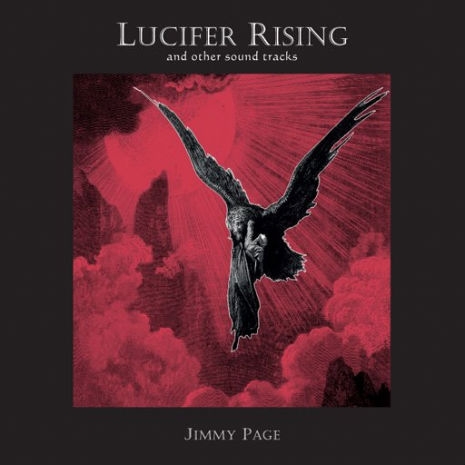
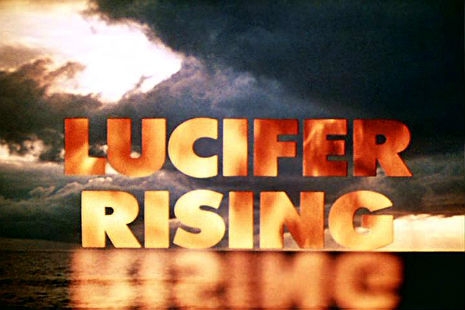
Led Zeppelin guitarist and leader Jimmy Page has been fired as composer for the soundtrack of the film ‘Lucifer Rising’ by it’s director, Kenneth Anger. Speaking in London on Friday, Anger decried Page for time-wasting and a lack of dedication to the project, and claimed that Page’s personal problems had made him impossible to work with. Page has been working on the film for the past three years and has so far delivered some 28 minutes of completed tape. The story of the collaboration -and the ensuing rift- goes back to 1973 when Page first agreed to compose and perform the movie soundtrack. He and Anger first met at Sotheby’s, at an auction of boots by the English Occultist/Magician Aleister Crowley. Both Page and Anger are students of Crowley’s teachings. Anger is a practicing Magus (a priest/magician) and his films’of which ‘Scorpio Rising’ is perhaps the best known—- are replete with occult symbolism. Anger himself describes them as “Spells and Invocations”.


Written by Marc Campbell | Discussion
Kenneth Anger Film Animated GIFs

image
image
image
image
See more animated GIFs after the jump…

Written by Tara McGinley | Discussion
Page 2 of 3  < 1 2 3 >