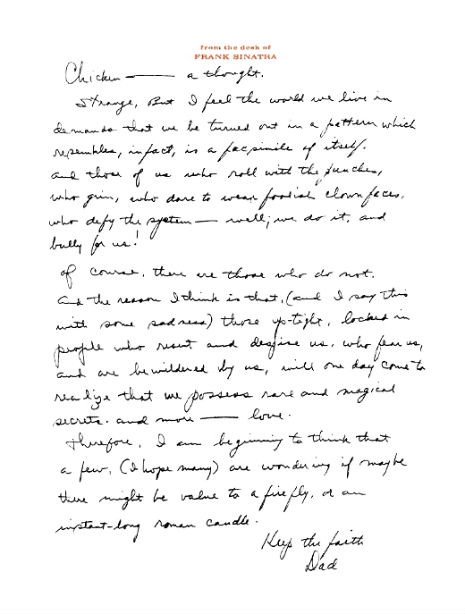
A letter from Frank Sinatra to his daughter Nancy—which she kept framed in her house—penned around 1969.
According to an article in the Toledo Blade dated April 19, 1969 “keeping the faith” for Nancy included “a refusal to take alimony from her husband, because she considered it ‘unfair’ when she is perfectly capable of working.”
from the desk of
FRANK SINATRA
Chicken — a thought.
Strange, but I feel the world we live in demands that we be turned out in a pattern which resembles, in fact, is a facsimile of itself. And those of us who roll with the punches, who grin, who dare to wear foolish clown faces, who defy the system — well, we do it, and bully for us!
Of course, there are those who do not. And the reason I think is that, (and I say this with some sadness) those up-tight, locked in people who resent and despise us, who fear us, and are bewildered by us, will one day come to realize that we possess rare and magical secrets, and more — love.
Therefore, I am beginning to think that a few, (I hope many) are wondering if maybe there might be value to a firefly, or an instant-long roman candle.
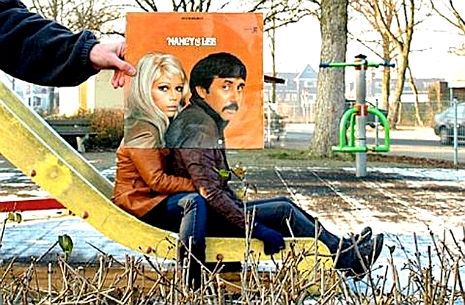
The 1973 film Nancy & Lee in Las Vegas takes an almost cinéma vérité approach to its subject as it documents the less-than-glamorous grind of playing to casino audiences in Sin City.
It’s showtime and Nancy Sinatra and Lee Hazlewood do their damnedest to entertain a distracted Vegas audience, most of whom have likely lost or are about to lose next month’s rent. Despite delivering some fine performances, with terrific backing from the Wrecking Crew (Hal Blaine, Billy Strange and Don Randi), Nancy and Lee just can’t get a rise out of the crowd at the once grand Riviera Hotel and Casino. The vibe is flatter than a glass of day-old champagne.
Having lived in Vegas for a couple of years, I’ve seen shows where two-thirds of the audience are clearly just cooling their heels between long bouts at the slot machines or they’ve gambled away all their cash and are doing their best to get through the night without slitting their wrists - the very definition of a “tough crowd.”
Scenes of Sinatra and her mother venting back stage are remarkably candid and unvarnished, giving us a glimpse into celebrity-hood’s bleaker dimensions. And the vintage footage of the Strip is way cool.
Songs performed include “Did You Ever,” “Arkansas Coal,” “Friendship Train,” “Summer Wine,” “Jackson” and “She’s Funny That Way.”
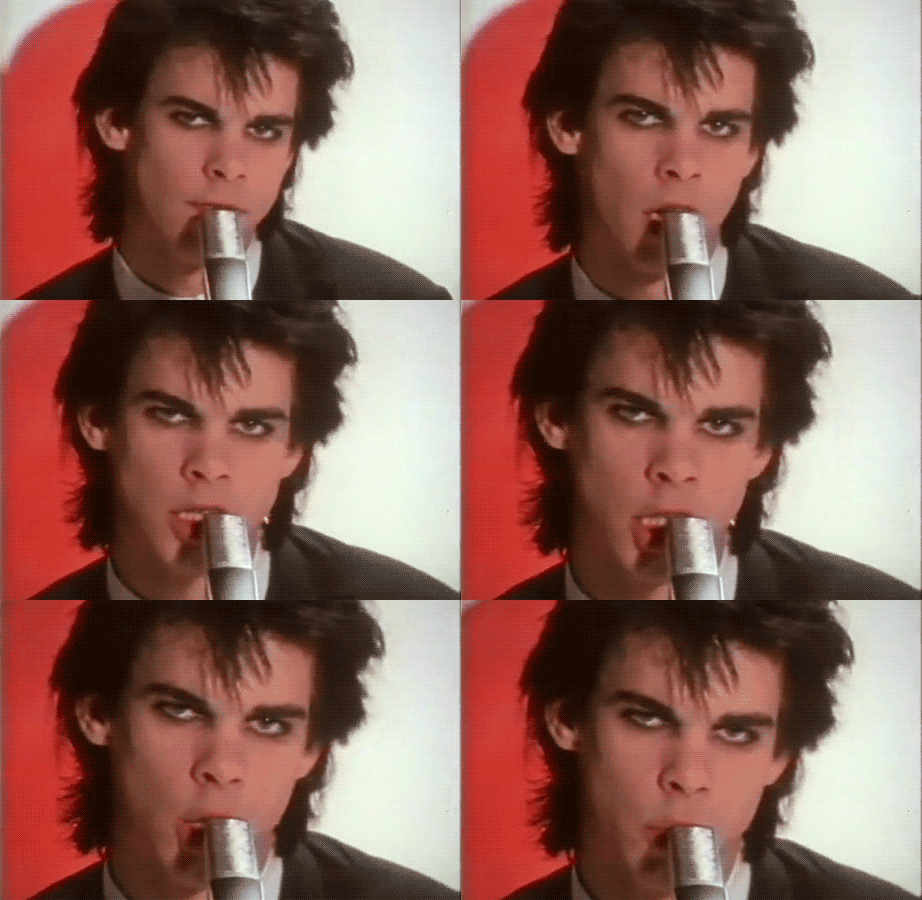
A fresh-looking, immaculately dressed 21-year-old Nick Cave covers the Nancy Sinatra classic along with Mick Harvey, Phil Calvert and Tracy Pew as The Boys Next Door, the original name of The Birthday Party, in 1978 (Rowland S. Howard would join them soon afterwards).
I’m a massive Nick Cave fan, but I’ve never seen this clip before. It’s pretty amazing to witness how fully formed his rockstar persona was then, even at this tender age.
Love the mascara. Adam Lambert eat your heart out…
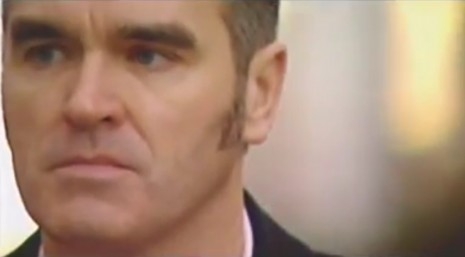
From 2003, The Importance of Being Morrissey is the most revealing and quotable documentary made on Steven Patrick Morrissey.
In it he compares meat eating to child abuse; attacks the Royal Family and Tony Blair; responds to the accusations of racism; and we hear about his depression. There’s also some great concert footage, and a mixed selection of celebrity fans who explain their fervor for the Mozz: J K Rowling identifies with Morrissey in a darkened room, though still won’t give up bacon; former neighbor, playwright Alan Bennett couldn’t say his name, but thinks he has an interesting face with a story to tell; Will Self likes his muscular intellect; Noel Gallagher thinks he is the greatest ever lyricist; Chrissie Hynde thinks people who don’t get him can go fuck themselves; Bono thinks he’s funny; and Nancy Sinatra says he’s a great hugger.
Oki has put together a collection of Joy Division mashups with female singers like Cher, Katy Perry and Beyonce called Divas Of Joy Division which you can download for free here.
I’m a massive Joy Division fan so I approached Oki’s concept with trepidation, but was surprised to find that some of the tracks have an eerily appealing vibe.
This particular cut which combines “She’s Lost Control” with Nancy Sinatra singing “Bang, Bang” took a couple of listens before it got its hooks in me. But it did.
Sinatra’s flanged vocal not sitting right in the pocket (which is wobbly as it is) creates the unsettling atmosphere of a dark drug experience which seems perfect for songs about madness and homicide.
I mashed up the mashup with some video so you’d have something to look at.
David McCallum has long been a TV icon, since his early days as the pin-up sidekick Illya Kuryakin to Robert Vaughn’s Napoleon Solo in The Man from U.N.C.L.E., through the bizarre Sapphire and Steel to “Ducky” Mallard in today’s NCIS. What’s perhaps less known about the blonde-haired Glaswegian, is the fact he is a classically trained musician, a career McCallum nearly followed, as he explained to 16 magazine back in 1966:
The wonder was that David ever became an actor at all—for he was trained to be a musician from the age of four, playing the oboe with classic clarity. An appreciation of music ran deep in the McCallum family. David’s father, a famous violinist and leader of the London Philharmonic Orchestra, was taught classical music at his mother’s knee.
The McCallums came from a little Scottish mining village, Kilsyth in Stirlingshire, where David’s paternal grandfather was the village grocer. It was a deeply religious community, and David’s grandmother hoped her son would learn the harp. But no one there could play the instrument, so young David Fotheringham McCallum was taught violin instead. And his own son, David Keith McCallum—born on September 19, 1933, at 24 Kersland Street, Glasgow—inherited this musical tradition.
When the family moved to Bracknell Gardens, Hampstead, in London, David went to University College School, and musical evenings became a feature of this childhood. He was taught violin and piano, but it was the oboe that he mastered. However, David secretly harbored a longing to become an actor, so when one of his uncles needed an oboe, David offered his—cheap!—and started out on his acting career. Though he laughingly calls the oboe “...an ill wind nobody blows good,” David still admits, “I always knew that I could turn to music if I failed as an actor.”
Like many sixties stars, McCallum was given a recording contract, and between 1966 and 1968, released four albums on Capitol Records - Music…A Part Of Me, Music…A Bit More Of Me, Music…It’s Happening Now!, and McCallum. However, rather than singing his way through these discs McCallum, together with producer David Axelrod, created a blend of oboe, French horn, and strings with guitar and drums, for musical interpretations of hits of the day. These included “I Can’t Get No Satisfaction”, “Downtown”, “Louie, Louie”, “I Can’t Control Myself” and his own compositions, “Far Away Blue”, “Isn’t It Wonderful?” and “It Won’t Be Wrong”.
The best known McCallum tracks today are “The Edge,” which was sampled by Dr. Dre as the intro and riff to the track “The Next Episode,” and “House of Mirrors,” sampled by DJ Shadow for “Dark Days”.
McCallum did sing with Nancy Sinatra in The Take Me to Your Leader Affair episode of The Man from U.N.C.L.E.
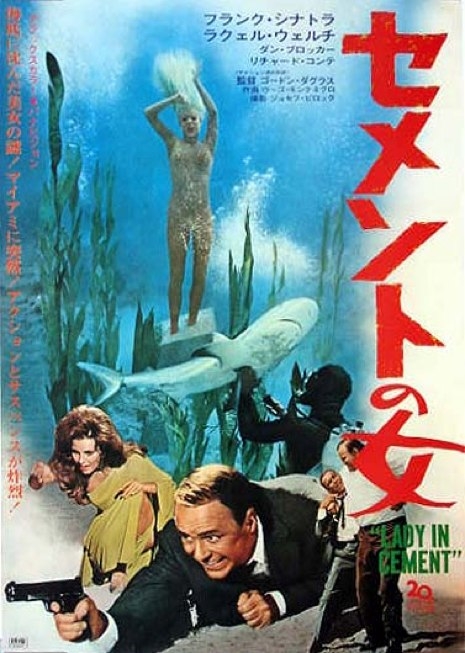
“Tony Rome” was Frank Sinatra’s hard-boiled detective alter-ego in two films, 1967’s Tony Rome and its 1968 sequel, The Lady in Cement. Bucking the trend of Bond and the sub-Bonds like Our Man Flint (with James Coburn) and the “Matt Helm” series starring his Rat Pack buddy, Dean Martin, the “Tony Rome” movies were much more noirish in their approach, although, natch, this being Ol’ Blue Eyes, there were silly, sexist and “in joke” elements aplenty in the films.
Sinatra was directed in both films by Gordon Douglas (who directed him in Robin and the 7 Hoods) and surrounded by A-list cast members Raquel Welch, Bonanza’s Dan Blocker, Jill St. John, Gena Rowlands and sexy Sue Lyon (who played the title role in Stanley Kubrick’s Lolita).
I have always particularly liked the jaunty theme song to Tony Rome, written and produced by Lee Hazelwood and sung by Nancy Sinatra, you can hear it here.
Hugo Montenegro provided the groovy soundtrack to Lady in Cement, here’s the trailer:
Speedway is a typical lightweight Elvis romp from the ‘60s co-starring Nancy Sinatra who plays a sexy IRS agent who comes to audit racecar driver Elvis, whose business manager (Bill Bixby) is an idiot addicted to gambling. She succumbs to the King’s charms, natch. There are songs and a plucky homeless family living in their car. That’s the plot in a nutshell.
Carl Ballantine from McHale’s Navy and Gale Gordon, best known as Mr. Mooney from The Lucy Show are also part of the cast. One production number, for a song called He’s Your Uncle, Not Your Dad, takes place in an IRS office! It’s perfectly dreadful, if entertaining, drivel, but it does have two great numbers in it. Elvis does a rocker called Let Yourself Go that was released as a single, but flopped, which is a shame, because it’s one of my top favorite Elvis tracks. And Nancy Sinatra performs a swingin’ little number called Your Groovy Self, complete with minimalist mod choreography, It’s one of her best songs, certainly one of her best performances on film and the sole track by anyone other than Elvis to appear on the soundtrack album to one of his movies.
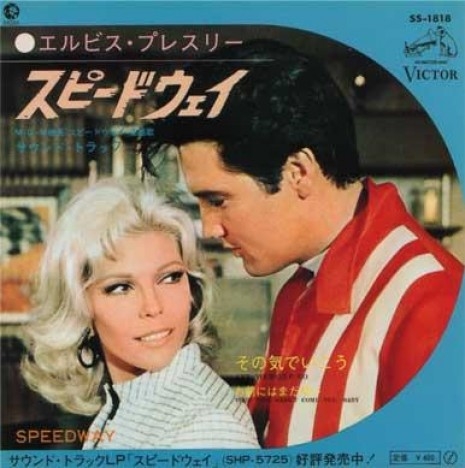
Two fun facts: First, Speedway was originally written for Sonny and Cher! Second, take a look at the nightclub: Quentin Tarrentino’s set design for Jack Rabbit Slim’s in Pulp Fiction was inspired by the decor of the Hangout, where Speedway’s in-crowd mix in a racecar booth ‘60s disco splendor.
The plot device that gets Nancy to sing is when Carl Ballantine, the maitre’d of the Hangout shines a spotlight on her, and for some arbitrary Elvis-movie logic, she has to “get up and do something.” This is what she does: