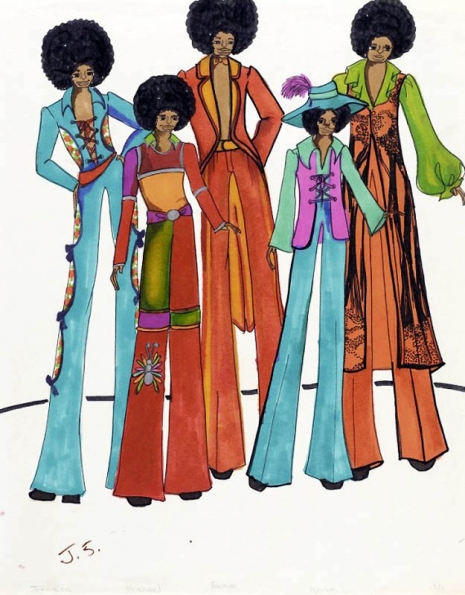
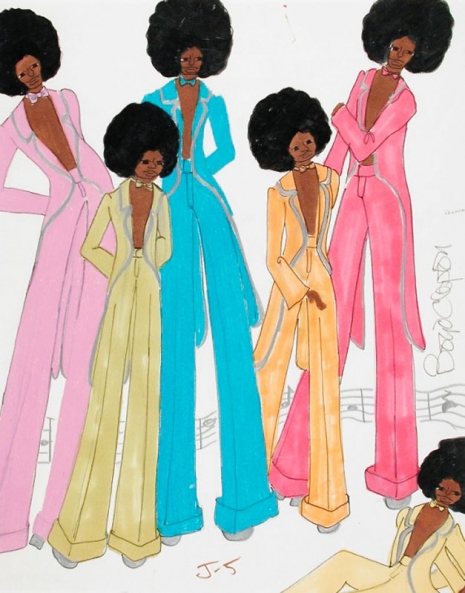
A sketch of The Jackson 5 in clothes envisioned and made for the band by designer Boyd Clopton.
In addition to creating unique stagewear and costumes for acts like The Jackson 5, Stevie Wonder, the Supremes and Aretha Franklin (among many, many others), Boyd Clopton was also a talented painter whose personal works have been known to fetch as much as twenty grand when they become available.
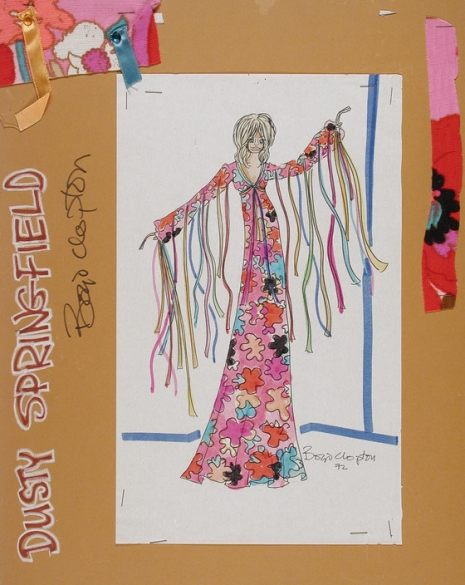
A resident of Venice Beach during the glorious time it was still very much a mecca for bohemian beat poets, musicians, and creatives, Clopton lived there for three decades starting sometime in 1960 when he was in his late 20s. In the early 70s, Clopton’s wildly groovy designs were being worn almost exclusively by The Jackson 5 during their live shows, television appearances, and photo shoots. Aretha Franklin was also a fan of Clopton’s duds and would make it a point to seek him out whenever she was in Los Angeles (as mentioned in a 1974 interview published in Ebony magazine). Like other designers, Clopton would sketch out his concept clothing on paper for his clients. Unfortunately, Clopton’s career was cut short by his untimely death in 1989 at the age of 55. Single articles of clothing designed by Clopton have sold for hundreds and even thousands of dollars in auctions as have his sketches—many which reside in an archive maintained by the Los Angeles County Museum of Art.
Below, some examples of Clopton’s fantastic sketches featuring his famous muses, as well as a few shots of The Jackson 5 wearing his outrageous outfits in real life. Keep it funky, now.
A sketch of Marlon Jackson of The Jackson 5 in one of Clopton’s designs.
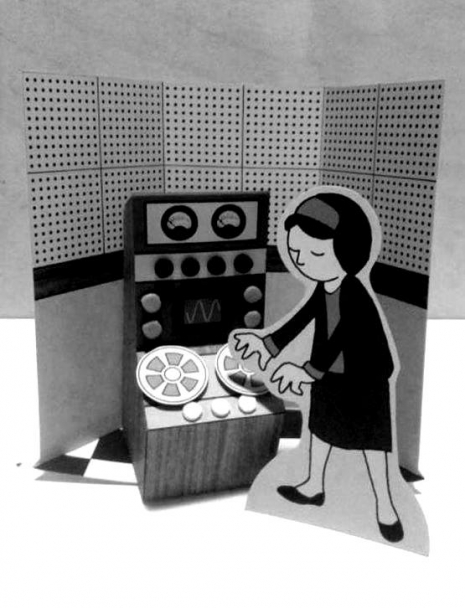
I normally don’t care about papercraft objects, I guess because I wouldn’t know exactly how to use or display them. They seem so fragile to me. That was until I saw this adorable Delia Derbyshire paper diorama card featured via a friend’s Facebook page. It would make a perfect gift for someone who’s a fan of Derbyshire. It looks sturdy, too!
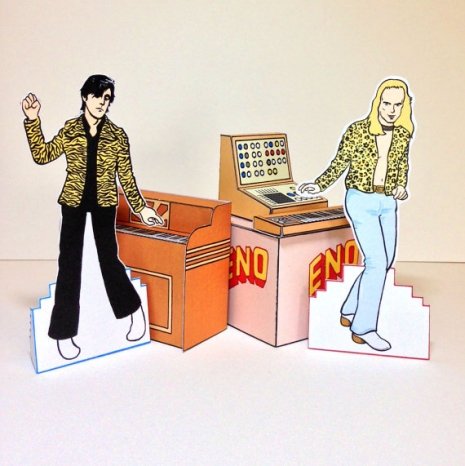
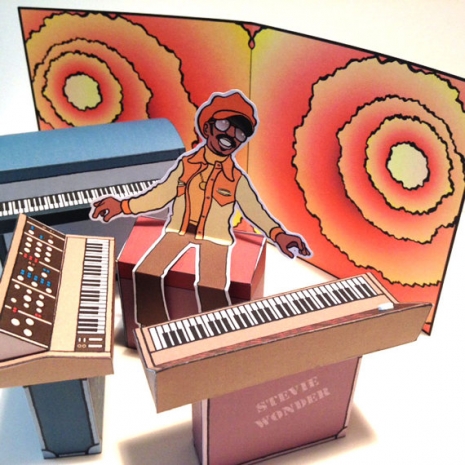
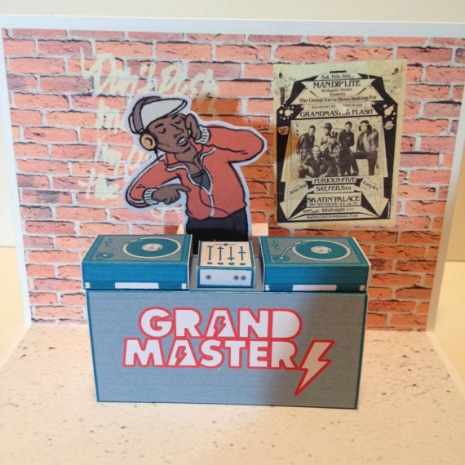
Well, It piqued my interest and I discovered they’re made by Etsy shop HeyKidsRocknRoll. Not only is there one of Delia Derbyshire but pop-up cards of Roxy Music, Grandmaster Flash, De La Soul, Stevie Wonder, Run-D.M.C., Raymond Scott and Hank Williams, too.
Sadly, it looks like someone has already purchased the one of Derbyshire. But I’m sure if you contact the Etsy shop directly and inquire, more could possibly be made.
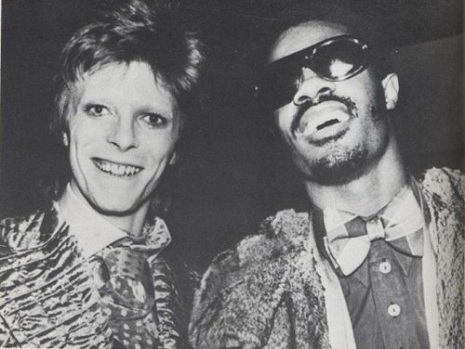
Getting it or not getting it to varying degrees are Kate Bush, Stevie Wonder, David Bowie, Cliff Richard, Steve Harley, Mick Taylor, Peter Gabriel, Paul Cook, John Lydon, Meatloaf, and a surprisingly astute young Leif Garrett putting in their two cents on the topic of “Punk.”
According to the caption on YouTube, these comments aired in December 1979 on a program called Countdown on a specific episode called “End Of the Decade.” Presumably this is something from the archives of Australian television. It looks like an editor’s raw “selects” in the formulation seen here.
“You wanna snort, Steve? A toot? It’s goin’ round.”
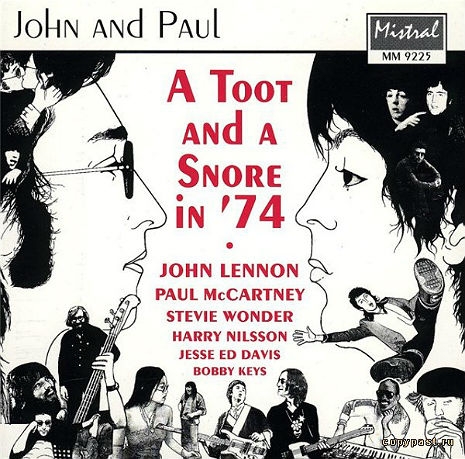
With the recent reunion of Ringo Starr and Paul McCartney on the Grammy Awards, I was reminded of A Toot and a Snore in ‘74 a bootleg album of the sole recording session that John Lennon and Paul McCartney participated in after the break-up of The Beatles.
Lennon, who was in his “lost weekend” phase of drinking and drugging—and living with May Pang in Los Angeles—was producing Harry Nilsson’s Pussy Cats album at Burbank Studios. On the first night of the sessions, March 28, 1974, Paul and Linda McCartney showed up. Also present were Stevie Wonder, Harry Nilsson, Jesse Ed Davis, May Pang, saxophonist Bobby Keys and record producer Ed Freeman (who had been working with Don McLean in the next door studio).
There was a bit of a “convivial” scene going on, as one might gather from the bootleg’s title. McCartney later remarked that the “session was hazy… for a number of reasons.”
In his 2006 biography, McCartney, Christopher Sandford described the situation:
“The room froze when McCartney walked in, and remained perfectly silent until Lennon said, ‘Valiant Paul McCartney, I presume?’ McCartney responded: ‘Sir Jasper Lennon, I presume?’ (Valiant Paul and Sir Jasper were characters played by the two, in a televised Christmas play early in the Beatles’s career). McCartney extended a hand, Lennon shook it, and the mood was pleasant but subdued, cordial but not especially warm, at least initially.”
May Pang’s 1983 book, Loving John offered more detail:
Our first session was scheduled for the day after we moved in and it went beautifully- so beautifully that it only took four hours to lay down the basic rhythm track and vocal to “Subterranean Homesick Blues”. When the tracks were finished, the musicians did not want to go home, so they hung out, jamming with each other or practicing their own licks. At midnight, however Keith [Moon] and Ringo left. It was time for them to hit the town.
The jam continued for another half hour, then visitors arrived. The visitors were Paul and Linda McCartney.
Paul headed straight for John. “Hello John,” he said eagerly.
John however was a study in casualness.
“How are you Paul?” he replied softly.
“Fine, how about you?”
“Okay.”
“Hi duckie,” Linda said to John, kissing him on the cheek.
“Hello Linda.”
John and Paul made small talk as if they had been speaking on the phone two or three times a day and had spoken a few hours earlier. It was one of the most casual conversations I had ever heard. They couldn’t be the two men who not only had been trading vicious attacks with each other in public but also had squadrons of lawyers poised in battle against each other while they carved up their multimillion-dollar empire. They looked like any old pair of friends having a pleasant low-key reunion.
The small talk continued; then Paul, like a man possessed, suddenly bounced up and headed straight for Ringo’s drum kit and began to bash the drums.
“Let’s play!” he exclaimed. Linda immediately headed for the organ. “Let’s play.” She echoed. They couldn’t be stopped.
John strapped on his guitar and began to play “Midnight Special,” one of the numbers the Beatles used to jam on when they first began to record together. So did Jesse Ed Davis and Danny “Kootch” Kortchmar, while Harry sang along.
Then we had another visitor, Stevie Wonder, who was also recording at the Record Plant.
“Stevie, Paul is here, and we’re going to jam,” John called out.
“Okay,” said Stevie. He went to the electric piano.
“Let’s record it,” said John.
“Yeah,” Paul agreed. John suddenly became very enthusiastic.
“We need a bass player,” he told the startled producer in the control booth of the studio next to ours. “Paul and I are jammin’ together.”
“I play bass!” the producer exclaimed. He dashed from his session to join ours.
“Fung Yee, I want you to play,” John told me. “Grab a tambourine.” I got up and joined the musicians
“Let it rip,” said John
That was the first time John and Paul had played together since Abbey Road in 1969, and it sounded wonderful. The team of Lennon and McCartney had been reunited with amazing ease. After they’d run down the song, John turned to Paul and said “Could you please tell your organist [Linda] to turn down the volume? I can’t hear Mr. Wonder”
John and Paul played it again, and it sounded even better. They made joyous music together that night. That was the only time John and Paul backed by Stevie Wonder and Harry Nilsson played together after the break- up.
I’m supposing that May Pang wrote the above from memory, because what’s on the actual tapes is not quite the stellar music a line-up such as this one might be expected to produce: It’s basically just a drunk, coked-up jam session, yet still a drunk, coked-up jam session of great historical significance.
You can read a transcript at Bootleg Zone. To be perfectly honest, it’s easier than listening to it!
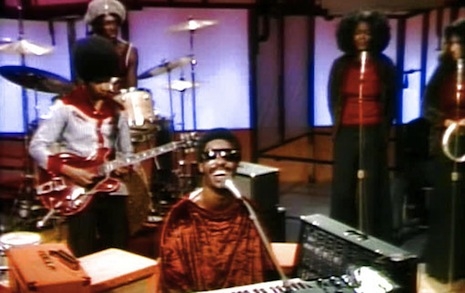
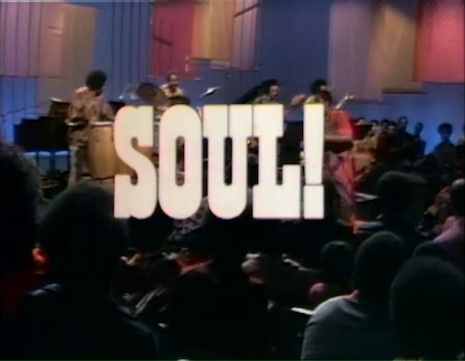
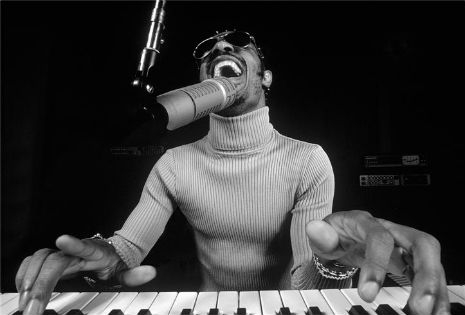
Oh boy. It just doesn’t get much better than this. A few days ago I brought you some video of The Rolling Stones on The Dick Cavett Show in 1972. While he didn’t appear in the footage, Stevie Wonder was the opening act for the Stones on that tour. Today I have a spectacular full hour of Stevie at the height of his powers playing on the PBS show Soul! later the same year with his band Wonderlove.
The episode was broadcast on December 20, 1972, just two months after his landmark album Talking Book was released. One month later, “Supersitious” would be the number one song in the country. As you watch this footage, try to wrap your brain around the fact that the man was all of 22 years old.
From all indications Soul! was a wonderful show indeed. Produced by Ellis Haizlip, it ran from 1968 to 1973 and featured a wide array of incredible black performers and personalities, including Al Green, Kool and the Gang, the Staple Singers, Richie Havens, Earth, Wind, and Fire, Herbie Hancock, and Gladys Knight and the Pips as well as fascinating individuals like James Baldwin, Imamu Amiri Baraka, Louis Farrakhan, Nikki Giovanni, James Earl Jones, Melvin Van Peebles, and Stokely Carmichael. On occasion people like Curtis Mayfield or Wilson Pickett would take over the hosting duties. Nobody can say they put on a dull program.
There’s so much astounding stuff in this video. Stevie sings a chunk on “My Cherie Amour” in Italian, while “You and I” is accompanied by a fully choreographed ballet. Stevie covers Marvin Gaye’s “What’s Going On,” Bob Dylan’s “Blowin’ in the Wind,” and the Temptations’ “Papa Was a Rollin’ Stone”—on this last number, Stevie uses a vocoder to arresting effect. There’s a brief, amusing interview with host Gerry Bledsoe. Like any good show, things heat up steadily, and by the end things are well-nigh out of control, up to and including the kaleidoscopic video effects (which actually make use of a kaleidoscope).
As is so often the case, the instructions are simple: just hit play—it’ll improve your day.
Track listing:
For Once in My Life
If You Really Love Me
Superwoman (Where Were You When I Needed You)
You and I (We Can Conquer the World)
What’s Going On/My Cherie Amour
Blowin’ in the Wind
With a Child’s Heart
Love Having You Around
Signed, Sealed, Delivered I’m Yours/Papa Was a Rollin’ Stone
Superstition
Maybe Your Baby/Superstition Outro
Uptight (Everything’s Alright)
During his concert Sunday in Quebec City, Stevie Wonder declared he would not be playing Florida again until the abolition of “Stand Your Ground,” the law that allowed George Zimmerman to go free after murdering Trayvon Martin. His impassioned speech to the crowd:
The truth is that—for those of you who’ve lost in the battle for justice, wherever that fits in any part of the world—we can’t bring them back. What we can do is we can let our voices be heard. And we can vote in our various countries throughout the world for change and equality for everybody. That’s what I know we can do.
And I know I’m not everybody, I’m just one person. I’m a human being. And for the gift that God has given me, and from whatever I mean, I decided today that until the “Stand Your Ground” law is abolished in Florida, I will never perform there again. As a matter of fact, wherever I find that law exists, I will not perform in that state or in that part of the world.
Because what I do know is that people know that my heart is of love for everyone. When I say everyone I mean everyone. As I said earlier, you can’t just talk about it, you have to be about it. We can make change by coming together for the spirit of unity. Not in destruction, but in the perpetuation of life itself.
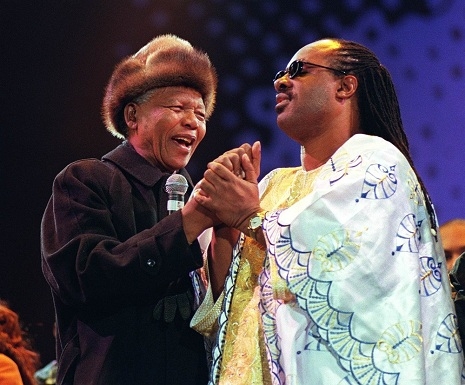
Wonder is no stranger to artistic boycotts. He was a part of a wave of musicians who refused to play South Africa’s Sun City resort to protest apartheid, even penning a song, “It’s Wrong (Apartheid)” to raise awareness. It’s possible Wonder’s declaration could spark a trend of boycotts to shame Florida into overturning its draconian laws.
Of course, boycotts today don’t really have the same cultural context they once did for Apartheid. Last November, Wonder himself played a concert for Israeli Defense Forces, in spite of emphatic demands from activists for artists to boycott Israel in protest of the Palestinian occupation. Overwhelming international public sentiment opposed Apartheid, which was easily identified as cut and dry racial segregation, but for the west, the topic of Israel is mired in Islamophobia, and is much more difficult to organize around. Likewise, we have a lot of paranoid, reactionary gun nuts in this country, and artists might argue that playing Florida isn’t an endorsement of a single law. Regardless, I do think famous spokespeople (for better or worse) help steer the national dialogue, and we need to do everything we can to keep focus on the abolition of the “Stand Your Ground” law.
In 1976 Stevie Wonder’s record company came up with a pretty hip way to promote his new album Songs In The Key Of Life. They outfitted a bus in Sydney, Australia with a sound system and played the album to the delight (and in some cases, consternation) of the bus passengers. They called it the “Wonderbus.”
Classic—absolutely smokin’—set from Stevie Wonder at the height of his powers in 1974, on the German TV show Musikladen.
The quality here is outstanding and in this age of pressing a button to make music, the musicianship on display is all the more impressive.
Song list:
1. Jam
2. Contusion
3. Higher Ground
4. Don’t You Worry ‘Bout A Thing
5. I Can See The Sun In Late December
6. He’s Misstra Know-It-All
7. Living For The City
8. Superstition
The whole show is great, but by the time they’re playing “Superstition,” Wonder and his band achieves lift-off.
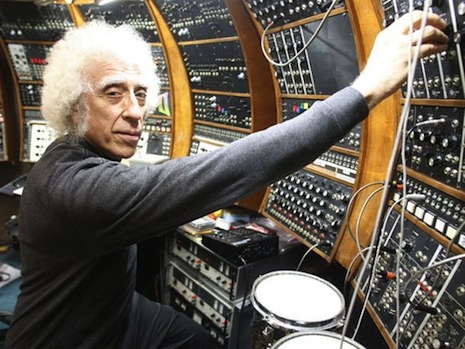
TONTO (an acronym for The Original New Timbral Orchestra) is a massive electronic music production center built by Malcolm Cecil in the late 60’s and used on the two Tonto’s Expanding Head Band records, but most notably on the great early 70’s records by Stevie Wonder. Here’s a wonderful new clip of Cecil describing and demonstrating the mighty beast’s magical powers. Look, learn and (if you’re me) salivate.
These are just stunning! Stunning! I certainly wouldn’t mind owning one of those fantastic Zappas. From the artist Lisa Brawn:
I have been experimenting with figurative woodcuts for almost twenty years since being introduced to the medium by printmakers at the Alberta College of Art and Design. Recently, I have been wrestling with a new challenge: five truckloads of salvaged century-old rough Douglas fir beams from the restoration of the Alberta Block in Calgary and from the dismantling of grain elevators. This wood is very interesting in its history and also in that it is oddly shaped. Unlike traditional woodcut material such as cherry or walnut, the material is ornery. There are holes and knots and gouges and rusty nails sticking out the sides.
To find suitably rustic and rugged subjects, I have been referencing popular culture personas and archetypes from 1920s silent film cowboys to 1970s tough guys. I have also been through the Glenbow Museum archives for horse rustlers, bootleggers, informants, and loiterers in turn-of-the-century RCMP mug shots for my Quién es más macho series. Cowgirl trick riders and cowboy yodelers in their spectacular ensembles from the 1940s led to my Honky-Tonkin, Honey, Baby series. Inspired by a recent trip to Coney Island, I have been exploring vintage circus culture and am currently working on a series of sideshow portraits including Zip the Pinhead and JoJo the Dog-faced Boy. There is also an ongoing series of iconic gender archetypes, antiheroes and divas, which includes such portraits as Sophia Loren, Maria Callas, Edith Piaf, Jackie Onassis, Steve McQueen, and Clint Eastwood.






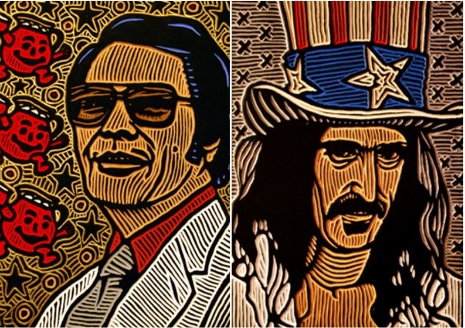
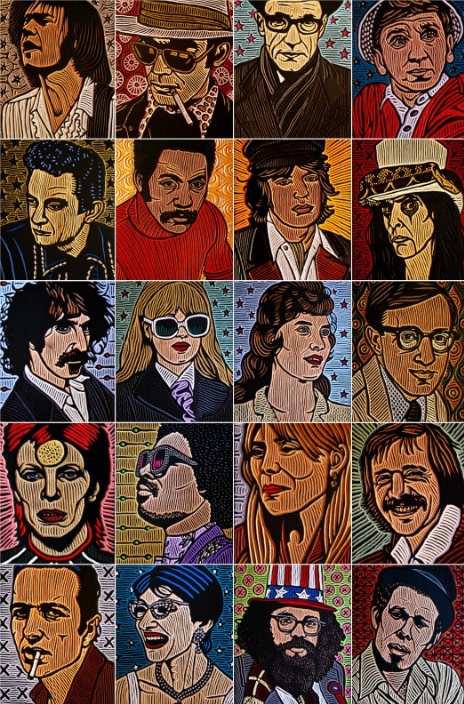
 I have been experimenting with figurative woodcuts for almost twenty years since being introduced to the medium by printmakers at the Alberta College of Art and Design. Recently, I have been wrestling with a new challenge: five truckloads of salvaged century-old rough Douglas fir beams from the restoration of the Alberta Block in Calgary and from the dismantling of grain elevators. This wood is very interesting in its history and also in that it is oddly shaped. Unlike traditional woodcut material such as cherry or walnut, the material is ornery. There are holes and knots and gouges and rusty nails sticking out the sides.