Angela Jackson thought she wouldn’t be seen at the back of the packed hall. She wasn’t sure why she thought this, but felt, knew something was going to happen and she didn’t want anyone (anything) to see her. Angela wasn’t sure why she had come to this spiritualist meeting, it was just something she thought would be fun, but now she was here she felt she was meant to be here.
Angela thought about her father Charlie, how once as a child she had dreamt that her father would be dead before Christmas. A month later Charlie was diagnosed with cancer and died soon after. If dreams do come true, then maybe nightmares also come true?
The whisper of voices stopped as a woman appeared on the stage. Angela hunched in her seat. The woman looked like she was sleepwalking, but her eyes were open, scanning the audience, looking for someone (something). Angela felt the woman looking, staring at her. How can she see me at the back? She squirmed. But the woman stared at Angela and began to sing:
Welcome to my world..
The room felt cold. No one laughed, no one coughed, no one whispered. The psychic continued:
Won’t you come on in…?
It should have been funny but still no one laughed. It seemed everyone was holding their breath. Angela knew the song—Jim Reeves “Welcome to My World,” it had been one of her father’s favorite songs.
Miracles I guess, Still happen now and then….
Angela looked up at the psychic on the stage, her mouth opening closing singing the words. As soon as their eyes met the woman stopped and said:
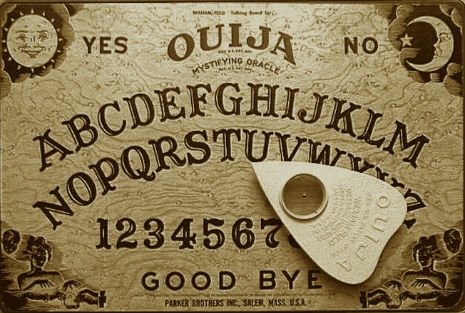
“Your dad has a warning for you. You’re thinking about using a Ouija board, but don’t. No good will come from it.”
It was true—Angela had been thinking of using a Ouija board, she knew that it was “risky because there was no knowing who you may connect with. Demons and evil spirits could get through too.” And that he father maybe knew this and was worried about “demons and evil spirits.” Maybe. Despite his warnings, Angela couldn’t get the idea out of her head—she developed a fascination with Ouija board. An idea once sown grows.
Angela from Kilbarchan, Renfrewshire, Scotland, was telling her story to a reporter from the Sunday People newspaper. She sat at home, a cup of tea in her hand, thinking back to what had happened and the horrific events that followed.
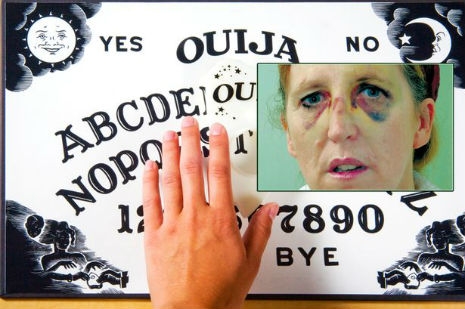
One night, two of her neighbors had invited Angela over for drinks. The evening started well, but then the conversation shifted, moved, onto Angela’s favorite subject—the afterlife, and that’s when someone (who?) suggested they try the Ouija board.
“They’d obviously done it before because they pulled out a stack of homemade cards with letters of the alphabet and numbers written on them.”
Angela described to the newspaper how the room was lit by flickering candlelight and the three of them sat cross-legged on cushions around a make-shift Ouija board—which all sounds like the opening scene to a Hammer Horror movie, but let’s continue:
“My heart thudded with excitement as we all placed our index fingers lightly on the bottom of an upturned whisky glass they’d placed on the table.
“It began to pull in every direction. ‘Who is it you want to speak too?’ Robert, my neighbour, asked.
“The glass started moving towards the letters, spelling out… A-N-G-E-L-A.
“The spirit wanted to speak to me. But then it spelt out, ‘Die bitch’. ‘That’s not funny,’ I said. But Robert said, ‘Angela, we didn’t do anything.’ He snatched his finger back from the glass and we all shrieked as the living room door slammed shut on its own.
“My voice quivering, I asked, ‘Who are you?’ With only my finger on the glass it moved faster. ‘I was murdered,’ it scrawled. ‘Just like you’re going to be.’”
Angela asked again: “Who are you?”
This time the glass moved quickly spelling out the word: “S-A-T-A-N.” (Was Satan “murdered”? I wonder…)
Angela screamed, then shouted, “I’m not scared—to hell with you!”
The tumbler flew from the Ouija board and smashed against the living room wall. (Of course, it did…)
One of the neighbors jumped up and turned on the lights. “We should never do this again,” he said. There was a sense of fear, panic, as the candles were quickly snuffed out, thin black fingers of smoke reached up.
Though Angela was terrified, she needed to know more—she couldn’t stop now, she had to find out what was going to happen—she was the one who was going to be “murdered,” or so she believed. It preyed on her mind, festered, she had to know. Eventually they (who?) did try again, but this time there was no answer, no message, nothing. But still Angela couldn’t stop thinking about it. (Cue dramatic music…)
“Then one night I woke screaming and sweating from a terrible nightmare. I’d dreamt I was being attacked by a man carrying a hammer.
“That’s when I knew things had gone too far. I was scaring myself to death. I’m not doing the Ouija board any more, I vowed.”
This was later, after the neighbors (what were their names?) had moved away, when Angela had no one to share her sense of foreboding, her fears. Everytime she went out she felt people staring at her, watching her, waiting.
Then one night, leaving her home to visit her 28-year-old son, Darren, who lived nearby, Angela locked the front door and walked down the cold concrete stairwell steps to the street below. As she left the building, talking to her son on a cell phone, from the corner of her eye she sensed someone move towards her.
“From behind me I heard a voice. ‘Die bitch,’ it growled. I froze at the sound of those words. Shaking with fear, I turned to see a man in a white T-shirt, emerging from the shadows wielding a claw hammer.
“I screamed as he brought the weapon down on my head with a sickening thud. He hit me again and warm blood began trickling down my face.
“I couldn’t see where my attacker was I just wanted to get away. Drenched in blood, I made it to the front door and then collapsed.
“Waking in hospital I felt confused and groggy. ‘You were attacked,’ a doctor explained. ‘You’ve suffered a fractured skull.’”
Angela told the police what she remembered, but her attacker was never found.
Over the following months, she lived in fear that this deranged man would return “and finish the job, just as the spirit had warned through the Ouija board.”
But this never happened. Six years on, Angela is still scared that “the spirit’s prediction will one day come true.”
“If I’d listened to Dad’s warnings through the psychic maybe none of this would’ve happened. But now I’m warning all of you - never mess with Ouija boards. You don’t know what evil lurks in the afterlife.”
It’s a good yarn, but is any of it true? It appears to me, we have three separate events that have been drawn together to create one personal narrative, which may (or may not) be true. Angela is a woman who has suffered various personal and private tragedies in her life (some of which have been documented in various newspapers), but my concern is not with her, but with the veracity of her tale and how it has been reported.
For example, when Angela was attacked in January 2008, she made “claims to know her attacker and that she has been involved in a financial dispute with the man.” If she knew her attacker, then why were there no arrests? If there was an arrest, then what happened next? There is no paper trail of news stories reporting what did happen next, just strange, scurrilous, rather serious and possibly libellous allegations made on certain blogs. This inability to ask pertinent questions is all part of that journalistic amnesia from which news reportage appears to suffer with growing frequency.
This is especially true in regard of the two papers reporting these stories as the Sunday People, who covered the Ouija board story, and the Daily Record, who reported the attack, are owned by the same company. Did they not carry-out any background research or delve further into the story?
Next, who were Angela’s neighbors who invited her in for a seance? What were their names? Where did they go? Was the tumbler smashed against a wall? Did the glass spell out “Satan”? Was murder threatened? Why is there no corroboration of these reported events? Surely it would not have been too difficult to ask other neighbors as to who these mysterious people are? Or, even check with the electoral register as to who lived in the house at the time?
Then of course, we are not told where this original psychic meeting held? Who organized it? When? What are other people’s memories of it? Who was the psychic who sang the Jim Reeves number? It’s all great atmospheric detail but little more than scene-setting without any corroboration.
Indeed, the story leaves so many questions unanswered that it suggests the whole tale is probably bogus. And if it is bogus then a bigger and possibly better mystery becomes visible—Why would anyone tell such a tale? And why publish it?
Via the Sunday People