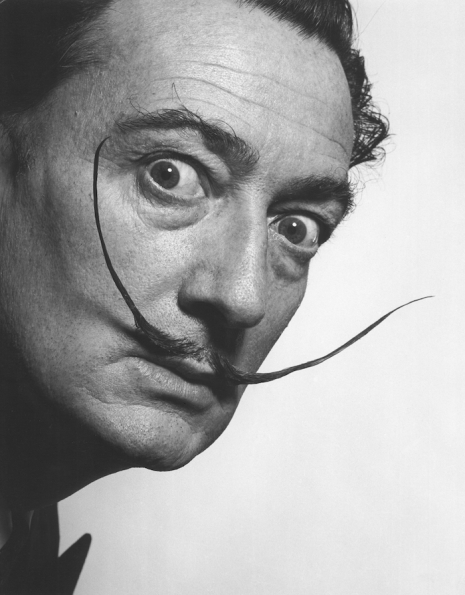


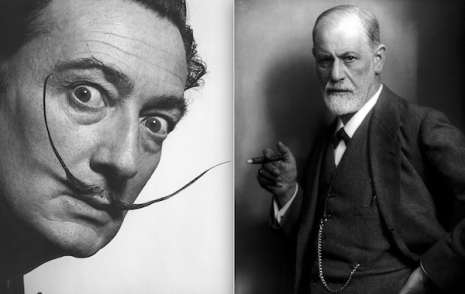
Before Salvador Dali met Sigmund Freud during the summer of 1938 in London, the great Surrealist artist had tried unsuccessfully on several occasions to meet the revered psychoanalyst at his consulting rooms in Vienna. Dali had lacked the confidence to knock unannounced on Freud’s door and instead had wandered the cobbled strasse holding “long and exhaustive imaginary conversations” with his idol. He had also fantasised about bringing Freud back arm-in-arm to his room at the Hotel Sacher, imagining the great psychoanalyst “clinging to the curtains” while he babbled freely about his dreams, his sexuality, and his fears.
Dali had spent his teens and early twenties reading Freud‘s works on the unconscious, on sexuality and The Interpretation of Dreams. His inability to meet the psychoanalyst in Vienna suggests Dali was in some way terrified of Freud, as if this grand examiner of human behavior was capable of seeing straight through him like a believer might feel when coming face-to-face with God.
When Albert Einstein met Freud in 1927, it was a meeting of equals. Two men who were pioneers in their chosen professions yet who had no understanding of what the other did or why it was important. Einstein later said Freud knew as much about physics as he did about psychoanalysis and claimed he could not understand the point of analysis at all. When offered to be psychoanalyzed by the great headshrinker, Einstein had refused stating he preferred to remain in “darkness” about his own motivations.
Freud fled to London from Vienna after Germany’s annexation of Austria in March 1938. He had heard of how the Nazis had burned his books, but dismissed the seriousness of their actions by saying:
What progress we are making. In the Middle Ages they would have burned me. Now, they are content with burning my books.
His nonchalance was bluster. When there was a sudden rise in anti-semitic attacks in Vienna, Freud quickly made preparations to flee the country. He arrived in London in April 1938.
Because of their interest in dreams and the unconscious, it may have seemed obvious that Dali and Freud would have made natural friends, but Freud’s taste in art was strictly traditional and he was wary of the Surrealists after a run-in with André Breton in 1921.
Breton was deeply enamored with Freud’s work and had been inspired to develop a technique of “spontaneous” writing to give free expression to unconscious thoughts and desires. Unlike Dali, Breton had the confidence to turn-up unannounced at Freud’s door and thrust his genius on the great man. Freud was not impressed. His lack of enthusiasm caused Breton to later dismiss Freud as nothing more than a “general practitioner…an old man without elegance” working away in his shabby consulting rooms.
Despite this, Breton still credited Freud with pioneering work into the unconscious imagination in his Surrealist manifesto in 1924:
Freud very rightly brought his critical faculties to bear upon the dream. It is, in fact, inadmissible that this considerable portion of psychic activity (since, at least from man’s birth until his death, thought offers no solution of continuity, the sum of the moments of the dream, from the point of view of time, and taking into consideration only the time of pure dreaming, that is the dreams of sleep, is not inferior to the sum of the moments of reality, or, to be more precisely limiting, the moments of waking) has still today been so grossly neglected.
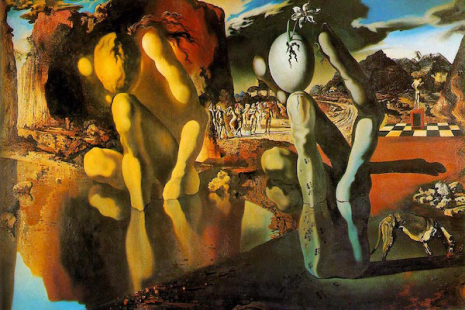
Dali did not have a manifesto, but he did have a painting The Metamorphosis of Narcissus which he wanted to show Freud. The meeting between the two men was organized by Austrian writer Stefan Zweig, who was also exiled in London.
Dali was just thirty-four. Freud, nearing the end of his life, was eighty-one. Dali arrived with his wife Gala and the art collector Edward James, who carried The Metamorphosis of Narcissus under his arm.
Dali was intimidated by the “father figure” Freud. His conversation was nervous and stilted. Freud asked if all Spaniards looked like him? If they did, then this might explain the Spanish Civil War. Freud’s joke fell flat. Dali later wrote that he wanted to be seen “a kind of dandy of universal intellectualism,” and be treated as an equal. As if showing his credentials, he presented Freud with a magazine that contained an article he had written about paranoia. Freud barely looked at it. Trying to interest him in the article, Dali explained;
...it was not a surrealist diversion, but was really an ambitiously scientific article, and I repeated the title, pointing to it at the same time with my finger. Before his imperturbable indifference, my voice became involuntarily sharper and more insistent.
Freud just stared “with a fixity in which his whole being seemed to converge.”
Then Dali revealed his painting, to which Freud said:
...in classic paintings I look for the unconscious, but in your paintings I look for the conscious…
Dali was unsure what Freud meant and took his comment as criticism.
While small chat was exchanged between Freud, Gala and James, Dali began sketching. He suddenly saw Freud as a gastropod:
Freud’s cranium is a snail! His brain is in the form of a spiral – to be extracted with a needle!
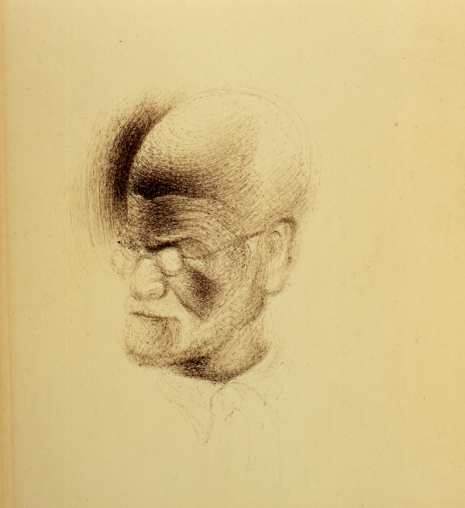
Dali’s drawing of Freud is now at the Freud Museum.
Dali thought his meeting with Freud a failure, but days later, Freud wrote Stefan Zweig:
I really have reason to thank you for the introduction which brought me yesterday’s visitors. For until then I was inclined to look upon the surrealists – who have apparently chosen me as their patron saint – as absolute (let us say 95 percent, like alcohol), cranks. That young Spaniard, however, with his candid and fanatical eyes, and his undeniable technical mastery, has made me reconsider my opinion.
Zweig never showed Freud Dali’s sketch of him, fearing the picture looked more like a skull than a snail.
Soft Self-Portrait of Salvador Dali (1969) is a made for television documentary that captured the artist in fine fettle as he delighted in performing for the camera. Dali is seen indulging in his trademark mix of showman, clown and serious artist, hammering out a tuneless miaow on a cat piano (Dali associated pianos with sex after his father left an illustrated book on the effects of venereal diseases atop the family piano as a warning to the dangers of sexual intercourse); or sowing feathers in the air, as two children follow pushing the head of a plaster rhinoceros; or, his attempt to paint the sky. Directed by Jean-Christophe Averty, with narration provided by Orson Welles.
Previously on Dangerous Minds:
At home with Salvador Dali
Salvador Dali goes to Hell: Astounding illustrations for Dante’s ‘Inferno’
Salvador Dali’s bizarre but sexy photoshoot for Playboy, 1973
Salvador Dali’s cookbook is every bit as insane as you would expect it to be
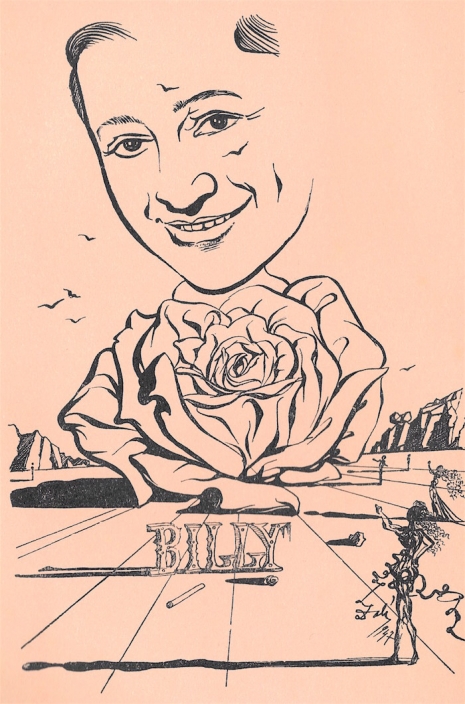
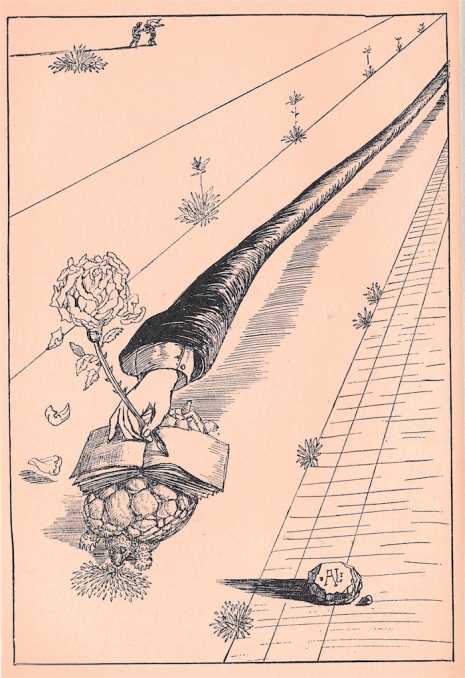
Salvador Dali’s strange and surreal illustrations for the autobiography of a Broadway legend
Salvador Dali’s signs of the Zodiac
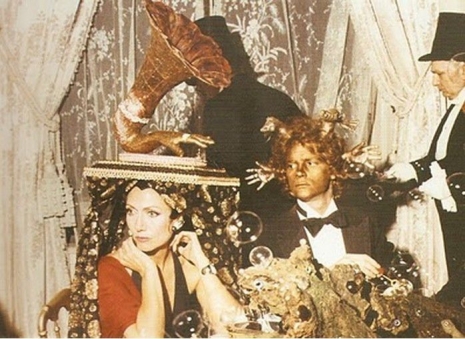
Salvador Dali: Surrealist Party from 1941
Meet the great ‘English eccentric’ who financed the Surrealists