“Art should not be a lie”: Artist Raymond Salvatore Harmon reflects on love, life and death
Life seemed good for artist Raymond Salvatore Harmon. Life is what you make it. Then his wife died. Life doesn’t seem as fair anymore. The deck seems somehow loaded. No one can ever know the grief another feels. Yet, we try to understand. But we can never understand. Grief is an ocean away from anyone’s understanding.
Harmon is one of the most distinct, original and successful artists working in Europe today. American by birth, Harmon always felt himself an outsider in his homeland. In his youth, he found sustenance as an outlier. A youthful cyberpunk reading Ballard and Gibson, learning how to hack and create, and subvert the new digital world to find a truth about himself.
From such experimentation came clarity, which led Harmon to focus on his talents as a multi-media artist. Film, painting, sculpture, performance, writing. All were part of Harmon’s distinct identity. No, not identity, talent as an artist. A talent which led Harmon to forge an unparalleled path through contemporary art.
Dangerous Minds caught up with Harmon to discuss his art, life, career, and the recent tragic loss of his wife.
DM: Tell me about your upbringing and background.
Raymond Salvatore Harmon: “I was born on that midwestern plain of Armageddon where the American industrial revolution was fought and lost. A small working-class town about an hour outside of Detroit, a vacant landscape of corn fields and rotting abandoned factories. The smell of rust in the wind on a summer day, the sound of rain against broken windowpanes and winters of bleak, endless lead-coloured skies.
“Once upon a time, the largest Goodyear Tire factory in the world polluted the town of my birth. A boiler explosion in the ‘80s was the final straw for the company to move to union-free Mexico. 30,000 people lost their jobs (including my father), and the town went practically bust after half its population moved away.
“We would skateboard in and explore this factory for years, a mammoth site of buildings with the ground so toxic the EPA forbade it to be redeveloped. A kind of amusement park only Michigan kids know.”
When did you first decide to become an artist?
RSH: “There were artists in my family, an aunt who lived on Long Island in Greenport. We would summer a stone’s throw from Orient Point and a bike ride from Montauk. Her husband was the minister of a small local church. So, art was always around me as a child.
“In particular, I had the good fortune to be in a school in Michigan that had a vocational education program with a ‘commercial art’ class that really gave me wings out of small-town America. The teacher, Dennis Turner, saw the future in the late 1980s and filled the class with Amiga computers and a first-generation Silicon Graphics workstation. We were doing GIF animation, colour cycle animation, 3D digital art, video editing and early VR at a time when no art school in the world had a digital arts program. We beta tested Disney’s in-house animation software, were on the promo list of labels like 4AD and Nettwerk, and basically existed in a bubble that was twenty years ahead of its time.
“I was really into cyberpunk sci-fi and what is now called ‘speculative fiction’ in my teens. Those writers – Gibson, Stephenson, Sterling, Shirley, Dick, Ballard, etc were a great education on what the future held for those of us who would see the 21st century. A roadmap to a future that was much more accurate to today than On the Road ever was.
“My friends and I became hackers, pirating software, bbs chat rooms, the Well, 2600 magazine, the class even had a subscription to Mondo 2000. It was a particularly formative place to be at a time when I felt disconsolate as a teen with the American Empire and all that it entails.”
What were your first adventures into art? Who inspired you?
RSH: “Although my formative years of art were based in a traditional studio/school process of learning about the masters, and embracing new technologies, where my heart as a kid lay was on the streets. Michigan had a fantastic music scene that was very much a part of who I am even today. While going to Ann Arbor and Detroit to see shows, my friends and I started doing graffiti. The immediacy of the work, the fragile moment of exposure while painting, all filled my teen anarchist heart with an adrenaline rush. I was straight edge in high school, who needed drugs when you had the pleasure of stealing cars, jumping trains, and seeing amazing live music?
“It is hard to describe the intensity of the music scene in Michigan in the early 1990s. I was seeing UK groups like 808 State, Meat Beat Manifesto, the Shamen, and the Utah Saints back to back with Rollins Band, Ministry, My Life with the Thrill Kill Kult, Helmet, Cocteau Twins, Spiritualized, the Jesus and Mary Chain, Mazzy Star – the whole of late ’80s and early ’90s indie music. Going to raves in abandoned factories, seeing astounding underground punk and noise acts at house parties. I saw Huggy Bear at a college townhouse party, grew up hanging with the dudes from Wolf Eyes, and had Mule and Laughing Hyenas play parties at houses I lived in. It was a time and a place.”
How did you develop your own style? What shaped it? Where did the ideas come from?
RSH: “After an attempt at university, I left Michigan when I was twenty. I spent a year and some change in NYC in the mid-1990s, couch surfing and being homeless, even though I had a job in the framing department of Pearl Paint. I slept on the six train for a couple weeks, riding from Chinatown to East Harlem before changing trains in the opposite direction. I left NYC, and after a few months hitchhiking to and from the West Coast, I ended up moving to Chicago and starting my real education.
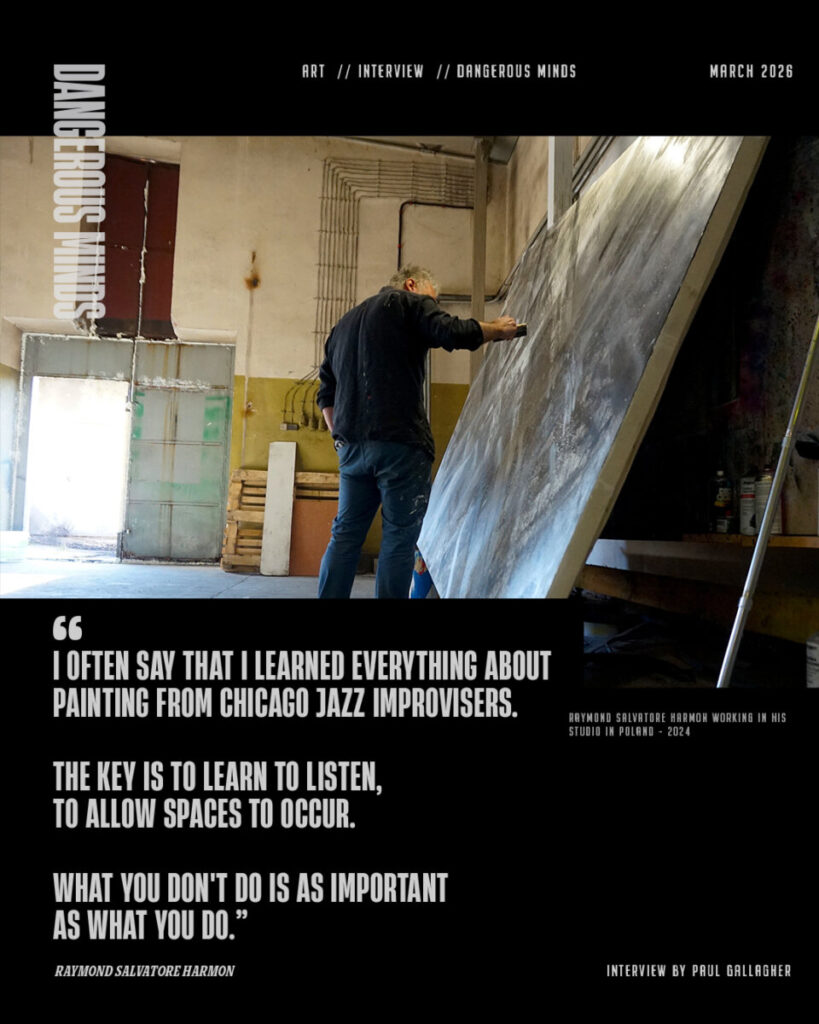
“In Chicago, I lucked into two situations that helped me develop as an artist. I started working for Bob Koester at his record store, the Jazz Record Mart, and eventually moved to his label, Delmark. There, I became a record producer working with people like Andrew Bird, Rob Mazurek, Kalaparusha, Joshua Abrams, and Jeff Parker. I often say that I learned everything about painting from Chicago jazz improvisers. The key is to learn to listen, to allow spaces to occur. What you don’t do is as important as what you do.
“At the same time, I found myself in a position of studio manager for the Polish American installation and new media artist Miroslaw Rogala. I built his installations and travelled to Europe a ton. I got to work in most of the major art institutions of northern Europe, bypassing the normal mode of gallery life, going straight to museum private views and embassy dinners. It was [while] working for him in Poland that I met my future wife.
“Between the label and Rogala’s studio, I befriended Ed Paschke, a Chicago pop artist who was a mentor to Jeff Koons. He and I could be found at Vesna’s Sunnyside tap on a Saturday night, seeing the Barrett Deems jazz trio and eating Vesna’s fantastic open buffet fried chicken, or drinking bourbon with Bob at the Get Me High, seeing Von Freeman or Ira Sullivan play.
“Ed had a studio a couple blocks from my first studio in Rogers Park, Chicago. It was a seriously dangerous area then. Open trafficking of all sorts on the streets, shootings every weekend. I would stay at my studio working until 5am to avoid the post-midnight violence.
“In Chicago, I focused my practice on experimental film. The first years I worked in 16mm and 8mm film, doing live performances using modified projectors and spliced film loops. I would stage guerrilla screenings on the sides of buildings, walked into the MCA with a set of projectors and do a performance without permission. Just do it and deal with the (almost never any) consequences. Rogala introduced me to the work of Krzysztof Wodiczko, who was a major inspiration for my outdoor guerrilla projection work.
“It was then that I was doing a side gig as a projectionist for film fests and got on the screening committee of the Chicago Underground Film Fest. Through the festival, I was able to meet Alejandro Jodorowsky, Ken Anger, Paul Morrissey, Miranda July, Animal Charm and a ton of others. Eventually, the live celluloid-based performances drifted to doing circuit-bent video, creating Frankenstein-style video devices by hacking them apart and back together in ways never intended by their designers. Glitch as a true mathematical error of processing. All hardware-driven, no computers on the performance end.
“In the last few years of Chicago, I had a sizable studio called BETA that I had filled with film and video gear. It was my first full-scale production space and afforded me the ability to do work in a broader context. I was painting as well as making film work, but the paint was still mostly private with few shows.
My last exhibition in Chicago before I left was Transcendental Territories, a show of digital pieces printed onto Lexan sign material in UV ink, mounted in light boxes. The centre of the show was an interactive video piece that tracked the viewer and altered the video live. Back then, in 2006, it was too far ahead of the digital art curve to be noticed, especially in Chicago.”
How do you create? What are the things that set you off in a particular direction?
RSH: “In 2007, freshly divorced from my first wife, I reconnected with an old friend while I was on tour doing video with the Exploding Star Orchestra in Europe. I took my five-day tour in London to see her, fell in love and moved to the UK. We had met in 2000 in Wroclaw, Poland. She had moved to London in 2005.
“In London, I settled by accident in the East End, a neighbourhood now renowned for its arts community, Hackney Wick. I found a great deal on a house with a garden, and we moved in, and I ended up living at that location longer than any other address in my life.
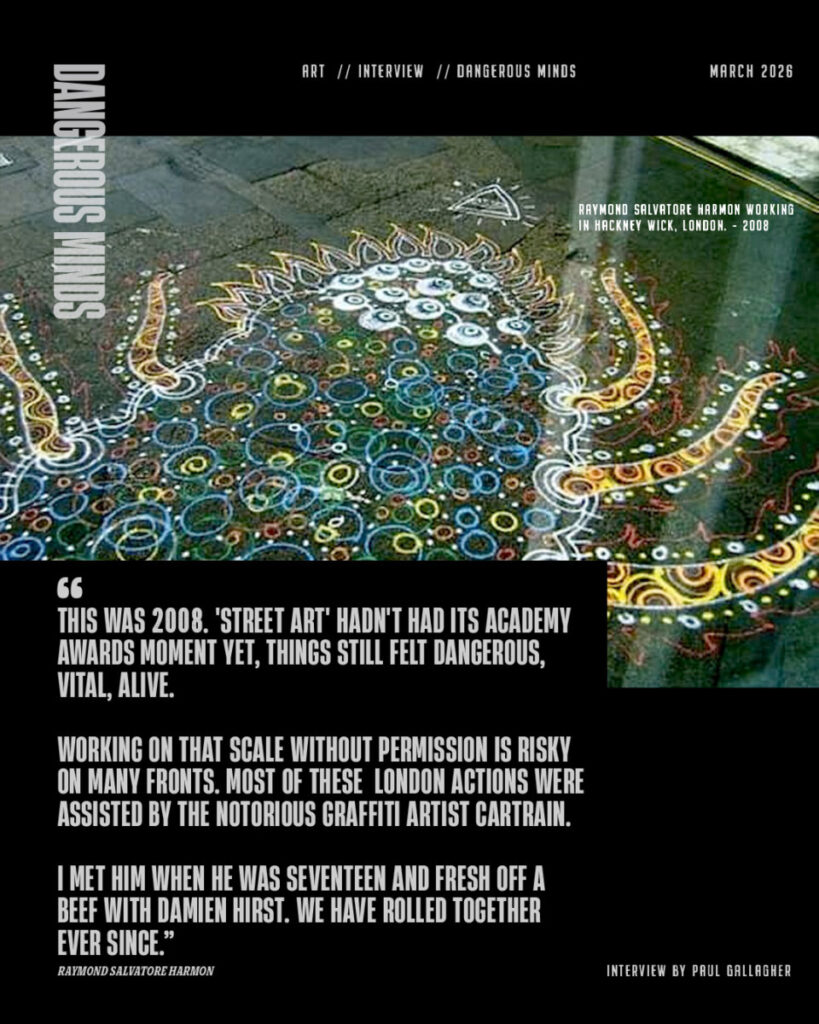
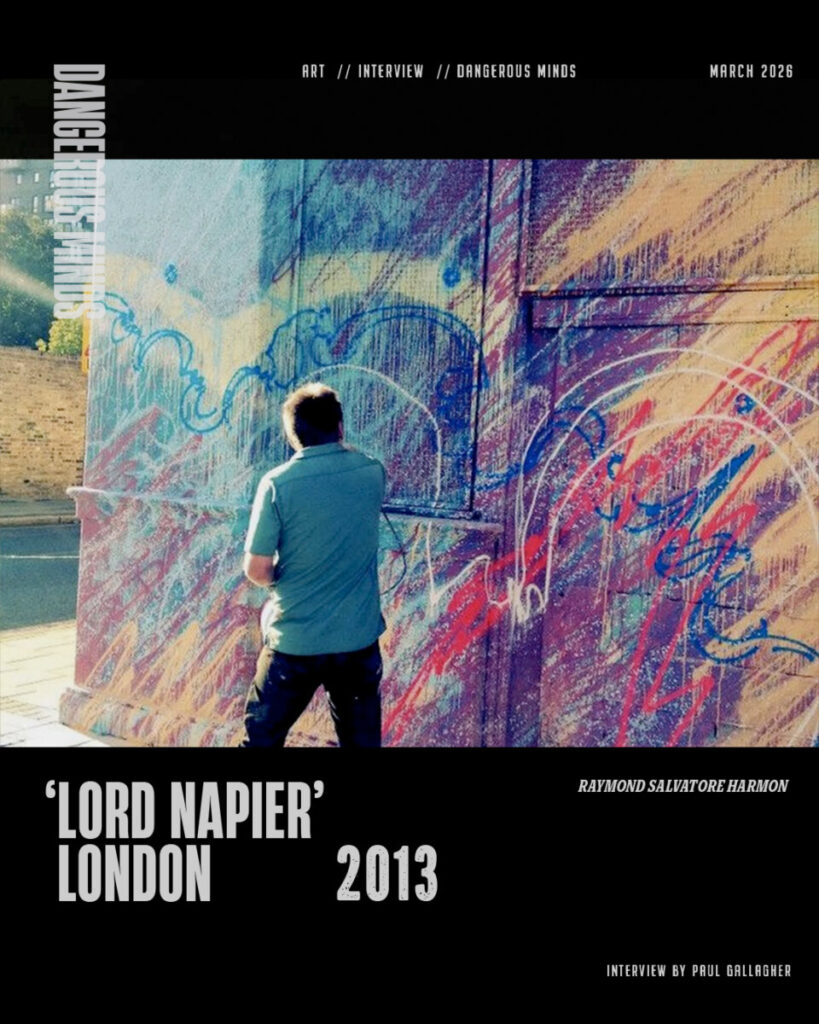
“Hackney Wick inspired me, the abandoned Victorian factory vibe, the graffiti, all harkening to my youth. I started doing street pieces again, these [were] the first as an adult artist. I quickly moved to using a garden pump sprayer from the traditional Halford’s paint tins. With a garden sprayer, I could do much larger pieces fast. Back then, I was working on the flat, painting mostly street intersections and rooftops.
Eventually, I developed my process, I started working in my garden, doing pieces on large, heavy paper. I worked with vibrancy, colour as a warning. Like in nature, where a bright colour equals poisonous. The forms originally coming from organic shapes, sea creatures, tentacles. I have always been a big Lovecraft fan.
“This was 2008. ‘Street art’ hadn’t had its Academy Awards moment yet, things still felt dangerous, vital, alive. Working on that scale without permission is risky on many fronts. Most of these London actions were assisted by the notorious graffiti artist Cartrain. I met him when he was seventeen and fresh off a beef with Damien Hirst. We have rolled together ever since.”
What is a typical day in your studio like? How do you work? Is there a set pattern or more organic?
RSH: “I tend to approach art-making like a job. I get into a pattern of working at certain times of day. I can be nocturnal for a few years, then switch to late daytime work. In Poland, it was 11am to 5pm. I am usually working on a couple of things in the studio at the same time. I will have a painting I am working on, but also some more complicated experiment or series that has medium ‘set times’ and glue binding times or whatever. I also try to keep working on my archive of digital and analogue film, sound, video, as an ongoing process. As I cleared out my studio in Poland last year, I made an extensive backup of hard drives. Eight TB in total, it comprises the whole of my digital art and archive from 1997 until 2025. That needs to be fully catalogued and indexed eventually.
“I see making as an ongoing learning process. Materials research, in particular, is where I have spent a lot of time and effort. Understanding the mediums I am working in, the archival nature of some being better than others, seeing how new materials can be pushed in different directions.
“I am in love with paper as a surface. I would say 80% of everything I have done in the past decade or more has been on various kinds of papers. I am particularly interested in non-pulp synthetic fibre papers. They last literally forever, and you can really beat the shit out of them while you are pushing the paint.”
What are you feeling and thinking when you create art?
RSH: “In the past decade or so, I have given a lot of thought to what art making is, in particular. Not ‘what is art?’ as much as ‘why do we do this?’. I have come to believe that art making/artistic practice is a kind of neurodivergent compulsion. In the way some neurodivergent people count stairs or watch trains. We, artists, are a very culturally distinct class of neurodivergents that have, over centuries, been commodified in society. We have, due to the nature of our compulsions, been given a job culturally. Making things.
“This compulsion to make is not the only symptom of artistic neurodivergence; we are also highly aware of the world in which we exist. Of the pain and suffering, of the shiny things and the masked emotions of those around us. Between this heightened state of awareness and an overwhelming need to make things, we have become fixtures in society. Much in the way the shaman was once a role played by those who could ‘see into the beyond’. Artists see the now.
“The difference between art and other creative media like theatre, cinema, and even music is that these media create illusions. Fabricated lies that lead the viewer into an emotional space via sleight of hand. Art should not be a lie. It should tell the truth. It is the raw, unflinching ‘reality’ of it that makes it art.”
What did you hope your work would achieve? Why? What response do you want for the viewer?
RSH: “I have always ultimately looked at how there are certain boundaries imposed on creative practice. You are supposed to get a studio and make objects, or do public work, which entails long bureaucratic paper trails of council permissions and bullshit. I am drawn to that edge of art that borders on crime. No permissions, no proposals, just action. My work is ultimately about resistance. About how systems are created to control narratives, not to push boundaries.
“After my solo show ACID in London in 2015, my career seemed on track. By that point, I was married and legally in the UK after years of skirting immigration. I had found a group of collectors who supported my work, and things seemed great.
“But my wife Magda worked as the manager of a homeless hostel in Camden, and the things going on in the UK were having a direct impact on her. The funding cuts, the reduction in mental health support, these all made her job like a frog in hot water. Eventually, she couldn’t do it anymore.
“It was by chance in 2017 that I was able to buy a large piece of property on a mountainside in Portugal. We had gotten it as a long-term plan, nothing we were in a hurry about, just a daydream for the future. But the situation in London was unsustainable.
“So as Brexit loomed on the horizon, we packed up our belongings and left Hackney Wick for central Portugal in the spring of 2019. By this point, I was represented by two galleries, had a regular income from selling art, and figured doing so from the side of a mountain wouldn’t be much different than doing it from London.
“What I didn’t plan for was the plague. Six months into Covid both galleries had closed. No one was buying art. Everyone was stuck at home, chewing the scenery, wondering when it would end. Despite the setbacks and battles on the ground in Portugal, we managed to get through the plague much better than most of my friends. We didn’t feel boxed in out there on the side of a mountain. That life is tough, though; it’s a physical day-to-day routine that needs doing. Hard farm-style labour in a country where everything happens in slow motion. I built a small cabin we lived in and started on building a house. It took me five years of living there to get almost to the final stages of a finished house. Then, at the point the house was 95% done, my wife got cancer.
“The Portuguese health care system is fantastic, but being so remote made everything too difficult. Finally, we ended up relocating to Porto for her treatment and surgery. We were forced to sell the property and walk away from all of our hard work in order to be nearer to the hospital. It was a heartache to leave that bit of heaven, but the drama surrounding everything made her want to be closer to her mother back in Poland. So, after her surgery, we relocated to Lower Silesia, Poland.”
Would you say your work is political?
RSH: “Living in Europe, I have spent the last 20 years of my life as an immigrant. In the west immigrants are often vilified, but as an artist, it is near imperative to one’s practice that we are exposed to views outside of our cultural comfort zone. To be at a language disadvantage is a difficult and frustrating thing. To know no one in a place you are living is harder than is possible to imagine. But these experiences are incredibly powerful lessons for an artist.
“In Homer’s Odyssey, the narrative of the protagonist’s journey is that it takes him ten years to return home. But in every retelling, one glaring fact is overlooked, that seven of those years he was trapped on the island of Ogygia (modern day Gozo, Malta) by the goddess Calypso. We get a huge amount of detail in the other incidents of his journey, but his years on Ogygia are usually glossed over. My Maltese family comes from Gozo, my grandfather a farmer, my grandmother a lacemaker. Before my wife passed, we went to Malta, and I stood at the top of Calypso’s Cave in consideration of that beautiful place. Here my family lived, and yet in the early 20th century, poverty was so extreme that they chose to leave that paradise for Detroit. Becoming immigrants in a foreign land of snow and industry.”
Can we talk about what happened?
RSH: “In Poland, things seemed to be getting better. Magda had gotten through surgery/chemo and was healing. I found a fantastic building to use as a studio, a still-functioning metal shop factory that was right across from our apartment. The factory plant was a hybrid of 19th century German architecture with a bunch of bad communist era concrete block outer buildings.
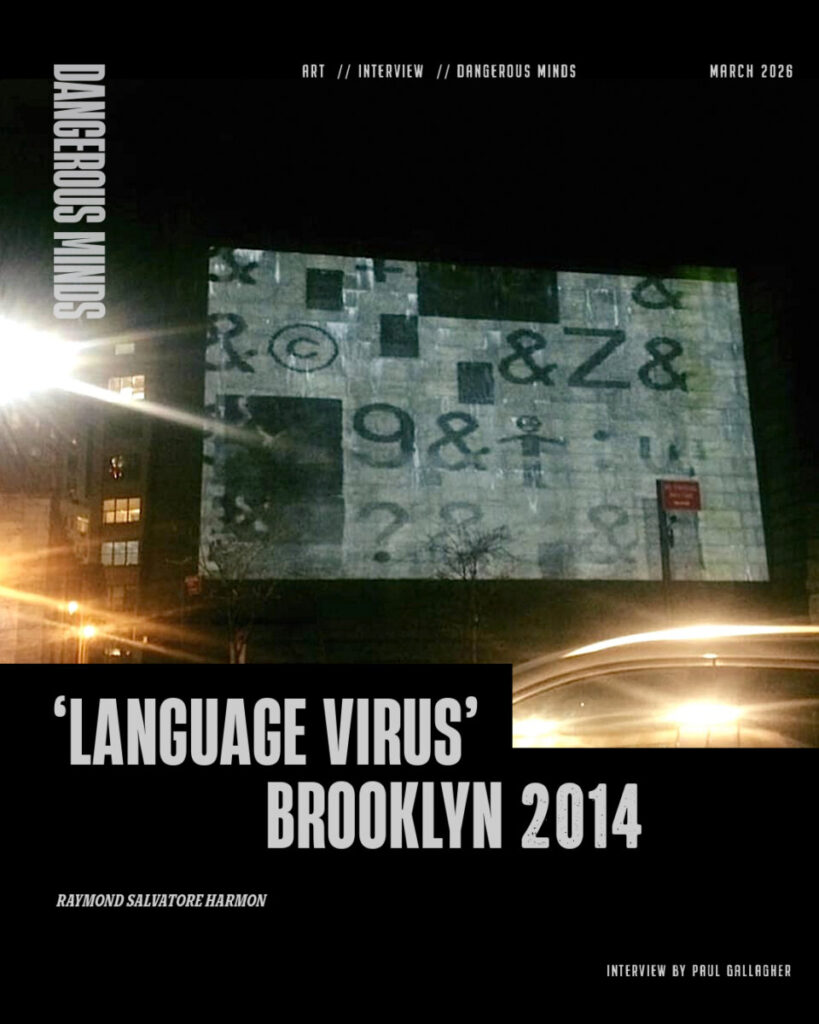
“Having not really painted during the five or so years on the mountain, I began in earnest to work again. In the beginning, I picked up where I had left off, but quickly, my work evolved into some new form. A kind of amalgamation of my digital work with paint. I had long worked between the worlds of digital and physical art, turning photos of paintings into 3D objects, making those into augmented reality environments. My 2014 AR piece, Mirage, used a full-scale mural (40m x 7m) in DTLA as the key to an augmented environment where the painting moves out away from the building to fill the physical space virtually.
“So, in the Polish studio, which I also called BETA, I worked seven days a week. At first, in a fervour of new practice. In one year in the studio, I produced some 250 pieces of art, mostly paintings. But eventually trouble started again, my wife found out that the cancer had spread. We had returned from a trip to Malta (I am ethnically Maltese) to scout possible places to live long term when she found out.
So, the painting became desperation. A way of occupying my mind as she started back into the cycle of oncology. It was just another four months later, and she passed suddenly.
“In immeasurable grief, I packed everything into storage (3000 books, as many pieces of art), closed the studio and spent seven months wandering Europe in a daze. I first went to London, where the incredible support of one of my collectors gave me some place to be while I tried to hold on to my sanity. As much as I was living in a state of eternal darkness, having Primrose Hill outside your door isn’t a bad place to grieve, on the whole.
“I went to Athens to do a film screening at Lee Well’s IFAC Athina in the summer and discovered that travel helped to lessen the lead weight I had been living with emotionally. Athens was new, and the distraction was healing. It was while visiting Hydra to see an incredible installation by Andra Ursuta (put on by Dakis Joannou’s DESTE Foundation) that I happened to spend some time with a stray kitten near the slaughterhouse. I considered its ability to survive there in the heat of the summer and how life itself is difficult for all creatures.
“So at the end of summer, I went to Venice, then Madrid to visit a new gallery, Villa Magdalena’s fantastic inaugural show of work by Mie Yim, and ultimately to Malta to look for apartments. Along the way, I was constantly returning to Poland to stay with my mother-in-law, who had no one else, as my wife was an only child.
“In December, I had gone to Tangier to explore a project there when I got the call that my mother-in-law had passed. I had woken that morning and knew something was off. I left Tangier the following day and returned to Poland.
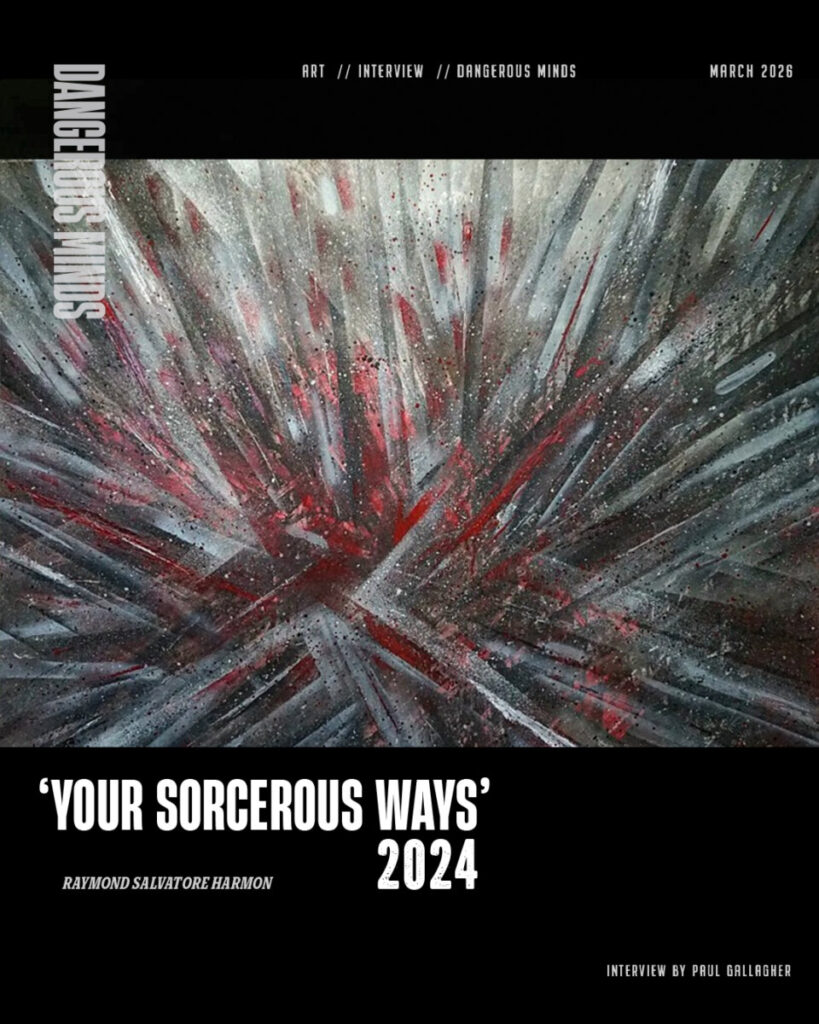
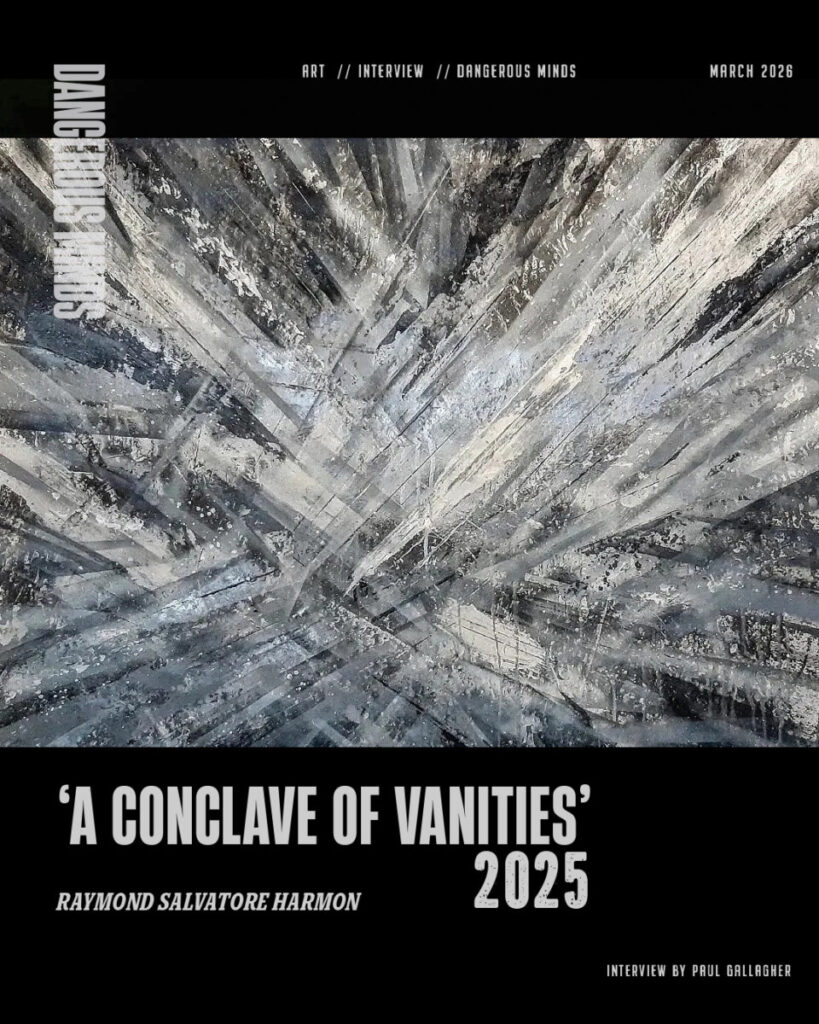
“The past two years of struggle and grief have reshaped me considerably. My work in the Poland studio has shifted away from that madness of coloured vibrancy to earth tones and dark shades, visually becoming a kind of crystalline fragmentation of reality. I had begun to explore several series of 3D folded pieces and topographical canvases. To me, these are an extension of an internal landscape shaped by pain and loss that surrounds me emotionally.
“When I showed a set of these new pieces to the collector whose spare house I stayed in over the summer, he remarked at the change and thought that the work was stronger than before. I don’t know, to me it is just different, all things being what they are.
“I feel like artists deal with grief differently. I watched a lot of religion come into play around me while others dealt with the death of my wife and then her mother. I feel like, in some way, art is a ‘religion’ that gives us similar tools for coping with grief. We have a kind of built-in outlet that allows us to process the pain and loss in ways others rarely can. It is that old Jodorowsky adage that we turn shit into gold.”
What next for you?
RSH: “One of the key factors of my career has been the self-produced pop-up exhibition. I have had many commercial gallery shows, but these tend to be neat little things with some pieces hung on a wall. My real interest is in making the space itself a container for the art. So doing these popups has given me a way to skip over the permissions and planning and bullshit and just do it. I can go larger in scale, use spaces with more character, and, in general, I have a free hand to do what I want. That freedom means paying out of pocket, but it also means being able to do what needs to be done.
“As I try to sort out the nonsense of things in Poland and my life, I have decided to return to London, opening a new studio in Ilford in the spring. I will need an organisational base for doing a show of these newer works in the coming year, though I have not decided on self-produced or a gallery for their coming out. There is also a rumour that an important painting of mine will come to auction this spring. It will be the first time one of my pieces has been available via a commercial auction.
“It has been seven years since I left London. Much has changed, not the least the person I am. My work, my ideas, my heart are all irreconcilably different from when I left London. I have been shaped like earthen clay from the forces of profound grief. A world without my wife is a world much less vibrant, much less full of desire. Now I have only my art and my cat Lucien to make my way forward.
“I feel very strongly that an artist’s most important goal should be to live life as an artist. Being an artist is ultimately about the first-person experience of living an artist’s life, about the making of art and existing in a space-time full of absurdities of one’s own invention. We are set apart from society in all cultures, and our position lends itself to a kind of class-free movement between social groups that gives us a particular insight into human existence. As artists, we must embrace this; we must live a story. It is not just the things we make that are important; it is the life we live that gives them context.
“I have lived by a personal motto for most of my adult life, which is ‘Live long and leave a good biography.’ But until this past year I never truly grasped that just because the story is interesting, doesn’t mean it has a happy ending. We cannot write the story of our life, we can only live it.”