


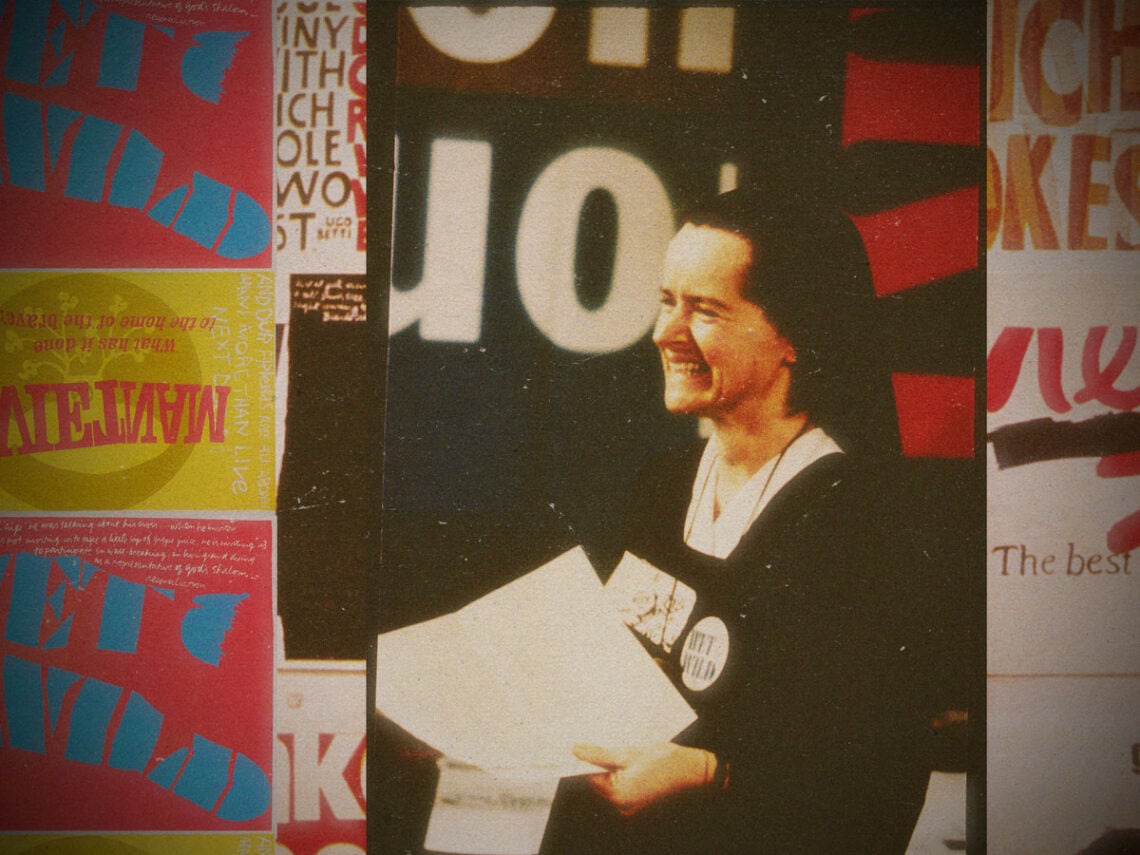
Corita Kent: the nun who used pop art to fight for social justice
Sister Corita Kent was born Frances Elizabeth Kent in Fort Dodge, Iowa, the fifth child of parents already involved in the world of art. While I’m sure those parents saw the young Frances taking after them artistically, they probably didn’t see exactly how she’d pursue her work coming.
Kent attended Blessed Sacrament School for junior high, a school that was partially staffed by the Sisters of the Immaculate Heart of Mary. The influence of those nuns on her was palpable, and when she graduated from Los Angeles Catholic Girls’ High School in 1936, she knew exactly what she wanted to do. Kent wanted to be like the sisters who had encouraged her and her art throughout her childhood, and entered the Roman Catholic order of IHM sisters.
After taking the name Mary Corita, the surprisingly progressive regime in this sisterhood enabled Kent to continue her artistic studies while she lived and worked at the Immaculate Heart community, getting her BA from Immaculate Heart College, then her MFA in art history from the University of Southern California in 1951. Emboldened by this progressive scene, Kent allowed her art to get more progressive in kind, taking influence from more modern forms of art, including, most notably, from pop art.
By the late 1950s, Kent’s life was consumed by art. She was the chair of the Immaculate Heart’s art department and a teacher by day, but never stopped making art and becoming a respected artist in her own right. Getting noticed for her radical, pop art-influenced work that wasn’t just controversial because it quoted pop music and featured major figures from pop culture, but also because, as the 1960s went on, she started adding an undeniable political slant to her work.
This was the mid-1960s, after all. For all the “peace and love” sloganeering didn’t just come from hippyish contentment, it was a plea to see sense from a populace that were genuinely worried that the world was coming to an end.
The Cuban Missile Crisis, the Vietnam War, the Civil Rights Movement and various humanitarian crises across the world had radicalised people, and Kent was no different. Her art reflected the point of view of the Immaculate Heart in its fierce opposition to war and injustice, so much so that their stance ended up all over Los Angeles.
It was Kent, with the support of the Immaculate Heart, that created a billboard which was a common sight in Los Angeles over the 1960s. A gorgeous countryside landscape with the words “we can create life without war” written over the top of it. It wasn’t to promote a product or even a charity movement, just the idea that war is not a necessity that we have to build life around. Something which we can’t seem to understand over half a century later.
The response to this billboard was rapturous, at least among the LA public. Within the Catholic Church, however, the response was somewhat different and somewhat more angry. The Catholic leadership of Los Angeles began to see the Immaculate Heart as a problem, with no less a figure than Cardinal James McIntyre calling them “communist”. Kent’s work was a particular issue to him as well, with him labelling her work as “blasphemous”. The very last thing this did, however, was make her fall in line. In fact, quite the opposite.
Given the choice between pursuing her activism and her life in the sisterhood, Kent chose her activism. Quitting the order in 1968. Several more of her fellow sisters followed suit, so much so that in 1980, the order folded. Kent spent the rest of her days as a working artist, one who never lost her faith but also never lost her moral compass, creating vital work until her death from ovarian cancer in 1986.