


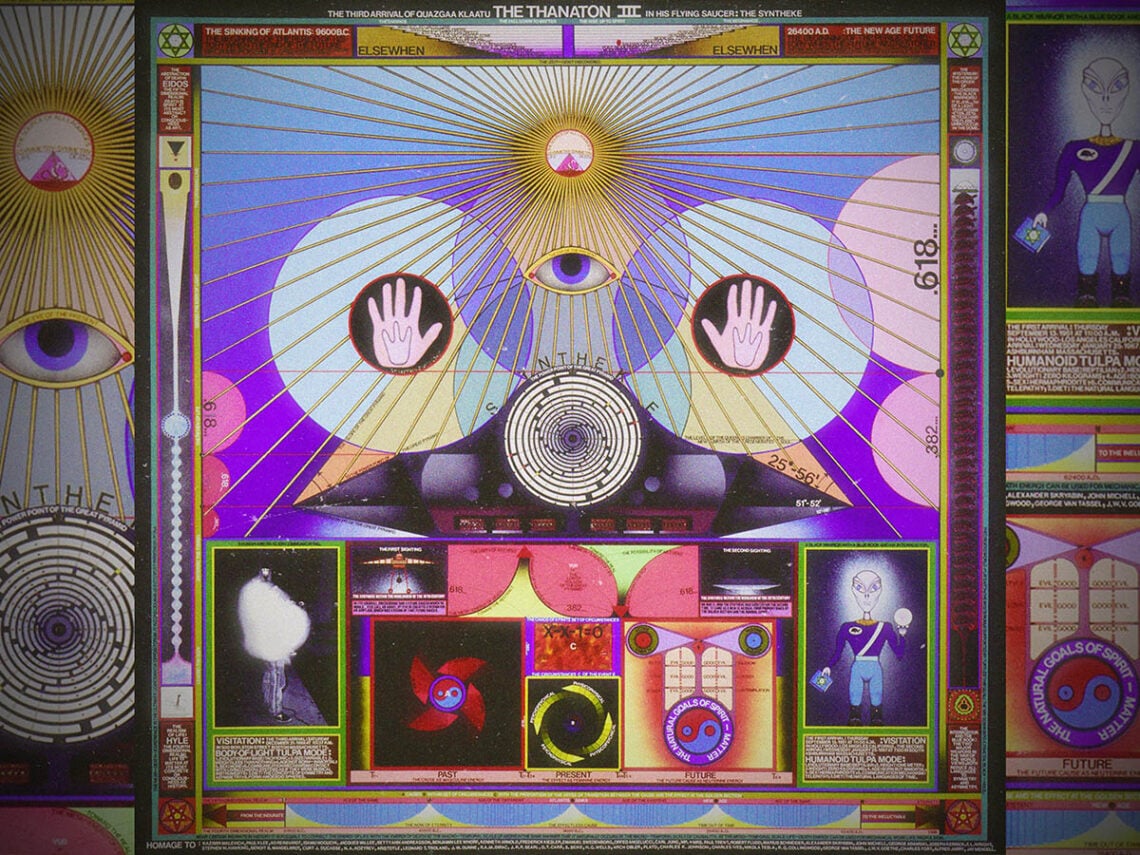
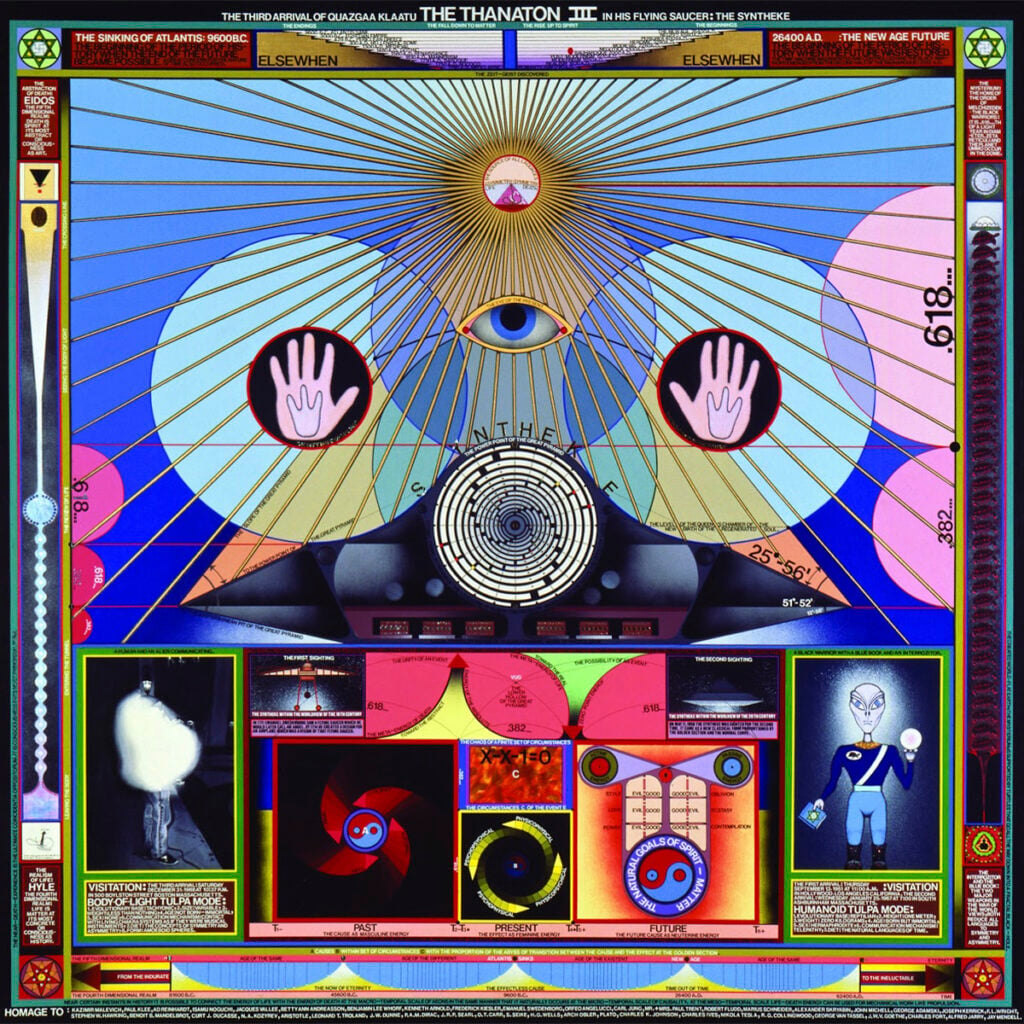
Thanaton III: The 1989 artwork Paul Laffoley believed was alive
Paul Laffoley remains one of those artists who seems to occupy an entirely separate category from almost everyone else.
Spend an afternoon looking through his work and you quickly realise you’re not dealing with paintings in the conventional sense so much as elaborate diagrams for impossible ideas. Every canvas feels as though it belongs to a much larger cosmology that only Laffoley himself completely understood.
If you’ve never encountered his work before, Thanaton III is as good a place to begin as any.
Laffoley’s unusual art forms can be categorised in several different ways. There are his architectural works, which resemble impossibly intricate blueprints; his designs for speculative inventions that look like they wandered out of forgotten science-fiction novels; his proposals for a functioning time machine; and even a house that could supposedly be grown from a single seed. Given that Jules Verne eventually saw so many of his own fantasies become reality, it’s difficult to dismiss Laffoley’s more outlandish ideas quite as quickly as common sense suggests.
Perhaps the most fascinating branch of his work, however, consists of what he called his “operating systems”, a term that still doesn’t really have an equivalent anywhere else in the art world.
Laffoley’s operating systems are paintings, and occasionally other forms of artwork, designed to be interacted with in what he liked to call “the theatre of the mind”. They aren’t simply objects to be looked at. They’re meant to be activated by the viewer. Some function almost like meditation devices, encouraging prolonged contemplation, while others invite the observer to imagine impossible transformations taking place within their own consciousness. One operating system even instructs viewers to place their hands on marked points within the painting before mentally projecting themselves into a kite as a form of astral travel.
Needless to say, Paul Laffoley wasn’t especially interested in conventional landscape painting.
That willingness to treat paintings as functional objects rather than decorative ones is probably what separates Laffoley from so many other visionary artists. Whether or not you accepted his theories was almost beside the point. The important thing was that he genuinely believed these images were capable of doing something. Looking at them wasn’t supposed to be a passive experience. It was participation.
With 1989’s Thanaton III, though, Laffoley believed something rather different was happening.
According to him, this wasn’t simply another operating system or another visual meditation device. It was, in a very real sense, alive.
Not alive biologically, obviously, but alive as an active process capable of interacting with the person standing in front of it. Like so much of Laffoley’s work, it’s impossible to know where metaphysics ends and metaphor begins, and that’s precisely what makes him such an endlessly fascinating figure. He was never interested in explaining away mysteries. He preferred constructing new ones.
I’ll let Paul explain Thanaton III himself in the interview below.
The conversation comes from my British television series Disinformation and was filmed in 2000. Whenever museums have exhibited Thanaton III, they’ve often screened this interview nearby because, frankly, there’s probably nobody better qualified to explain what’s going on than the man who painted it.
Thanaton III isn’t the only work of Laffoley’s to receive this sort of attention. During the major retrospective at the Palais de Tokyo in Paris in 2009, French television devoted an entire segment to the painting, recognising it as one of the defining works in Laffoley’s extraordinary career.
One of my favourite Laffoley anecdotes concerns his surname. He once explained to me that, when pronounced by French speakers, “Laffoley” effectively becomes “la folie”, or “madness”. He was convinced that the family name pointed towards ancestors regarded as village fools or outsiders, and went one step further by suggesting those same “fools” may have served as the real-life models for the gargoyles of Chartres Cathedral.
Only Paul Laffoley could begin with a discussion about genealogy and end up somewhere in medieval France surrounded by gargoyles.
Then again, that’s exactly why spending time inside his universe is so rewarding. Even if you don’t believe a word of it, you’ll almost certainly come away looking at the world just a little differently.