


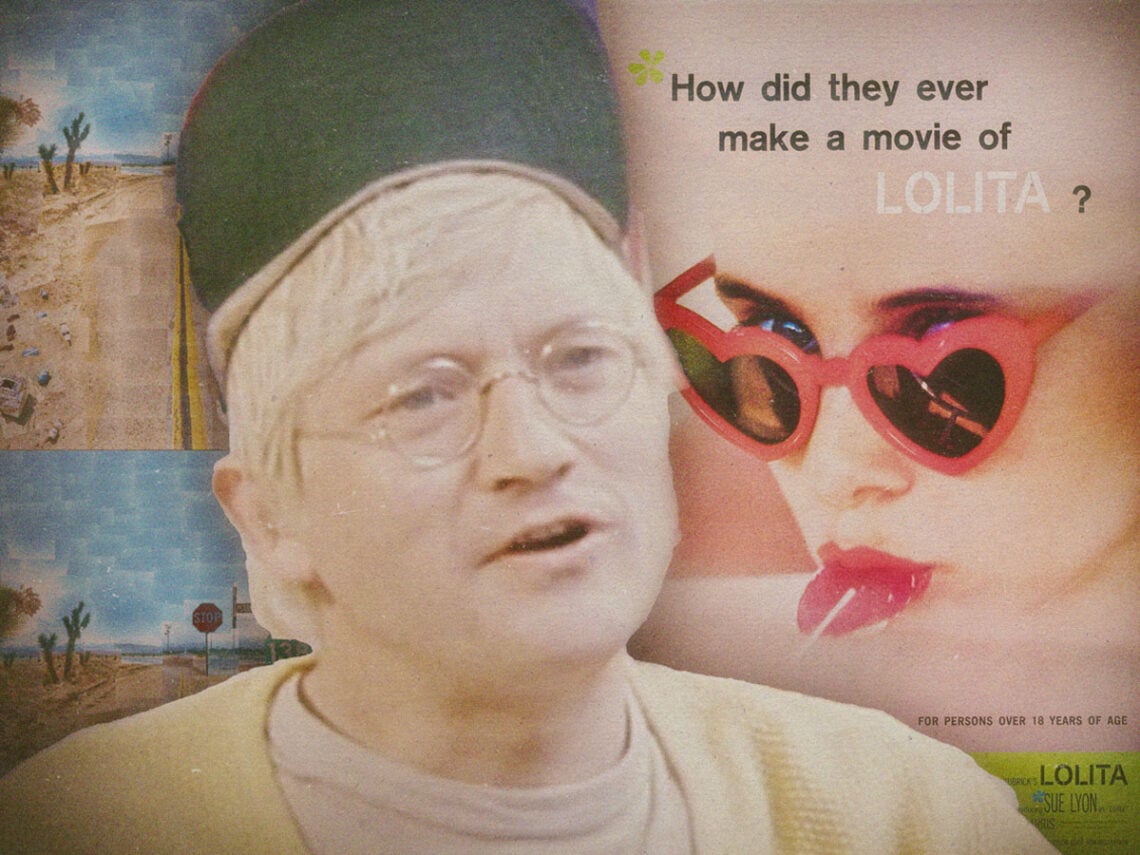
The David Hockney masterpiece inspired by ‘Lolita’
The art of the late David Hockney went far beyond painting. One only needs to take a single look at his most celebrated paintings to see the incredible control he had over the medium, the kind that legions of painters since would kill and die for.
The subjects of his paintings do not feel like paint on canvas. In true Hockney fashion, they feel like figures crafted out of solid light, with an uncanny sense of weight, depth and texture. Yet Hockney wasn’t satisfied with staying in his comfort zone. Which is the mark of a true artist, I suppose. He mastered a form, then went out and found something else to master again. What’s more, he did so because he found something that he considered a flaw with the entire medium of painting.
No matter what, Hockney could never find a form of perspective he was satisfied with in the world of painting, an inherently two-dimensional art form. Hockney wasn’t the only artist to struggle with this fact. In fact, the very movement of Cubism was invented as a way of trying to present three-dimensional objects in a two-dimensional medium. However, in his pursuit of genuine depth, Hockney left painting behind altogether and found photography.
Hockney developed a method of collage. One that involved taking several photographs of one subject, from several different vantage points. Then, once those photos developed, he arranged those images in a way that gave the subject gravitas in a way that was unachievable from any other artistic vehicle. Hockney composed several pieces of art this way, but none are so breathtaking as Pearblossom Highway, 11-18 April 1986, #2.
While Hockney had previously composed these collages around simple subjects like chairs, Pearblossom Highway is so astonishing thanks to being a landscape. An absolutely enormous vista depicting the titular California highway with hundreds of four-by-six-inch prints. Despite not having one subject to give depth to, the experiment worked, with every aspect of the piece having a life and perspective to it.
Years later, when Hockney was commissioned to paint the Grand Canyon, after trying to capture it in a traditional way, he scrapped the project and instead returned to the photograph method, which was the way the finished piece was shown in the 1990s.
Notably, Pearblossom Highway wasn’t shown in its original form. Rather than an original Hockney inspiration, the work was a commission from Vanity Fair. The magazine was printing an article about the way that Vladimir Nabokov’s harrowing masterpiece Lolita illustrated American roads and commissioned Hockney to create a piece that invoked the latter third of the novel. When (spoilers for a novel published in 1955), the title character escapes from her captor, Humbert Humbert, and he drives the length and breadth of the endless California Highway searching for her.
While Vanity Fair commissioned Hockney to take a few engaging photos of the California Highway system, the project spiralled into a work of its own, and the magazine instead tapped up Wim Wenders to do the honours instead. Wenders’ photos are magical, but Pearblossom Highway, though it’s inspired by one of the darkest novels of the entire 1950s, is something else entirely. One that really does need to be seen to be believed and is currently housed in the Getty Museum in Los Angeles, California.