


Use your head: whose skull did Damien Hirst turn into art?
There’s an argument to be made that the Young British Artists movement, the artistic equivalent of Britpop for good and (mostly) for ill, spearheaded by Tracey Emin, Sam Taylor-Wood, and most notably Damien Hirst, did more harm than good to the world of art.
Much like Oasis, Blur, Pulp and the like, the Young British Artists made for a hugely exciting time for British Art. One where everyone was glamorous, shocking and newly rich. Where works of art made by British 20-somethings were making the headlines of major newspapers the world over. What’s more, just a few pages after that, you could also find pictures of the artists who made those works stumbling into a cab outside the Groucho Club, flipping off the cameras before throwing up into a handbag worth more than your car.
Which is all very cool, and that’s more or less the problem.
The world of British art suddenly became a world where the surface was the substance. Where the effectiveness of art was discussed not by its inherent worth but by the tabloid columns written about it and, inevitably, the amount it went for in auction. There’s no denying that some of the most celebrated pieces of British art ever came from this period of time, but whether that’s a good or bad thing is a subject vociferously debated.
Damien Hirst is arguably the poster child for this, which checks out. After all, if you’d gone to the trouble to stuff a 14-foot Tiger Shark into a tub of formaldehyde, you’d at least want some recognition for it. The Physical Impossibility of Death in the Mind of Someone Living was one of his breakout pieces, first displayed in 1991. Some 15 years later, he decided to top it by showcasing something else dead, but this time, making it a whole lot more human.
Not to mention a whole lot shinier.
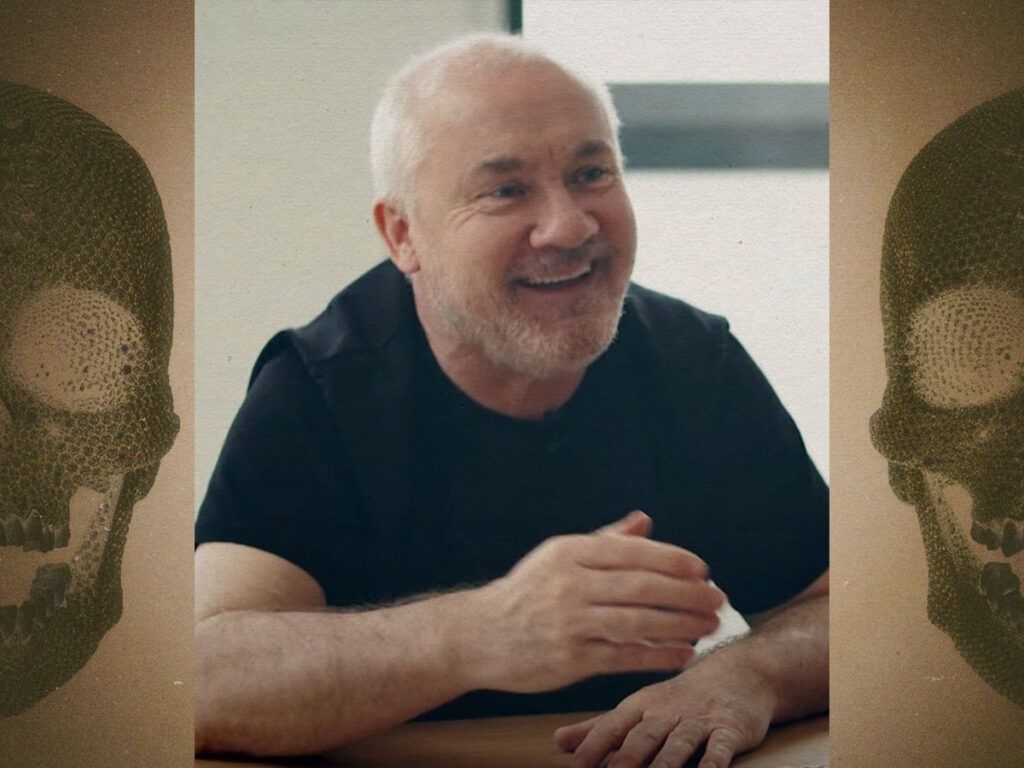
Why did Damien Hirst exhibit a skull?
In 2007, Damien Hirst debuted For the Love of God, easily his most notorious work to date.
There’s something truly grotesque at the core of the piece, being as it is, a human skull decorated with 8,601 flawless diamonds. The inspiration for the piece came from seeing an Aztec turquoise skull at the British Museum and wondering what the modern equivalent would be. Sending him down a rabbit hole that ended up creating quite possibly the most expensive Memento Mori ever made.
What’s more, this was no sculpture.
The skull that Hirst worked on belonged to an actual human being. We don’t know the specifics, but what we do know is that it belonged to a 35-year-old European who lived between 1720 and 1810. Hirst bought the skull himself from a shop in Islington, then commissioned Jack Du Rose to design and sculpt it, before it was manufactured by the Piccadilly jewellers Bentley & Skinner. Christ only knows what they must have thought of the brief.
However, they probably didn’t have quite the same reaction as Hirst’s mother had when he told her about the piece. In fact, her outburst was supposedly what gave the piece its name. When Damien Hirst told her what he intended to do, she shot back, “For the love of God, what are you going to do next?!”