


‘A Body to Live In’: Exclusive Interview with Angelo Madsen on Modern Primitive Fakir Musafar
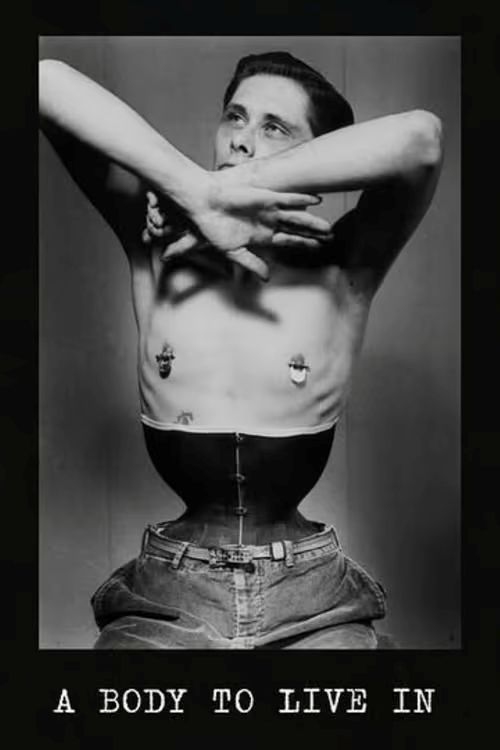
When he was just a teenager Roland Loomis started living a secret life. Raised in a strict Lutheran household. His father was a mechanic. His mother, a mechanic’s wife. Loomis knew he didn’t fit in. He was skinny and effeminate. He felt like an outsider. He knew he was different. He had hints. When he was four, he had visions of past lives. This led him to turn away from organized religion and look for something more transcendent. Something which reflected who he really was. It was 1944. There was a World War going on in Europe. Thousands were dying. Life seemed detached, unreal, and very fragile.
Loomis was born in August 1930 in Aberdeen, South Dakota. A lonely child, he spent his time reading books, magazines, and scrolling through encyclopaedias. He was searching for something. A way to connect with who he was.
In the cellar at his parents’ house, Loomis took photographs of himself. He posed partially clothed or naked. A leather belt pulled tight around his waist to shape an hourglass figure. Rope or chains fastened on his neck. He experimented with bondage. He pierced his body with sewing needles wiped down with alcohol. He took ideas from the photographs of rituals contained in National Geographic. Some might call this “cultural appropriation” today, but Loomis was just experimenting with body modification in the same way great artists have borrowed images or ideas from other cultures and countries. From all of this, Loomis created powerful self-portraits. Photographic works of art which are even more impressive because of his age.
He kept all this a secret.
He graduated in electrical engineering. Served as a soldier in the Korean War. This experience made him aware he was not alone. This was confirmed when after the war he moved to San Francisco and met other men who were into body piercing. He met and mixed with fellow travelers like Anton La Vey. This confirmation gave Loomis the courage to perform his body rituals in public. He married. He changed his name to Fakir Musafar. He was a photographer, a writer, a performance artist, a shaman, an advocate and teacher of body piercing. Musafar believed piercing rituals transcend the flesh and raise consciousness to a spiritual level.
In the 1980s, He became a controversial TV sensation appearing on daytime talk shows discussing his practices and beliefs. Some of his rituals led to accusations of cultural appropriation by Native Americans who claimed he denigrated their sacred rites. Musafar retreated. Then AIDs happened. The community of like-minded men started dying.
Throughout Musafar continued teaching and sharing his knowledge of piercing..
Before he died of lung cancer in 2018, Musafar recorded a series of interviews about his life. These partly form the basis for an extraordinary and compelling documentary on Fakir Musafar by Angelo Madsen called A Body to Live In.
Dangerous Minds contacted Madsen to find out more about this film and its director.
Let’s start with: Can you please tell me about yourself? Who you are, how you started directing, your background and your previous films?
Angelo Madsen: I live in New York City right now, but often live in Burlington, Vermont where I teach video art at a college. I have a small dog and a partner with whom I share 27sq meters of living space. I am originally from a small town in the Northern Midwest of the US, in Michigan, near the Canadian border. My dad worked at a sawmill his whole life and my mom is a life-long civil servant. They are both very creative people, but were content with the life they made in our small town.
I guess I have just always been a curious and explorative person, and was lucky enough to be raised in a family that nurtured my curiosity, even if they didn’t understand it or relate to it. I started playing instruments when I was four. I went to art school in Chicago in the early 2000s and had my mind blown with what was possible. I hadn’t thought about film or video as a medium for myself until my courses at the School of the Art Institute of Chicago. They had a mandatory 4-D class and I fell in love with the editing process. Literally manipulating time, crafting how time moves. I was astounded.
In those days I was either making videos or playing music or both for about eighteen hours a day. I guess I am a director, but I don’t exactly identify with it as a title. I’m a maker, and like to use whichever medium might work best for the specific goals of a project. I also work in visual art, performance, music, photography, I assemble objects and write, in addition to making films and videos.
At this point I’ve made, I think, 27 films over the last twenty years. About twenty of them are distributed by the Video Data Bank. Some short, some long, some medium length, some very DIY, some very fancy, some experimental, some documentary, some narrative fiction, some of my work is sexually explicit and some is created for normative mainstream outlets. I have a film on Criterion, one on Mubi, and did a New York Times Op-Doc. I don’t exactly have a field that I stay contained in. I like to follow my interests. I’ve made films about all kinds of things, but my films tend to be a bit more about ideas than about stories.
Stories suggest a lot of structural parameters, while ideas are freer to explore. I would say that personal relationships, subcultures, consciousness, cosmology, community, and the fringes of human experience are all central themes in my work.
Tell me about your friendship with Fakir Musafar? Did your film ‘A Body to Live In’ develop from this friendship? Was Musafar an inspiration to you?
AM: In my mind, all films develop from friendships. But to be specific, the film did not come into my consciousness until Fakir was already on his deathbed. I had thought about doing something with the archive, and a mutual friend urged me on. Fakir and I met in 2004. We had shared San Francisco area community and I participated in a few of his hook pulls and ball dances. The ball dance was my preferred. A bit less extreme than the hook pulls. We had a sweet connection.
He liked my films. I think much of my work developed from these experiences in my early twenties – specifically experiences that interrogated what it meant to be alive in a body and connect with others in the world through physical means that were not only erotic, but tinged with something else. Some kind of looking or searching. It’s like accessing a different part of yourself, and you can learn about who you are in a new way. I certainly wouldn’t put him on a pedestal. I knew him too well for that kind of blind idolization and now I know the archives too well. Do I think he was a profound figure? Absolutely. I think the film actually misses so much of his profoundness simply because it wasn’t always well documented and there is nowhere enough time in the span of an hour-and-a-half to fully delve into it.
Tell me about the young Fakir Musafar when he was fourteen-year-old Roland Loomis and creating these remarkable photographs?
AM: I should firstly say, that I am not a historian, and the film doesn’t really follow the biopic format. The film is more of a portrait of a community and the emergence of a subculture, through the images that Fakir created. So, though I start somewhat biographical I digress quite a bit from his biography in the film.
I think the fact that he was able to use complex photographic equipment and do DIY darkroom printing as a fourteen-year-old in 1944 is just a testament to how driven he was to follow his curiosities. He literally figured all of that stuff out on his own. And that doesn’t even consider the gravity of what he was documenting in those photographs! These early pictures (1944-1952) are largely self-portraits while engaged in some kind of body modification, and of course in 1944 that looked nothing like how we imagine it to look now or how it does look now.
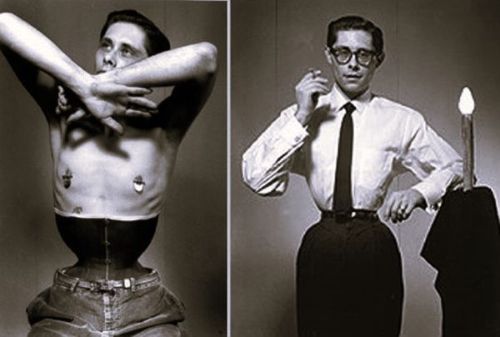
These pictures were as simple as him wrapping a belt around his waist as tight as possible to generate the appearance of a female figure. But it also wasn’t just about gender – it was about a physical sensation, and finding interesting erotic tensions within that physical sensation. There is one image where he is wearing very large hoop earrings, and he tucks his arms through the hoops so as to generate downward force, a kind of prolonged tension on the earlobes. Or his play with clothespins. That kind of BDSM play isn’t about pain. It doesn’t really hurt. It’s about altering how the body is perceiving a certain input signal.
I think all of this was totally instinctual to him. He was driven to do it, so he did.
Do you think his Lutheran upbringing repressed part of Loomis’s identity, in the sense he had to, at first, create his art in secret and it took him a long time to come out?
AM: I think probably. But I think more so he was extremely concerned with being committed to an asylum or being lobotomized, because that is the shit they would do to you back then. If people got caught cross-dressing or doing “deviant” acts to their bodies you could be institutionalized for life or killed. He was aware of this and protected himself accordingly. I think his early experiences with the hypocrisy and politics of Christianity, really drove him to look to alternate belief systems. His mom wanted him to be a minister, so he was kind of groomed for that. But it didn’t take long before he did a complete 180.
I don’t know if we can never fully separate from the ideologies implanted in us as children. I think more often than not we carry them with us and warp everything else around them. He wasn’t able to come out until he had very carefully identified people he could trust, and already started to build a community of support – that was what those early piercing parties in the 70s did.
What happened when Loomis moved to San Francisco? Who were the key figures he met? What blossomed from this group of individuals?
AM: When he moved to San Francisco in the mid-1950s he was studying technical theater at SF State, he got really interested in Alan Watts who was broadcasting his radio show out of Berkely then, he was really into the Beat poets like Allen Ginsberg, and used to party with Anton La Vey.
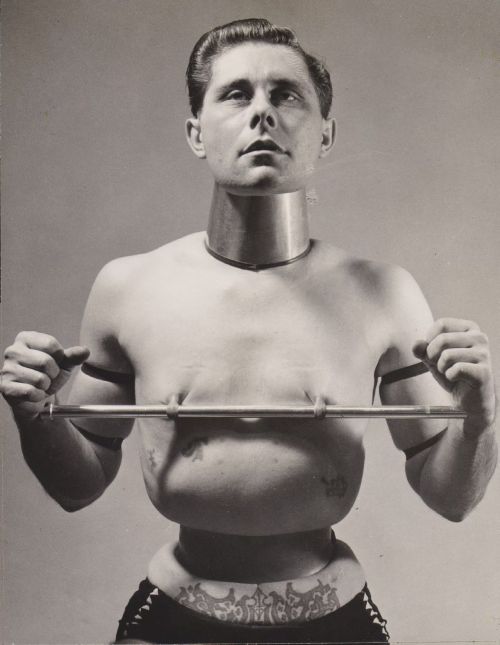
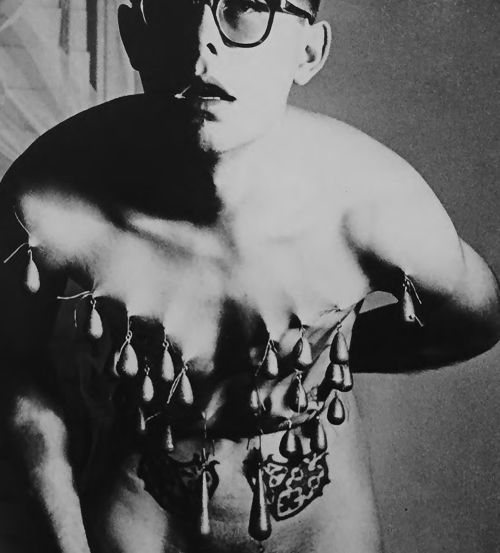
One of my favorite lines in the film is when Fakir talks about this period in his life, describing some of the parties they would throw before the formation of the Church of Satan and he says “they’d serve cheap wine out of a potty chair!” Those people all had their own core belief systems in place and they were all building their own separate followings. I think what blossomed from that was straight up, the 1970s. I mean, the start of real globalization, the new age movement, and all this post-war sexual revolution shit – before AIDS killed everyone. I digress. But during the late 1960s his experimentation with his body was getting more intricate, more complex, more researched, more intense. He had already permanently stretched his nipples up to maybe an inch and had permanent piercings in his chest so that he could do hook pulls and suspensions whenever he wanted. He started doing this as a performance – pulling things around attached to his chest hooks. At first it was kind of a circus side-show-thing and by the mid-late 80s it became performance art.
There are one or many books to be written. Paul King is the archivist who really knows the intricacies of this history.
Can you talk about the spiritual experience Fakir got from piercing and its rituals?
AM: Hmmmm.I guess I will say, what it looks like is never what it feels like. Something can look gruesome, but gruesome is not a feeling. It can also look painful, but painful is also not a feeling. When your physicality is altered, it allows for other kinds of thoughts and feelings to enter the body. When you kind of get out of your own way, there is room for breakthroughs, cleansing, recharging, receiving new information, reflection. I think the spirituality of it is simply in that fact that it allows you to look at the world from sideways. And then you understand how sideways the world is, and feel like a more integrated human.
A more Fakir way to say it might be more like, you’re going to have a conversation with God and that small hole in your body is the doorway to his house.
How did Fakir become a celebrity and what happened? What subcultures developed out of the piercing group which flourished in SF and LA in particular through the Gauntlet?
AM: Celebrity is a slippery word in his case because it’s true, that in certain worlds he was a legend. Yet, so many people I talk to daily have never heard of him. Even kinksters and people with facial piercings have no idea who this person was.
It’s always interesting to see what parts of history bubble up and when. I’m sure there will be some kind of resurgence of his work at some point. But right now it seems to fall in a gap. I think he developed notoriety through years and years of working his ass off. It was never handed to him.
In his 60s, after decades of photographing and performing, not to mention day jobs because he didn’t make money off of his art, he started a piercing school. That allowed him to build relationships with young people who could continue his work, and a lot of his later notoriety has to do with the number of professional piercers that he trained. That timeframe between 1970 and 1980 really spawned the entire subculture of body modification, from piercing and tattoos to branding and implants and surgical intervention. Like, it wasn’t just for bikers or sailors anymore.
There’s also an overlap with gender deviance and body modifications that are related to gender presentation. And of course leather men and faeries and kink communities. These all grew together. The convergence is one of the elements that is most interesting to me.
You have made a fascinating and compelling film, can you talk about the processes involved in making it, including the recordings with Fakir?
AM: Thank you so much. I’m grateful to have the opportunity to speak with you about it. It was a five-year long process, start to finish. I already knew most of the people in the film, so that helped get things going significantly. There is this concept in the documentary world about access. Like a big issue for people is how to get access to things and people. I never have a problem with that because I usually work with who I already know and what I’m already into, and I have known Fakir’s widow, Cléo Dubois for over twenty years. So it was really just getting her on board with the project. She was a bit hesitant in the first year, but allowed me unlimited access to the archives, which is the dream with a project like this. And as our work together grew, she became fully trusting in my vision of how the film would look and feel, and what areas I wanted to focus on.
Fakir died in 2018 and the film research didn’t begin until 2019. So that means that I never interviewed him myself. Everything you hear of his voice in the film is from various archival interviews, most of them from between 1990 – 2018.
Patrick Mulcahey, who was a friend of Fakir’s, interviewed him in his final weeks, and I draw on that interview quite a bit. He has a softer presence in that late stage of life interview, and I like allowing the film to be rooted in the softness that can come from age and experience.
In some of his early interviews, he seems very concerned with trying to make people believe that what he is doing isn’t crazy. So he continually points to all of these reference points in attempt to do that. And I think, retrospectively, those references foreclose some things more than they open up room to think deeper. Like, I think at that point in time it made sense in his worldview, but it somehow made him come off kind of militant and assured. I think viewers can pick up on those differences, and then that facet of his personality gets echoed by the conversations that Jim Ward and Cleo bring to the film. I was really lucky to get to sit with some of the elders of this movement for interviews. Those perspectives really helped to contextualize the era, the beliefs, the motivations, and the community.
Angelo Madsen’s film documentary ‘A Body to Live In’ will premiere at the BFI London LGBQTIA+ Festival on 20th March 2025.
There will be another screening of the film at the Genesis Cinema, Whitechapel on 23rd March, details here. More about Madsen’s film here.