


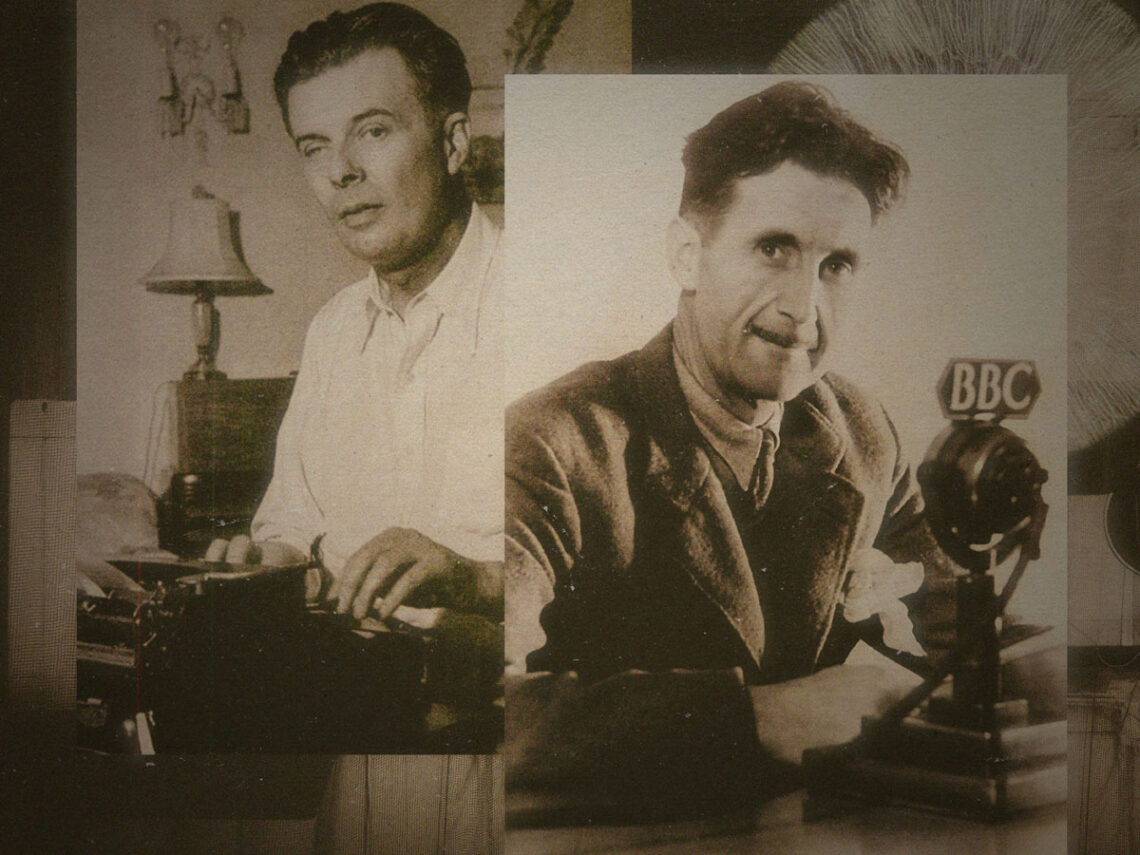
Aldous Huxley’s comical letter to George Orwell about why his dystopia was better
We writers are a catty bunch, with absolutely no exceptions.
Sure, there are varying levels to our bitchiness. Some are guilty of quite a lot more of it than others, but buried deep within the heart of people who turn words into food on the table is at least the slightest belief that your words are good enough to deserve that food.
A writer is someone who should know what good writing is and, by that same token, what bad writing is too. You make a writer confront bad writing and… well, they of all people will know exactly how to express the way they feel about it, and they will.
One might think that this is a modern phenomenon. After all, in these modern times, we seem to have forgotten what it means to treat other people with grace and respect. At the drop of a hat, we’re keen to tell someone exactly where they can stick it, even if they’ve done nothing wrong. We just like the feeling of telling people to go fuck themselves for no reason. To an alarming number of people, it’s the very core of free speech in the 21st century, and telling them they shouldn’t do that is an infringement of their civil rights.
The truth is, however, that people have always been dickheads to each other, the reasons for it just change with time. Even if you take two titans of the English language like George Orwell and Aldous Huxley, one would assume that they would treat each other with a level of respect and decorum. Especially because, fun fact, Huxley was actually Orwell’s French teacher when the genius behind Animal Farm and Homage to Catalonia was at Eton.
Yet, thanks to a letter sent from Huxley to Orwell, we know that the truth wasn’t as harmonious as we’d imagine.
So, why did Aldous Huxley criticise George Orwell?
The letter was sent in 1949 in the wake of the publication of Orwell’s masterpiece Nineteen Eighty-Four. A novel that, from the moment of its release, was hailed as one of the century’s most important works of fiction.
To be fair to Huxley, the lion’s share of his letter is in praise of his ex-pupil’s work. He describes the novel as “profoundly important” and analyses the actions of Ingsoc, the ruling political party in the novel, with the thoughtfulness of someone who hasn’t just read the book, but truly considered and understood it.
“The philosophy of the ruling minority in Nineteen Eighty-Four,” Huxley said, “Is a sadism which has been carried to its logical conclusion by going beyond sex and denying it.”
Unfortunately, Huxley did have a few notes on how an authoritarian state may operate and how Ingsoc felt less convincing compared to the totalitarian regimes depicted in some of his own work. “Whether in actual fact the policy of the boot-on-the-face can go on indefinitely seems doubtful.”
He says, somewhat snippily, “My own belief is that the ruling oligarchy will find less arduous and wasteful ways of governing and of satisfying its lust for power.”
In fairness to the lad, he wasn’t talking about some paperbacks he rushed out in between classes back at Eton, or an unfinished “masterpiece” rejected by every publisher in the English language. No, perhaps Huxley felt like he had a touch of authority on the subject of totalitarian regimes, as the work he cites as a better example than Orwell’s masterpiece is, y’know, Brave New World.
Arguably, the only other novel in the English language that can hold a candle to Nineteen Eighty-Four as a work of dystopian fiction.