


The Angels of Mons: Divine intervention in World War I
I don’t think we can ever truly understand just how much the psyche of humanity was forever warped by World War I.
Due to the sheer horror of its sequel, we might not spend enough time thinking about the conflict that, at the time, was known as The Great War. However, there was also a degree to which the world thought it was ready for a second helping. It arguably wasn’t, and the consequences of those horrors have pretty much directly led to all the horrors we’re living through today. However, the world at least knew what it meant for the majority of its countries to be at war with each other.
Prior to 1914, that was not the case. Before then, war was a conflict between individual nations. The kind of thing that was terrible to live through only if you were unlucky enough to be one of the two, maybe three countries involved, tops – the most likely option was that you’d read a few news stories about it, sigh a little about how sad it was that people were dying, then move on with your life… Then Archduke Franz Ferdinand got shot, and suddenly everyone was involved.
By looking at the history of World War I, you can see in real time people coming to understand exactly what this meant. The old jokes are 100% true; the overarching belief when the war began was that this whole mess would be over by Christmas. Within a month, the British Army was in the thick of its first genuine campaign of the war and realising with horror that this was to be no boy’s own trip to show the Jerries what for then be home for tea and medals.
It was instead the first time many people were shown the horrors of modern warfare first-hand, and not a lot of people were entirely equipped to see it.
Most notably, the proof of this was during the Battle of Mons in Belgium on August 23rd, where the British Expeditionary Force should have been absolutely massacred by a technologically advanced German army that also heavily outnumbered them, but the BEF weren’t newly conscripted Tommies who’d never held a rifle before, they were some of the hardiest and most experienced career soldiers in the British Army, and their tenacity meant they held the line a lot longer than anyone expected.
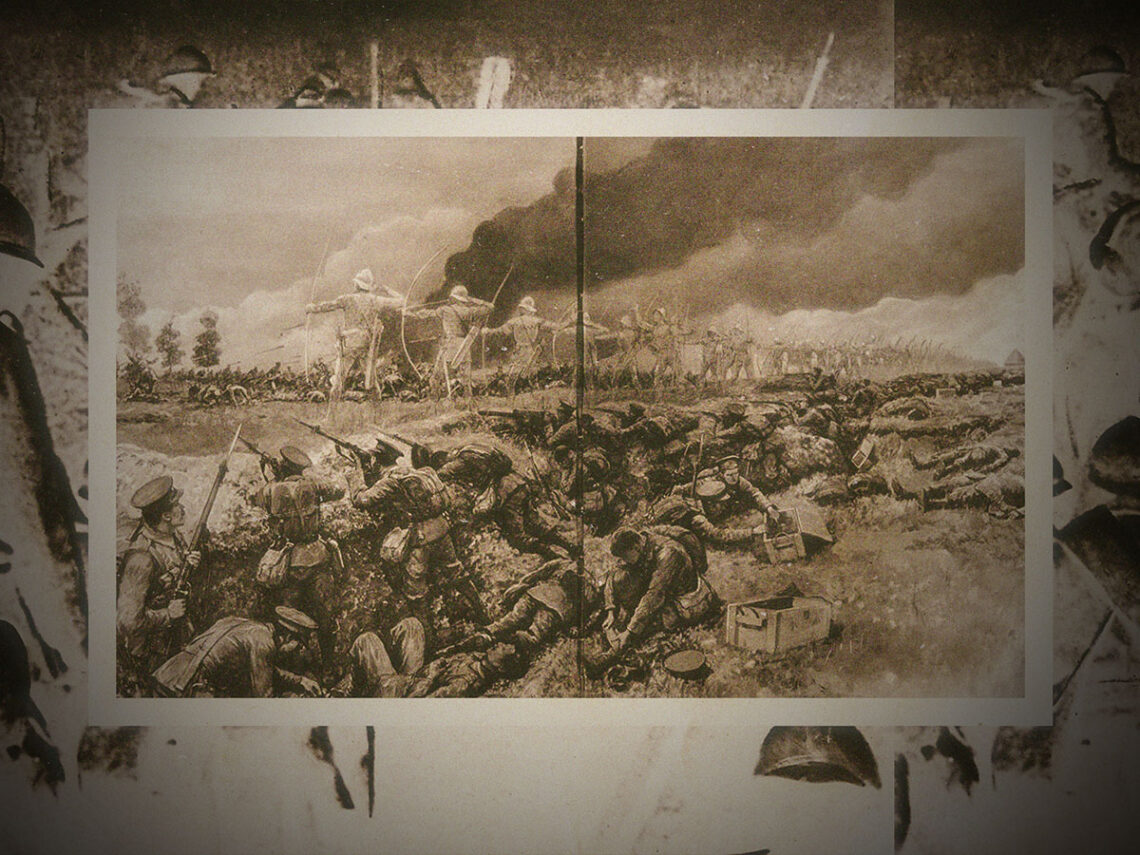
They sustained terrible losses but gave back as good as they got, and only needed to retreat when their French allies fell back first, exposing their right flank. However, people had started to get a first look at the reality of war and wouldn’t believe that it was luck and experience that kept the BEF in the battle. People could only believe it was literal divine intervention. A month after the British Army’s first major battle of World War I, the Welsh author Arthur Machen published the story ‘The Bowmen’, one inspired by accounts he’d heard from returning soldiers from the front.
They had told him that when all hope seemed lost, phantom bowmen from the Battle of Agincourt had descended from the heavens, some led by Saint George himself, and after a blur of activity, some 10,000 German soldiers lay dead. Now, this was almost certainly some fanciful way that some particularly poetic soldiers described the spirit they fought with, but the issue was that Machen’s story was published in many newspapers without a tag marking it out as fiction.
Thus, the story passed into folklore. People still had the romantic ideal of fighting for a glorious cause in their hearts and tried to rationalise it as enacting God’s will on earth. I can guarantee that this romance didn’t last the rest of the year, let alone the rest of World War I.