


‘Little Wars’: Did HG Wells create the role playing game?
In 2025, tabletop role-playing games are a billion-dollar industry.
Critical Role is one of the most popular livestreamed shows on YouTube. Half of the biggest show on TV, Stranger Things, is inspired by Dungeons and Dragons lore, as was one of the biggest video games of 2024, Baldur’s Gate 3. It sounds like a very modern phenomenon because, in a way, it is. It’s taken advantage of very modern technologies like video games, streaming TV and social media to become such a force in pop culture. This is despite the fact that, at its core, tabletop role-playing games are as old school as they come.
They are, in essence, collective storytelling. A bunch of people sat together talking. Each adding to a bigger picture and creating something greater than themselves, that they’ll go and tell others about, creating memories of their own and starting the cycle anew.
It’s part of a legacy that stretches back to the creation of language, yet in a way, it’s one of the newest forms of mass media we have. Theatre, literature and music have centuries of history to their name, while there’s an argument to be made that even cinema is older than the role-playing game.
So, where does this phenomenon come from? Most will say that the hobby began in 1971 with the publication of Gary Gygax and Jeff Perren’s D&D precursor Chainmail, which directly inspired their later phenomenon. However, Chainmail was part of the precursor to role-playing games, the wargame. Something which had over a century and a half’s history before Gygax and Perren’s effort, and was brought to the masses by one of the foremost figures of English Literature.
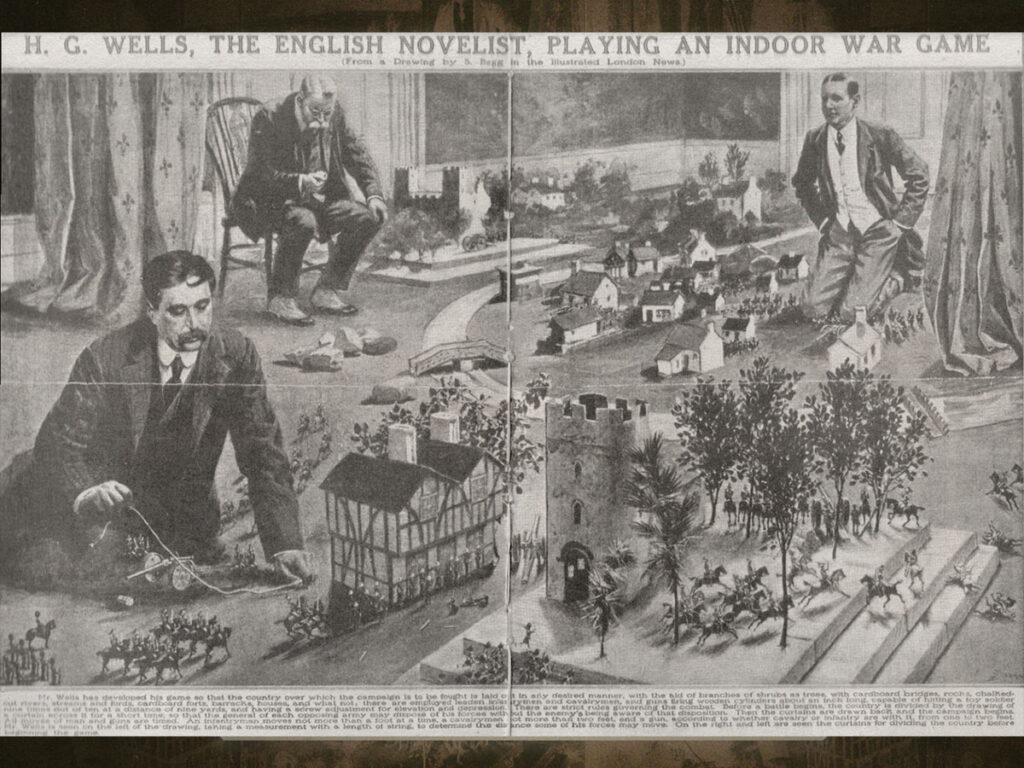
How did HG Wells bring role playing games to life?
The wargame sounds like exactly what it is, basically a souped-up version of chess where models representing military units are moved around a board to simulate battles between two commanders. However, wargames weren’t actually created as a hobby. Weirdly enough, wargames were created in the late 1700s and early 1800s as an actual tactic to train budding military commanders, and what’s more, they worked.
The military that established the Kingdom of Prussia and later Germany as forces to be reckoned with, despite their tender age, was built on a wargame designed by an advisor to the Duke of Brunswick, Johann Hellwig. This gave their commanders a facsimile of battle experience that most young military commanders just couldn’t replicate. 100 years after these wargames were used for military training, a writer by the name of Herbert George Wells wrote the rules to a wargame of his own.
While Little Wars is ostensibly a rules system for turning toy soldiers into units for wargaming, what they really are is a response to what wargames actually did. They turned war into a game. Winnable if you’re willing to sacrifice the right units. Which, in reality, becomes the right people. Which is why, for me, Little Wars deserves to be counted as a role-playing game rather than a wargame. The actual gameplay was secondary to the pacifistic message that you hopefully gained by playing it.
The trouble was that Little Wars was published in 1913. A single year after its publication, Wells was faced with the sobering realisation that his message was written far too late.