


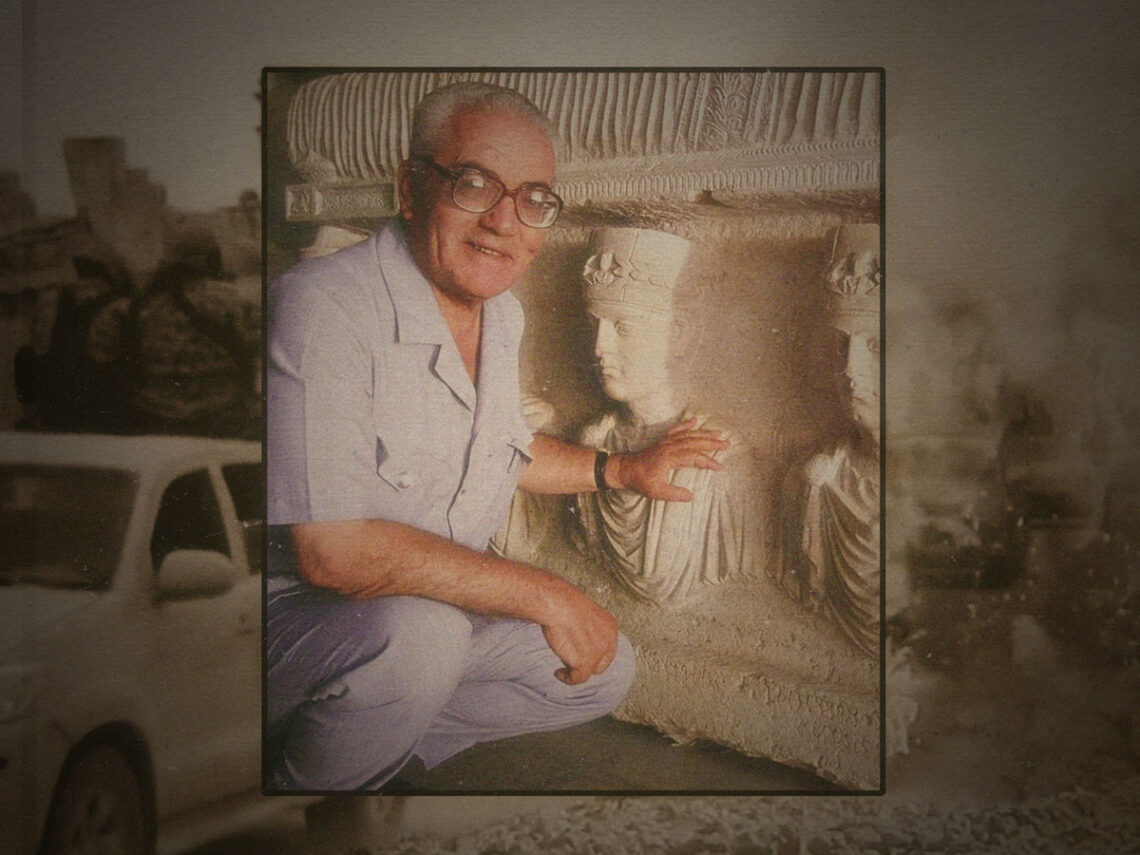
Khaled al-Asaad: the world’s bravest archaeologist who told ISIS to get fucked
Ask any archaeologist about Indiana Jones and you’ll typically get a knowing sigh and a roll of the eyes.
It’s a complicated topic because, on the one hand, it’s essentially the only thing a non-archaeologist will know about archaeology. That once upon a time, Harrison Ford and Steven Spielberg teamed up to make an absolute banger of a film called Raiders of the Lost Ark and made archaeology look like an absolute riot of tomb raiding, whip flinging and Nazi punching. Then there were a few others that weren’t as good. Each of them is still the first thing people think of when they think of archaeology.
Thus, real-life archaeologists are more than a little sick of fielding questions about Dr Jones’ exploits. “No, it’s not quite as glamorous as all that.” “No, it’s not that dangerous or exciting, it’s more about dusting rocks than running from boulders.” “No, very few of us look like prime Harrison Ford.” Yet they’ll never truly hate those questions because of the basic truth that the vast, vast majority of archaeologists first dream of their job because of the Indiana Jones movies.
I know I did when I first watched Raiders of the Lost Ark when I was a kid, how could you not? It is a work of fantasy, though, as are most things that feature terrifying evil spirits, the immortal keeper of the Holy Grail and anyone who can stand Willie Scott. However, the real-life stories of archaeologists who’ve resisted fascists are even more incredible than any Indie yarn, with none better, or more heartbreaking than that of Khaled al-Asaad.
Who was Khaled al-Asaad?
Born in 1932 and raised in Palmyra, Syria, al-Asaad dedicated his working life to unearthing the secrets of his home city, becoming the primary custodian of Palmyra in 1962.
His work excavating the ancient city singlehandedly elevated his home town to the status of a UNESCO World Heritage Site. It sounds like a good, long life. He followed his passion both for history and his home city and became internationally celebrated for it. By the time of his retirement in 2003 at the age of 71, he was a father and a grandfather, one of the genuine leading lights of his field. Darker times were still to come, though.
In May 2015, Palmyra fell to the Islamic State. Despite being over 80 years old, al-Asaad had come out of retirement a few months prior, when it became clear that the arrival of IS was a matter of when, not if. IS had been selling the historical artefacts of the cities they’d invaded to fund their war efforts, and thus, al-Asaad had helped evacuate the city museum of its priceless artefacts in time for IS’ arrival. He was not so lucky. He and his son were captured and detained by IS, and al-Asaad was tortured for a month to give up the location of the museum’s artefacts.
Perhaps al-Asaad reasoned that he’d lead a long, good life already. Perhaps he felt like he’d spent too long unearthing these artefacts, and he wasn’t about to let these thugs desecrate them. One way or another, the absolute hero didn’t break. After that month, IS’ patience wore out, and they murdered al-Assad, beheading him in a public execution.
Never forget, there are heroes in the real world. Loads of them. Just look for whoever is looking fascists dead in the eye and telling them “No”.