


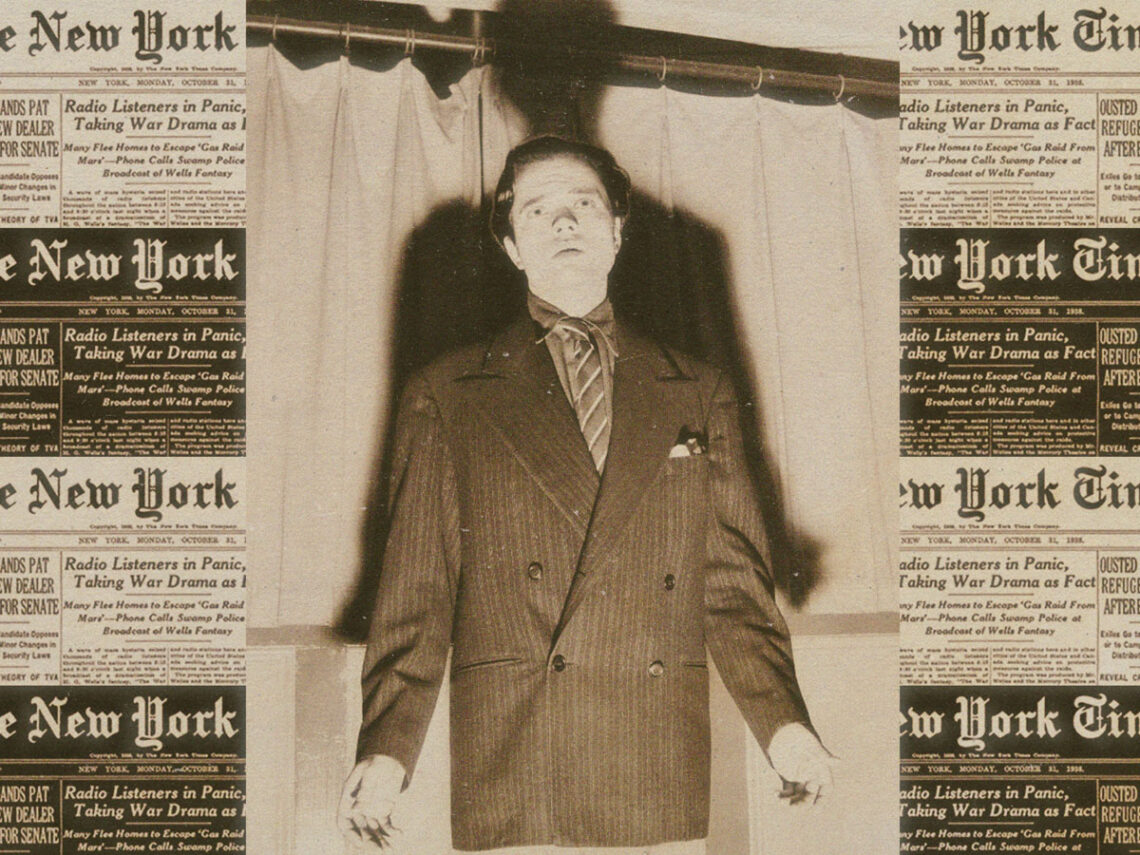
Phony War: Did Orson Welles really start riots with ‘War of the Worlds’?
Orson Welles was a consummate trickster.
This isn’t a slight or slander on the great man’s name, by the way. One of the people who would most often call Orson Welles a fraud and a charlatan was noted actor and director Orson Welles. Which makes sense, as after all, he’d be well familiar with all the ways he’s lied and charmed his way up the ladder of success; he’d lived them first-hand.
From the moment he strode into Dublin’s Gate Theatre at the age of 16 and conned them into giving him the lead in their upcoming productions by claiming to be a Broadway star, few people have defined faking it until you make it quite like Orson Welles.
To be fair to the lad, the barefaced lying was step one. It was the way to put a foot in the door. As famed footballing conman Ali Dia found out the hard way, it’s one thing to con Graham Souness into giving you a contract at Southampton. It’s another thing to actually play football for him, and Dia was exposed as a fraud the moment he stepped onto the pitch. Whereas, while Welles had never tread a Broadway board on account of still being too young to drink alcohol, once he stepped on stage, his ferocious acting talent made it clear that he belonged there.
By the age of 20, Welles was the most exciting writer and director in the American theatre. Since he’d been supplementing his income by appearing as an actor in radio plays, he’d also become very familiar with that medium. In 1938, when Welles was still (astonishingly) 23 years of age, he combined the three skills in one of his most infamous productions. He adapted a classic novel into a radio play, directed it to be a genuinely progressive production that today comes across as the radio equivalent of found footage, and then fronted the piece with one of his best performances as an actor.
While this should have been proof of his creative genius, the irony of it all is that it instead came across as more of a con than anything else he’d produced to this point.
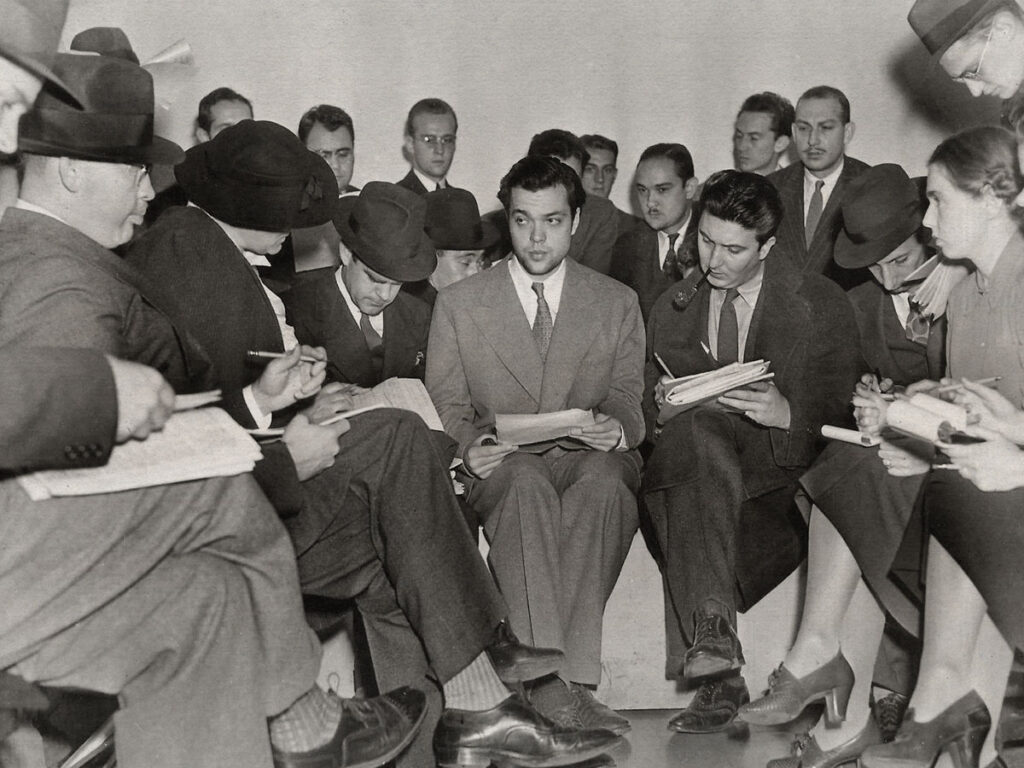
Did Orson Welles start riots with a radio play?
On October 30th, 1938, Orson Welles and his Mercury Theatre broadcast their adaptation of HG Wells’ The War of the Worlds.
If you haven’t heard it and have a spare hour or so, the show is still an absolutely fascinating piece of audio drama. It peaks early, with the second half of the show tailing off in much the same way the book does, but the first half is absolutely electric. It’s presented as a breaking news broadcast, with Frank Readick waltzing away with the entire show as the reporter covering the moment the Martians open fire on Earth in a still-terrifying moment.
This production has gone down in history for causing a nationwide panic, with entire towns fleeing into the night to escape the alien threat that was, supposedly, being covered by a news broadcast. Now, we do know that this is at least partially true. One of the audio engineers of the broadcast took a phone call from their bosses demanding that they interrupt the show to remind the audience that this was a fiction, such was the amount of panicked phone calls the network was getting. Welles ignored these demands and carried on nonetheless.
However, perhaps this is all part of the trick Welles is playing. There are barely any reliable reports of entire towns swept up by panic at the invading aliens. Not even in New York City, where the invasion was supposedly happening. The show might have been presented as a news bulletin, but only the opening 20 minutes before settling into a more normal radio drama. Plus, the show was bookended by announcements stating that this was a work of fiction. If you asked Welles, people only tuned in after it started and missed those, but then, he would say that, wouldn’t he?
After all, Orson Welles was a consummate trickster. If you thought you weren’t right in the palm of his hand, that was exactly where you were.