


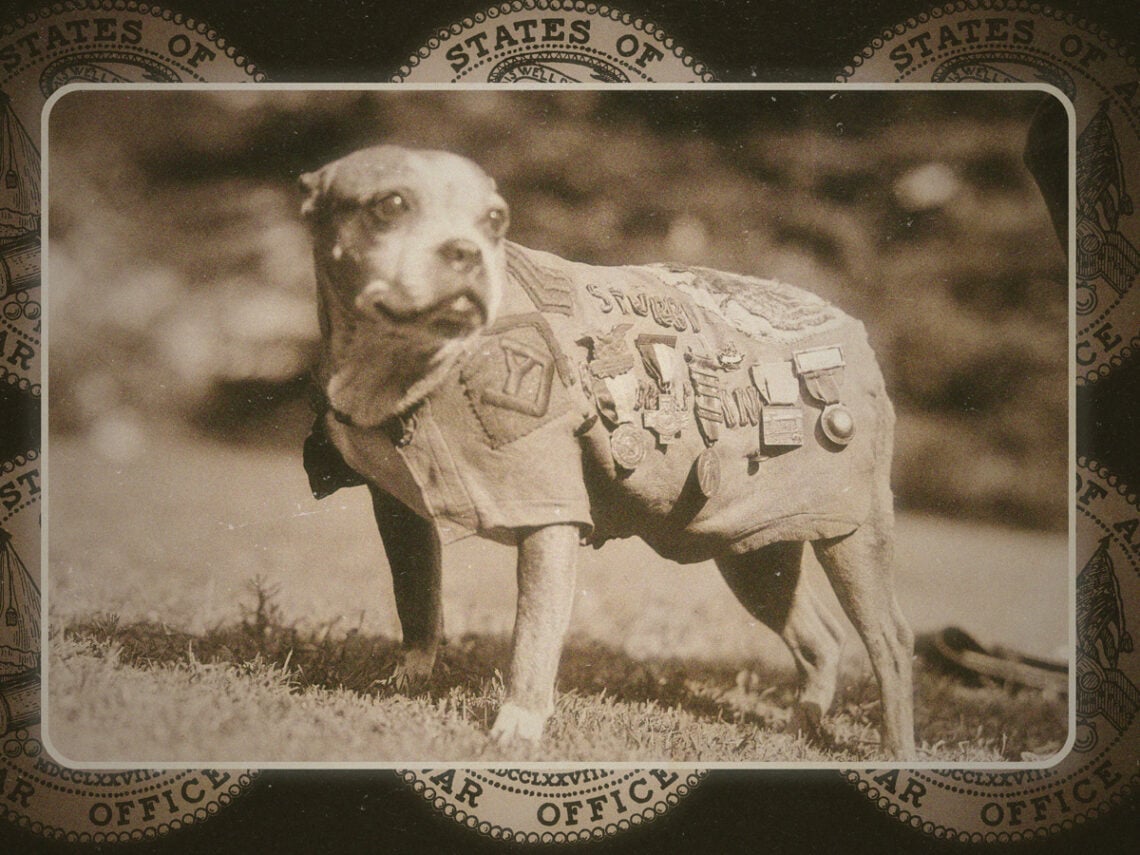
Sergeant Stubby: The most decorated four-legged soldier in WWI
It’s stories like this that make me reflect on the whole incomprehensible nature of what war means to humanity.
On the one hand, it’s an incredible story of how you can find human nature in pretty much anything, whether they’re human or not. There’s an indomitable spirit that connects us to nature in a way that we’ll never truly understand, and if we give it our trust, we can achieve anything, no matter the horrific odds we’re faced with.
On the other hand, it’s pretty explicitly an attempt to put an adorable, friendly face on war. Otherwise known as the things that governments do when the proles are getting a little out of hand and a cull of them is needed.
It is undeniable, though, that the story of Sergeant Stubby is incredible. He was a Boston terrier mutt that was found wandering the grounds of Yale University in 1917, where members of the 102nd Infantry were training. One soldier in particular, Corporal James Robert Conroy, took a particular liking to him, and when it came time for the outfit to ship out to France, Conroy hid him under his coat and snuck him onboard the ship carrying him to France. When Conroy’s commanding officer discovered Stubby, the little terrier saluted him as Conroy had trained him to. This melted the CO’s heart, and he let their new arrival stay on the ship.
Which is a very adorable way of saying that they let a dog join them in the front lines of World War One, where thousands of soldiers were dying every day. However, he was an invaluable boost to morale, and thus, he was again allowed to stay. This was despite being in such mortal peril that he eventually had to be sent back to the rear guard after being wounded by a stray German grenade. Again, the dichotomy of war stories. Isn’t it great that we gave this little pup a medal.
Just ignore the fact that we also made it get blown up with a grenade.
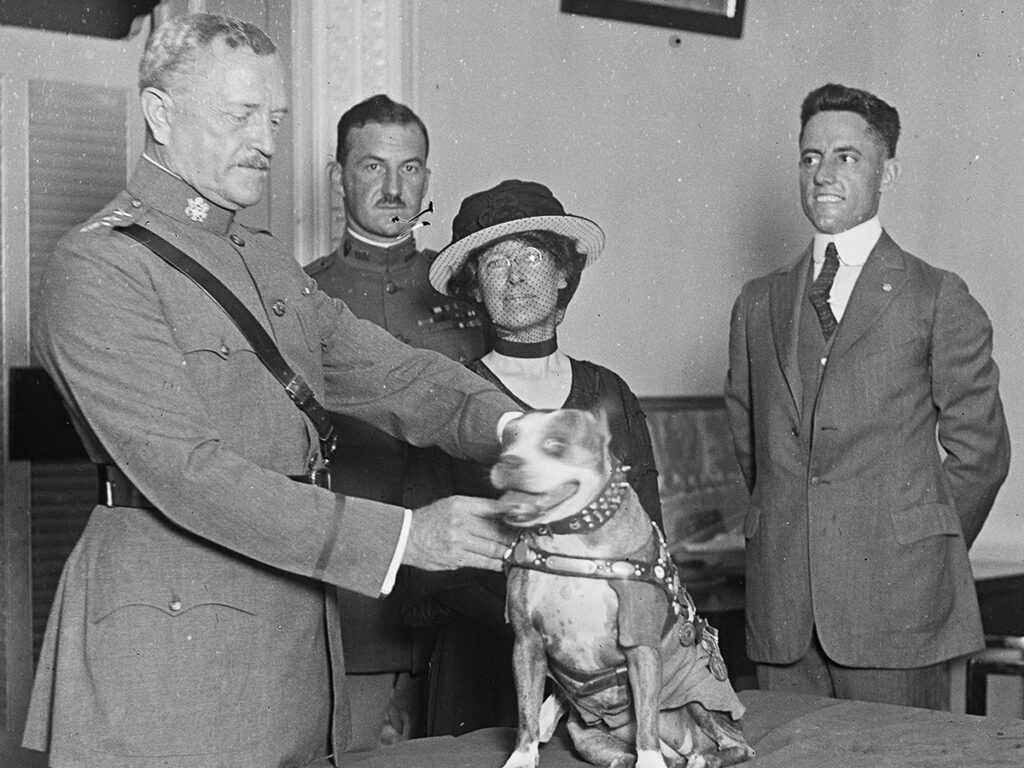
How did Stubby serve the rest of their time in the war?
After returning to the front, the new threat to the squaddies was no longer grenades but gas. The front was being terrorised by gas attacks, and thus, Stubby was kitted out with a little doggie gas mask of his own. However, the gas attacks were also what made Stubby much, much more than just a morale-booster. After all, what sense in the entire animal kingdom is more refined than a dog’s sense of smell? Suddenly, Stubby became a particularly adorable early warning system.
He was trained to recognise the smell of mustard gas and was instrumental in alerting his unit to incoming gas attacks. Stubby was so good at this that the unit began teaching him to spot all manner of things. His hearing was so acute that he could hear oncoming artillery before any early warning system made by man at the time. He was adept at locating injured soldiers in No Man’s Land. He was even able to uncover a German spy operating within the unit, and these feats got him promoted to the rank of Sergeant.
Given that Stubby wasn’t deployed until 1918, his wartime career was, thankfully, short. When the First World War came to an end in the same year, he was sent home and became something of a celebrity. Because after all, what government doesn’t want to put a friendly face on a recruitment campaign? Stubby’s face was friendlier than any human’s, so he was shoved out in front of presidents, theatres, and football stadiums, all in the name of good publicity.
Even today, a literal century after his death in 1926, he still stands as a monument to American achievements in warfare. His remains were taxidermied and placed in the National Museum of American History. One can’t help but imagine that after his death, the humane thing to do would be to let the poor dog rest, but no.
The war machine’s gotta keep turning somehow.