


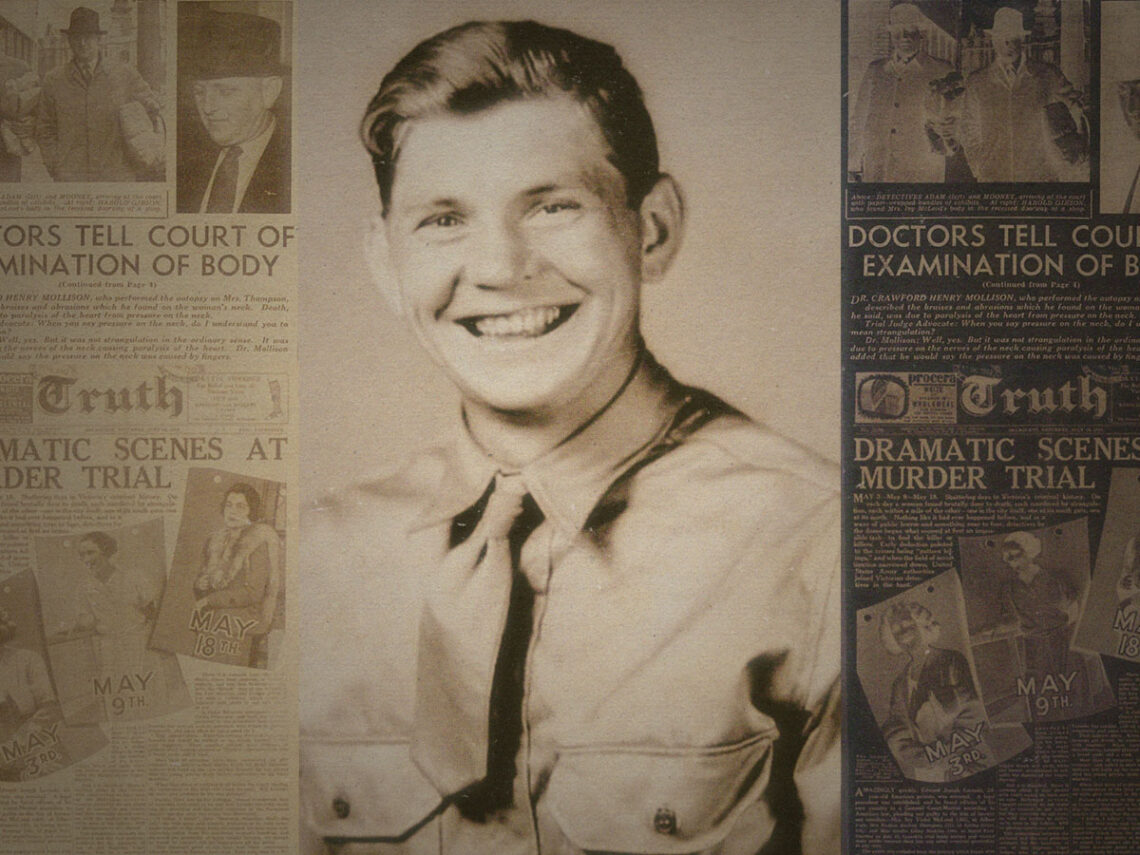
Edward Leonski: the 1942 serial killer who murdered women to “steal their voices
People like to think that they can tell a wrong-un from just the way they look. You hear it all the time, when someone is nicked for a crime that chills us to the core, any photo of them posted on social media is pelted with called of “they even look like a serial killer/rapist/whatever”.
Not to date this article too much, but that is absolutely cope. Cope that comes from a place of self-soothing, with us desperately wanting to believe that we can spot a danger to ourselves a mile off, despite all the evidence we have to the contrary. Anyone around us who looks “like a serial killer” probably isn’t. Which leads us to the even more terrifying prospect. That anyone around us who doesn’t look like a serial killer… well. They probably aren’t either. Probably.
Take one look at Edward Leonski for a perfect example of this. Leonski was a New Jersey native, born on December 12th, 1917. You never want to sound like you’re babying someone who committed heinous crimes (and seriously, she’ll get to those), but Leonski, like so many a serial killer, had a rough upbringing. He was born to an alcoholic father and an abusive, controlling mother. One of his brothers was committed to a mental institution when Leonski was a child. He grew up on the streets, not only of his native New Jersey but anywhere that would have him.
His violent tendencies couldn’t be contained by his love of boxing and bodybuilding. He physically assaulted a woman in the street in San Antonio, Texas, for no reason whatsoever, and got away with it scot-free. Come 1941, and his draft into the United States army, he was probably doing cartwheels with joy at the prospect of harming others and getting away with it. Because this was a man who clearly valued harming others over anything else, yet if you looked at him, you’d think butter wouldn’t melt in his mouth.
His sandy, blond hair slicked to the side, his slightly gormless grin, all give the air of a golden retriever of a lad. Not much going on between his sizeable ears, but a good lad at heart. He probably got away with a whole lot more unconscionable actions that we don’t know about today because of those looks. However, after he was stationed in Melbourne, Australia, something seemed to snap in Leonski that even his looks and the privilege that came with being an American soldier in 1942 couldn’t solve.
In the early morning of May 2nd, 1942, Ivy McCleod was found strangled to death in Albert Park, Melbourne. Six days later, Pauline Thompson was also found strangled to death. Both of them had all their valuables still on them when they were found, so robbery wasn’t the motive.
A third victim, Gladys Hosking, was found shortly afterwards. After that, several other women in Melbourne reported that they’d survived attacks from the same American serviceman, before enough of them came together to pick Leonski out of a police lineup.
He confessed shortly afterwards and was sentenced to death at a court-martial. In his confession, he said that what had caused him to kill his victims was their voices – not just to silence them, but to keep them for himself, as he fetishised their voices above all else, and the truly tragic part is that this was a violent and misogynistic streak that anyone could see from space, yet Leonski kept getting chance after chance, no matter how many people he hurt.
After all, he just didn’t look like a killer.