


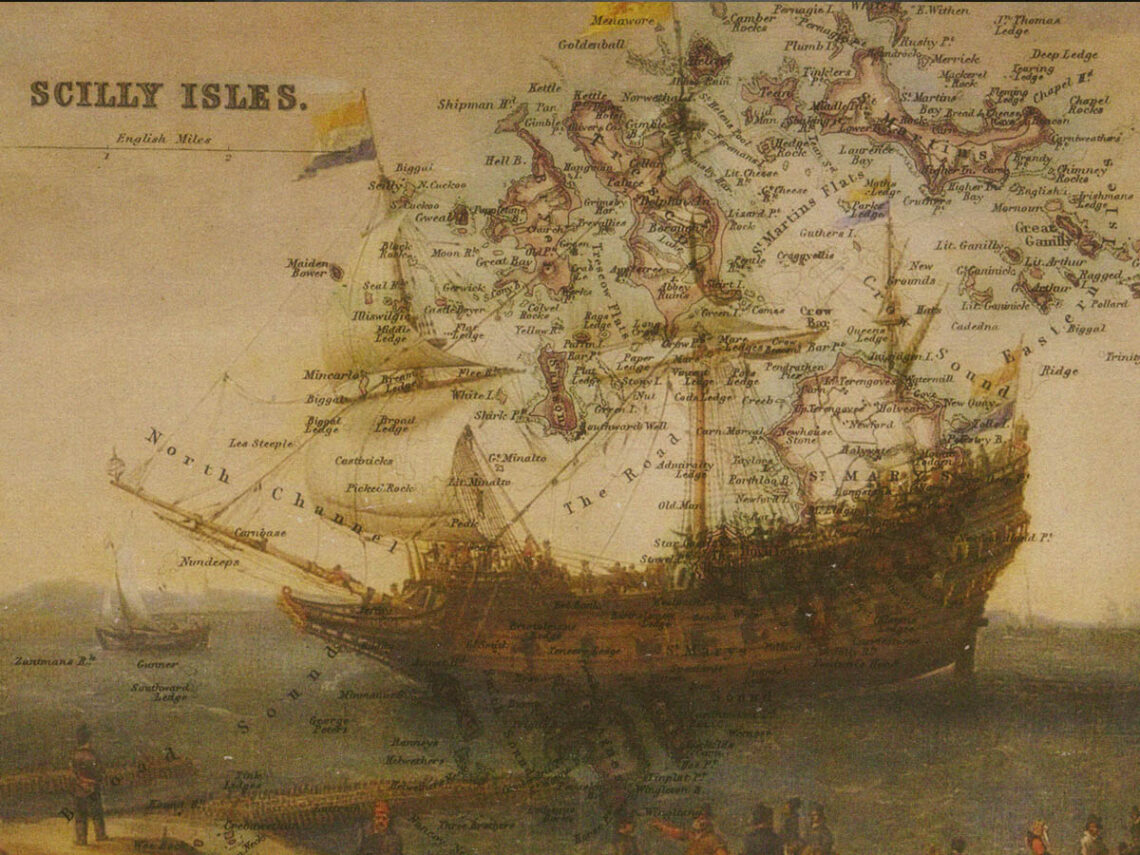
What is it good for!?: The 335 year war that ended in 1986
The year is 1648, and in England, the unthinkable is happening. The sky is green. Down is up. Dogs and cats are living together, and categorically more insane than any of them, the English monarchy is about to be wiped out in a brutal civil war.
This is because 1648 was the twilight years of the English Civil War, when puritan, politician and all-around bastard Oliver Cromwell led the Parliamentarian army against tyrant, king and fellow bastard Charles I and his slightly more bearable son Charles II. The war had basically already been won by Cromwell and his forces, having driven the monarchy from the capital and any of its major strongholds and forced them into the last remaining monarchist stronghold of Cornwall, on the southernmost tip of England.
Cromwell was nothing if not a completist, though, and carried on fighting until the royalists had to flee the mainland and settle on one of the two main characters of this particular story, the Isles of Scilly, an archipelago off the coast of Cornwall. This was the turf of John Granville, a staunch Royalist who welcomed Charles’s forces with open arms. There was a slight issue here, however, one which leads to the second main character of this story.
You see, the Parliamentarians had allies. England and the Netherlands had fought on the same sides of a number of wars going back multiple centuries. Thus, both the Royalists and the Parliamentarians reached out to them for help when the Civil War truly broke out. Seeing which way the wind was blowing, the Dutch forces sided with the Parliamentarians. So, almost as soon as the Royalists settled on the Scilly Isles, they suddenly had a number of Dutch warships up their taint trying to end the war on behalf of the Parliamentarians. However, this was a much, much harder task than anyone would have expected.
The Royalists had managed to maintain a fairly strong hold of the Navy. It is, after all, the Royal Navy. Thus, they could actually fight back against the Dutch fleets and, in true Royal Navy fashion, absolutely trucked them in naval combat. So much so that in 1651, the Lieutenant Admiral of the Dutch navy, Maarten van Tromp, arrived in person on the Scilly Isles to demand recompense for the Dutch ships and cargo lost in their skirmishes.
When these demands went ignored, the Netherlands declared war on the Isle of Scilly. Later that year, however, the Royalists officially surrendered. The English Civil War was finally over, and the Dutch went back to the Netherlands, proud to have backed the winning side. The problem was that the Royalist forces surrendered to Cromwell’s Parliamentarians. The Isle of Scilly hadn’t surrendered shit, much less to the Dutch forces. Thus, their war continued, unbeknownst to anyone, for the next 335 years.
Now, this is a great story. Like most great stories, it’s kind of a work of fiction. Tromp was a high-ranking military official, but high-ranking military officials can’t single-handedly declare war on a country. You’d think that some people would understand that today, but no. He absolutely threatened it, though, and the Isle of Scilly was a territory of England, which the Dutch were (technically) at war with as well as allied with (civil wars are complicated). However, all that means that the Royalist surrender would have included the Scilly Isles by definition.
However, never let the truth get in the way of a good story, and when historian Roy Duncan found that no official peace treaty had ever been signed between the Dutch and the Isle of Scilly, the Dutch ambassador to England was promptly dispatched to Scilly and a “ceasefire” was signed.
Thus somewhat legitimising the last three centuries of “combat” between the two sides.