


The Doctors’ Riot: The insidious grave-robbing trend that led to civil unrest in 1788
The so-called “resurrectionists” had a brass neck to give themselves a nickname that cool. They were nothing more than grave robbers at best and at worst, as this story from 18th-century New York shows, something much more insidious.
As a species, we’ve always been particularly weird about death. There’s an argument to be made that that’s perfectly justified. Especially when you take into account not only the emotional stakes of losing someone you love, but also the practical aspects of it.
Death is decay. It’s literally inhuman, and at one stage, death was even contagious. Thankfully, we’ve taken leaps and bounds in hygiene and health care in the last hundred years. But, before that, when someone spent much time near a dead body, it stood to reason that they would turn up dead too.
The first generation of doctors studying cadavers was seen as ghoulish and unnecessary. Poking around in “God’s domain” for the sake of it. Thus, hospitals and laboratorys actually getting a hold of corpses to study on was incredibly hard. This led to a black market of grave robbers digging up the recently deceased and selling them off to these institutions, who bought them for study purposes. A crime that was arguably necessary for the sake of future generations.
The problem was the fact that the most accessible cadavers came from paupers’ graves and, in late 18th-century America, those gravesites were mostly filled with the bodies of Black people, most of whom had been enslaved. Such was the case with the lot closest to Columbia College, the only licensed medical school in New York City.
Many Black corpses were sold to the school to be experimented on. This was an open secret at the time, so much so that a group of freedmen witnessed these “resurrectionists” at work in February 1788, stealing and selling their kin even after their death.
These freedmen reported this activity to the Common Council. It went ignored, surprisingly…
No authority would take action against it. Instead, it took a mass act of violence before something was eventually done about it. However, it began with a truly stupid move.
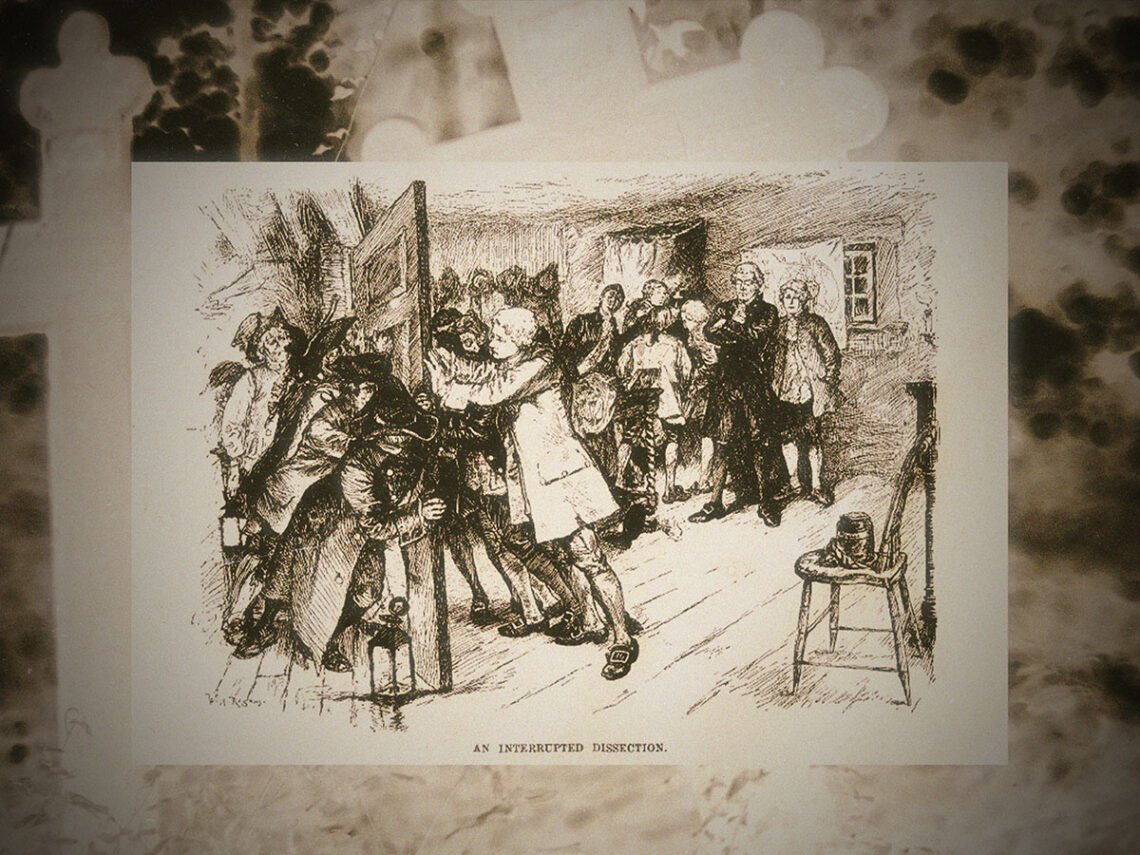
In April of the same year, a group of children were playing near a New York hospital and happened to spot a physician dissecting a human arm. They stopped to gawk, and the good doctor scared them away by picking up the arm and telling them it belonged to their mother.
While it was nothing more than a prank, one of the boys had actually lost his mother recently and sprinted home in tears. His father dug up his mother’s grave and found her coffin to be empty. He gathered an angry mob who marched on the hospital, breaking in to find several corpses of their friends and loved ones dissected and experimented on. This grew into a riot of well over 2000 people searching the streets for doctors to string up for their crimes.
It took days for the riot to be quelled, with the governor of New York sending militia into the streets to disrupt and scatter any gangs still out to cause trouble. The aftermath of these riots was harsher punishments for graverobbers and more protection set aside for grave sites. Good things in a vacuum. The issue was that it also set medical science back years, as the physicians and doctors were seen as ghouls for decades to come in New York. Restrictions were placed on the access they had to cadavers, and thus, medical research in the state slowed to a crawl.
To think it could have all been solved months ago had the word of those men been taken seriously. A real sliding doors moment for medicine in New York City.