


The grisly history of the Chelsea Hotel
People have this idea that the United States of America “has no history“.
As far as bits of banter go, it’s a relatively harmless one. There are pubs in London twice the age of the States alone, and painting the Yanks as the world’s nouveau riche is a fun stick to beat them with, especially when you take into account just how desperate they are as a nation to have their own culture.
Case in point: North Carolina barbecue is different to South Carolina barbecue, and there are people willing to kill and die on the hill that a true South Carolinian would add a mouldy sock to his barbecue before adding coleslaw to it. That’s for those mutants up North.
Yet, let’s be real here, of course, the US has history; it just depends on your definition of “history”. If you’re talking about royal dynasties stretching back thousands of years and buildings that have seen the rise and fall of countless regimes, then not quite. If you’re talking about a truly inclusive definition of history that’s just “people documenting their own stories,” then you’ve got another thing common.
Sure, there are no royal families to peruse (and there never fucking will be), but if you want stories from thousands of years ago, the countless Native American reservation sites will have some stories for you, let me tell you.
On the other hand, a place like New York City has more genuine history in an average corner than most cities, even if it’s about a quarter of those cities’ age. Among the best examples of this come from West 23rd Street’s Chelsea Hotel, a place where life has been lived, lost, and everything in between for decades. As much a historical site as any castle you care to mention, with just as much intrigue and dirty secrets to boot.
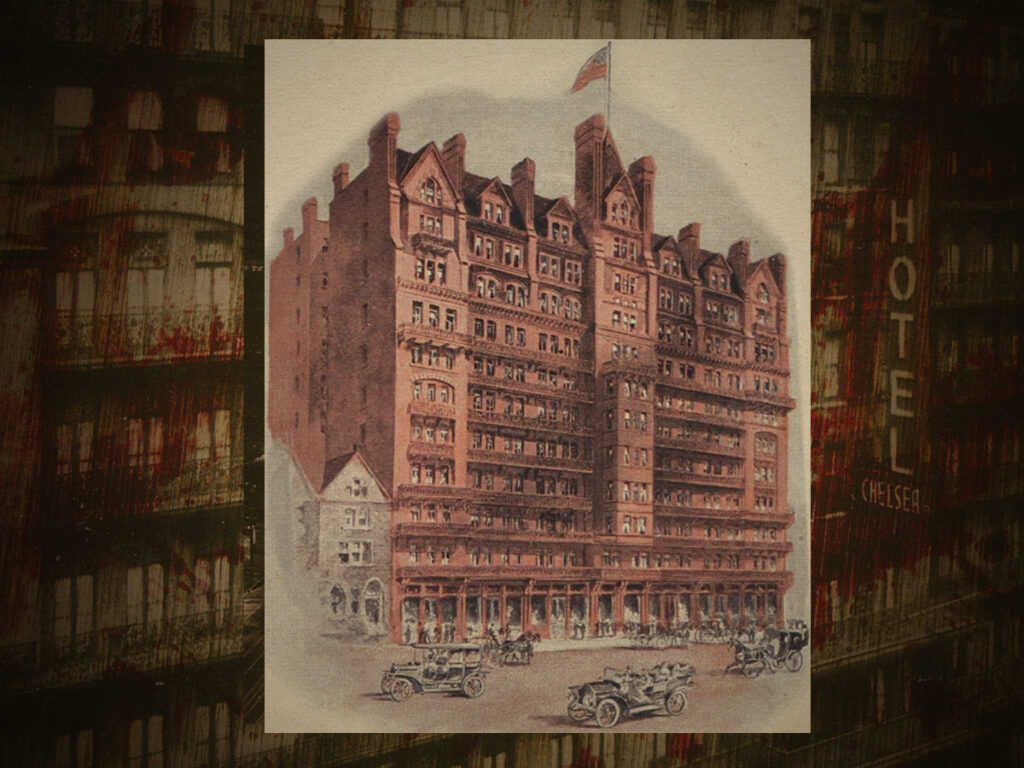
What are the stories of the Chelsea Hotel?
When you inspire a Leonard Cohen song, you know you’re doing something right and for years, the Chelsea Hotel was doing pretty much everything right. It was a hotbed for artists and bohemians, principally because it looks absolutely gorgeous from the outside (it’s still one of the more beautiful buildings in Manhattan, and that’s saying quite a bit), yet for decades, it was falling apart on the inside. Of course, artists loved it; it’s basically the same as all their romantic partners.
Of course, the names most associated with the Chelsea Hotel are absolute goddamn legends from the 1960s and 1970s: Bob Dylan, Joan Baez, Patti Smith and (regrettably) Sid Vicious and Nancy Spungen. However, the connection with alternative artists goes back further than that. All those artists were inspired by the legends of literature that called the Chelsea Hotel home before them, like Arthur Rimbaud, Mark Twain and especially Dylan Thomas, who died there in 1953.
Yet some of the most shocking stories of the Chelsea Hotel date back even further than that, and have nothing to do with any artist of Cohen or Thomas’ fame. Chief among them is the disturbing story of Etelka Graf, the wife of a concert pianist who stayed in the hotel in 1922. Now, I must preface this story with the fact that there are very few sources that cite this tale as fact, other than a few newspaper stories of the time, and basically nothing else is known of Graf other than her death, but to be fair to her, anyone would be remembered for going out like this.
According to legend, Graf jumped out of her fifth-story window, landing on the third-floor balcony without surviving the fall. That, horribly enough, wasn’t the truly disturbing part, though. That would be the fact that before the deed was done, Graf took a pair of industrial-strength scissors, cut her left hand off, and left it on her bed for her daughter to find. The story does have a truly grisly punchline if you believe one apocryphal version of it. According to some versions of the tale, Graf was Etelka’s married name. Her maiden name?
Sever.