


Sartre and Beauvoir: The love affair that shaped existentialism
The Cambridge Dictionary Word of the Year for 2025 was “parasocial”, and I can’t think of a more fitting word to sum up this era where being close to someone should be easier than ever. In practice, it’s harder than ever to truly know someone, let alone love them.
For those of you who don’t know, the concept of a parasocial relationship is one where you feel like you know someone personally, despite the fact that you don’t. It’s an inherently imbalanced power dynamic that has lead to truly horrific situations, but here’s the thing, it doesn’t actually have to be that way. Some parasocial relationships can be the healthy kind of soothing, and some can even be downright educational, especially by learning about the personal lives of some of the greatest thinkers of our time.
Which brings us to the relationship between Jean Paul Sartre and Simone de Beauvoir. One would assume that looking into their personal lives could only be a frivolous exercise in feeling “close” with two people born before the First World War. However, learning about their relationship can illuminate their philosophy. Showing how their way of thinking wasn’t confined to books and lectures, but was the very building blocks of their life.
Which is the way it should be, right? Intellectual discourse is so dead these days that the most famous “philosopher” of the past 20 years is a man who extolled the virtues of tidying your room while his house looked like a bomb site. Yes, looking into the personal lives of anyone you don’t know personally can be a slippery slope, but it can also show whether these people are more than just con artists who know how to sound clever to stupid people.
It should go without saying, but Sartre and de Beauvoir were absolutely the real deal.
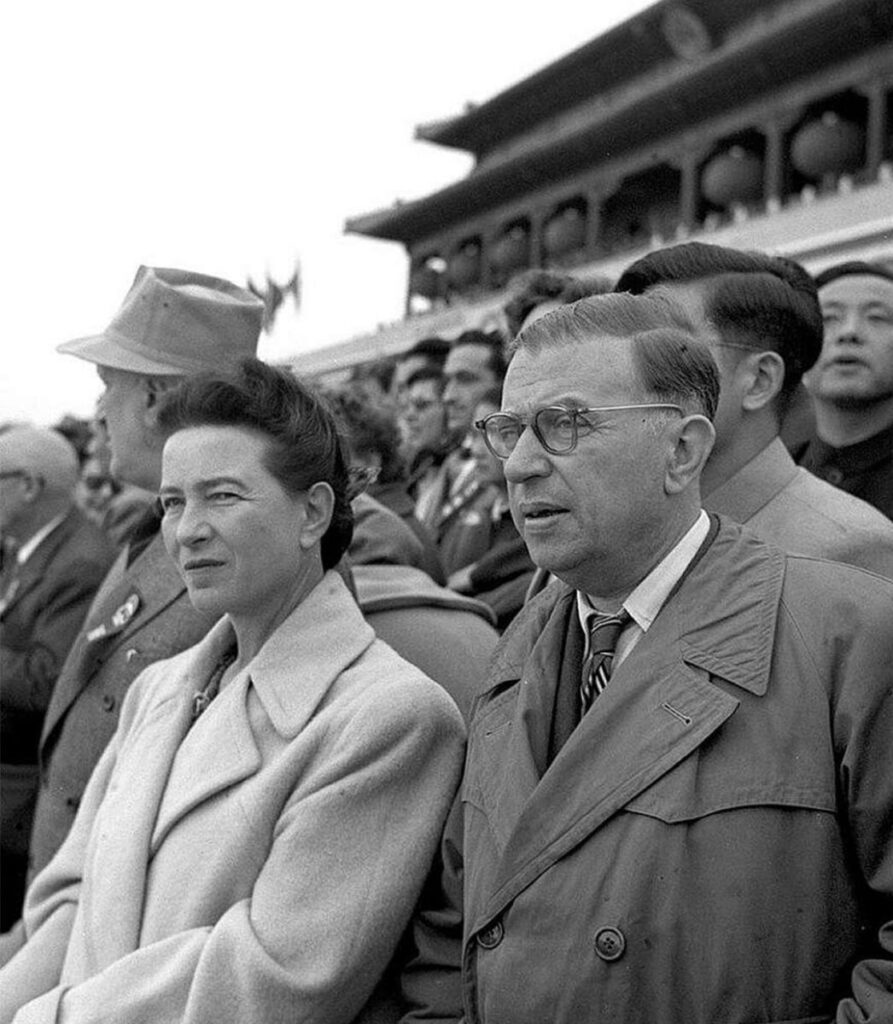
How did their love story shape existentialism?
Sartre and de Beauvoir are arguably the two philosophers most associated with the existentialist movement.
Countless books have been written by countless writers about the nature of existentialism, but in a nutshell, the movement is about how to find meaning in a meaningless world. They question the nature of (there’s that word again) existence and find the power inherent in how the meaning of life is entirely what you make of it.
Which could sound like nihilism to a layman, yet Sartre and de Beauvoir’s relationship shows this not to be the case. The two of them believed that true freedom lay in taking true responsibility for your actions. That nothing and no one has the right to enforce beliefs or behaviours on someone so long as that person accepts the consequences of it on others. What’s more, we don’t have to read their books to see this, but see their relationship instead.
For 51 years, Sartre and de Beauvoir had a very specific kind of romantic relationship. They were devoted to each other but both were welcome to take other lovers and spend time apart from the other as and when they pleased, so long as they were honest with each other at all times. This made their behaviour more than mere libertarianism or hedonism. They weren’t indebted to a society they didn’t believe in; they were indebted to the people they loved.
That’s as existentialist as it gets, and a philosophy all of us can learn from.