


‘Tibetan Book of the Dead’: What is the text that took hold of counterculture rock actually about?
Let’s be real here, the influence of so-called “Eastern Mysticism” in rock music in the 1960s was little more than a bunch of white boys with too much money being tourists.
To be clear, this isn’t the end of the world or proof of their fundamental moral failing (for that, just look at the ages of all their “girlfriends”). There are worse things to be than curious about cultures other than your own, far worse in fact. With vanishingly few exceptions, though, everyone who dabbled with Buddhism, Hinduism, Hare Krishna and the like was doing it because it was the style of the time at best and because they were bored at worst.
Not everyone was George Harrison, who had his head genuinely turned by the teachings of Swami Vivekananda and Paramahansa Yogananda. The vast majority of these rock kids taking up the sitar and giving transcendental meditation the old college try were more likely going the Rolling Stones circa Their Satanic Majesties Request era. Treating it as a new costume to try on, then throw away when they got bored.
The problem is that this costume they’re trying on is based on some of the most ancient and influential philosophies yet created by man. For proof of this, look at how the Tibetan Book of the Dead became, for all intents and purposes, a prop thrown around by pretentious rock stars. Good for inspiring a pop song or two before moving on to the next fad. Granted, one of the songs it’s responsible for inspiring is ‘Tomorrow Never Knows’, one of the greatest pop songs ever, but the Bardo Thödol is worth a lot more consideration than that.
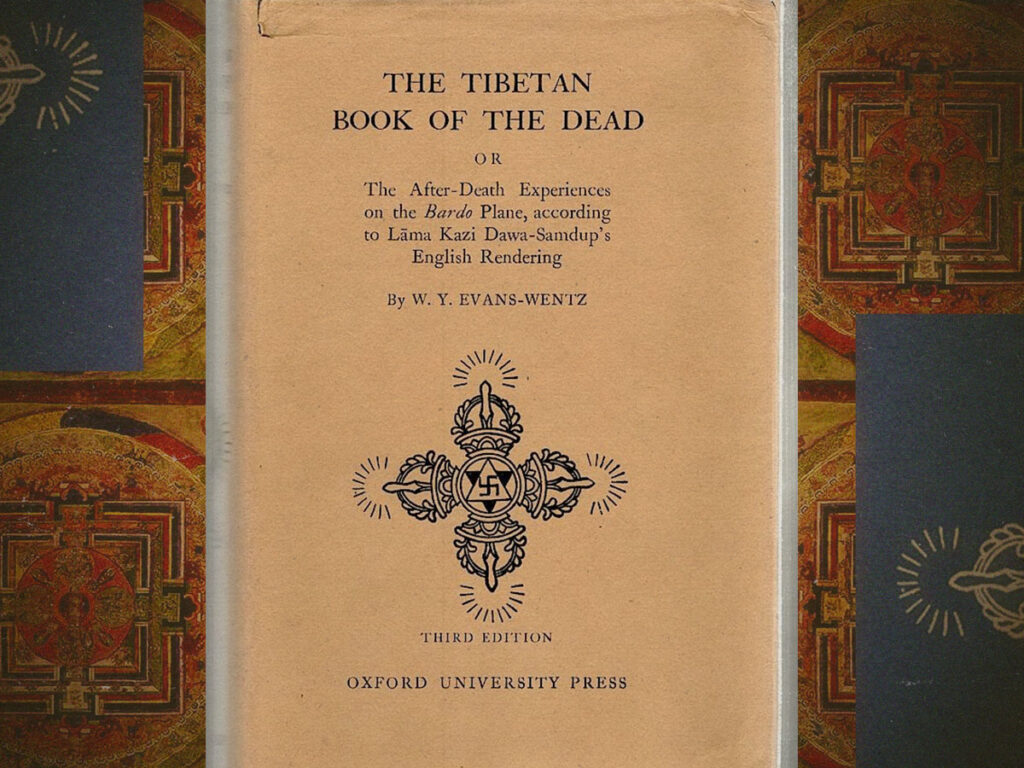
What is the Tibetan Book of the Dead actually about?
The Tibetan Book of the Dead is one of the texts most closely associated with Tibetan Buddhism.
One of the core tenets of this philosophy is that attachment to earthly possessions and wealth creates suffering. Say what you want about “imagine no possessions” coming from a former Beatle, but he at least retained some of the teachings from his brush with Buddhism. For a follower of the religion, one’s life must be led free of earthly attachments, as for a Buddhist, one’s life on this earth is what some might call “step one”.
Death is not the end in Buddhist philosophy, far from it. In fact, that’s why the Tibetan Book of the Dead was written. The philosophy believes that death is a transitional period, and the book was written as a guide for what to do after you’ve shuffled off the mortal coil. This transition is marked in three periods, or Bardos, as the book calls them. The first being the moment of death itself. The second is the one the book spends the most time focusing on, and for good reason.
In the second Bardos, the recently deceased spirit will encounter terrifying and spectacular visions, ones based on their karma in life. These visions will try to lead you into a reincarnation into a lesser being than you were before, and the meat of the book of the dead is teaching you how to overcome these visions. Both the things you can do in life and afterwards. The third and final Bardo is reincarnation into a new body, and the cycle continues.
And if you’re ever in doubt, one translation of the book famously says, simply turn off your mind, relax and float downstream.