


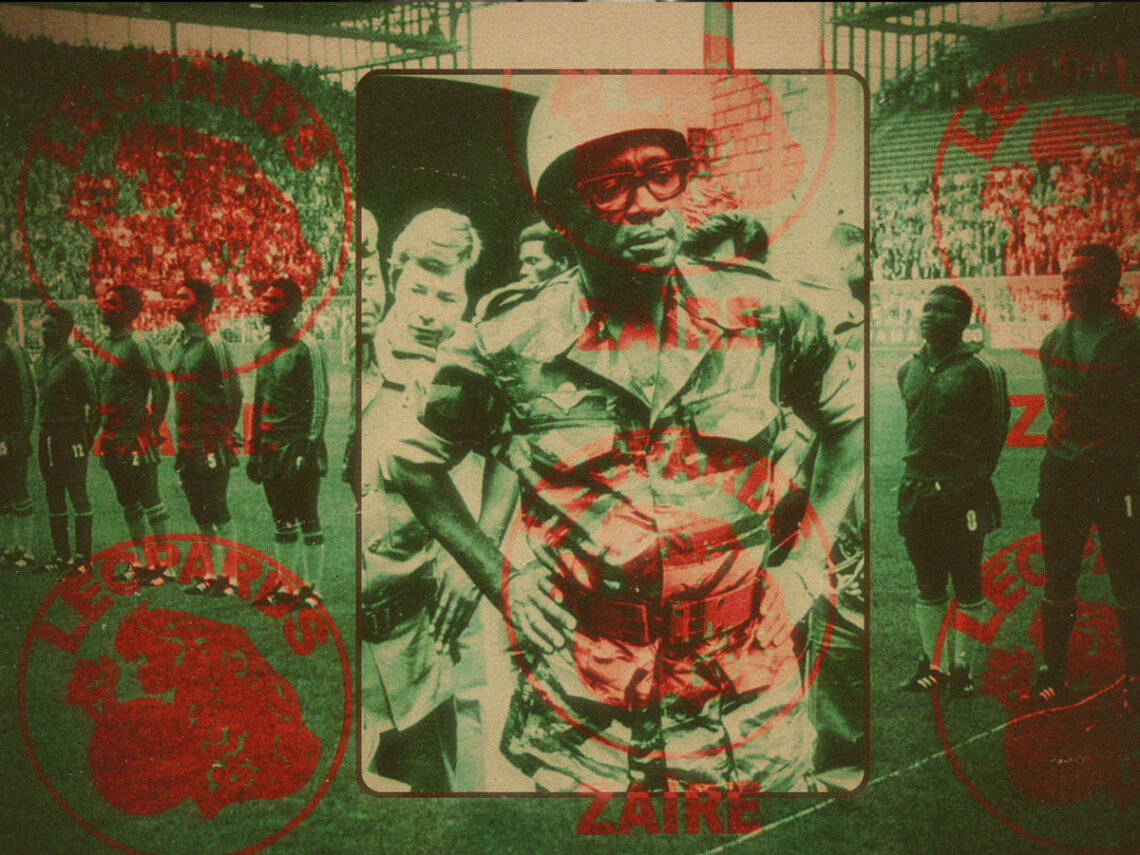
How Zaire protested its own dictator at the 1974 World Cup
Brazil vs Zaire (currently known as the Democratic Republic of the Congo). June 22nd, 1974 – the defending champions of the World Cup against a team mainly composed of amateur or domestic league players. The fact that A Seleção were only two-nil up in the second half at the height of their jogo bonito is a testament to Zaire’s determination, tactical acumen and fighting spirit.
Zaire were only the third African team to ever compete at a World Cup, and the only African nation playing in the tournament that year. You cannot overstate the effect that national pride has on a team in that situation, and the Leopards were no different. Especially when you take into account that this Zaire team were a force to be reckoned with. They were coming into the ’74 World Cup as winners of the African Cup of Nations, the second time they’d clinched the title in six years.
However, their previous game at the tournament had been an utter humiliation. Due to a mix of poor fitness and a lack of focus brought on by a player strike mere days before the game, Zaire had been obliterated by a fluid, attacking Yugoslavia team, losing nine goals to nil. Suddenly, the country had to prove they were just as welcome at the World Cup as anyone else. However, the Zaire national team had more than just their dignity in mind, fuelling the dogged, defensive display against the Brazilians.
Nearly a decade previously, Joseph-Desire Mobutu had taken power of the country (known as the Republic of the Congo in 1965) in a coup d’etat. He had spent the next decade trying to instil a sense of national pride in the country by ridding its culture of any influence from colonisers, changing the country’s name to the Republic of Zaire to reflect that attitude. Another major part of this charge was the country’s national football team, so one can imagine that he took his country’s hammering in their previous match with the empathy and understanding we’ve come to understand from dictators.
Except no, he didn’t, Mobutu made it abundantly clear that if the team lost their next game by more than three goals, each of them would be exiled from their home country. With the alleged treatment of some of his political enemies in mind, exile was Mobutu being merciful. In fact, the only reason that he would have allowed a three-goal loss in the first place was the fact that Zaire’s next opponents were literally Brazil. Anyone else and his demands would have been a lot heavier.
Thus, Zaire went into this match with a lot more than national pride on their mind, and what’s more, they held their own. After all, this wasn’t a banner Brazil side (their previous match had been a draw against a spirited Scotland team), so they had a chance to not disgrace themselves again, yet by the 66th minute of the second half, they were two-nil down and had a long, long 24 minutes ahead of them… Brazil won a free kick in the Zaire half, and as Jairzinho and Rivelino stood over the ball debating the angle to take, Ilunga Mwepu stormed out of the Zaire defensive wall and blasted the ball nearly out of the stadium.
This was an act of desperation and frustration, one that was designed to disrupt the game and prevent the Brazilians from applying more pressure, yet Mwepu himself said that there was a deeper intention to his illegal kick. While he received a yellow card, he was aiming for a red. Meaning that he could be sent to the dressing room early, then make a break for freedom on his own terms and escape the wrath of the dictator breathing down his neck.
The issue was that no one outside of the Zaire locker room was aware of the situation with Mobutu, and it was 1974. The sheer amount of patronising, racist ridicule thrown at Mwepu and the Zaire side is disgusting to see today, but far from shocking. John Motson was on commentary for the English broadcast of the match and called the kick “a bizarre moment of African ignorance” in a blatant bit of mask-off racism.
Mwepu was a professional who knew exactly what he was doing on every level, and there’s only one reason anyone would believe differently. Zaire would go on to concede one more goal in the match, ending it on Mobutu’s cut-off point and saving their citizenship by the skin of their teeth. They actually conceded a fourth goal that the referee thankfully chalked off for a dodgy offside ruling. Perhaps he was aware of the behind-the-scenes situation.
However, one wonders how much any of the Zaire players wanted to return home by the end of the ordeal.