


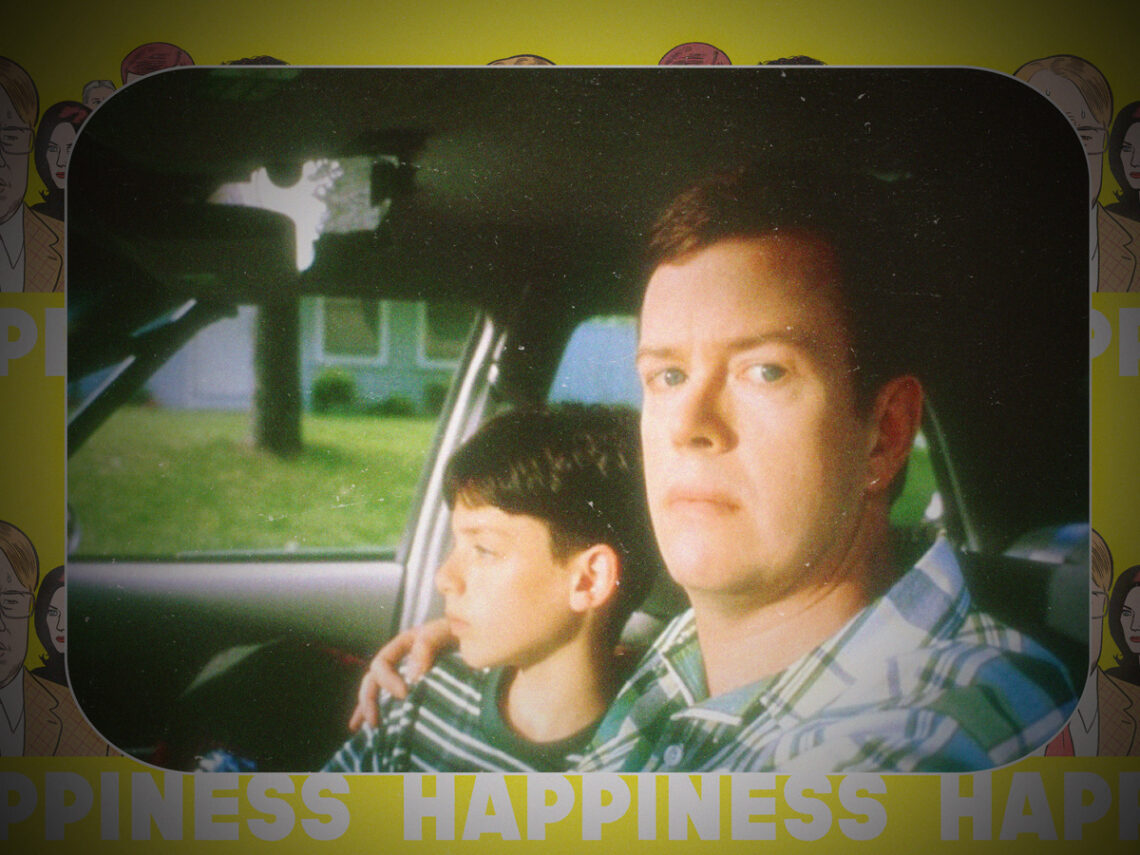
“Would you ever fuck me?”: How Todd Solondz crafted the most insane father-son confrontation in cinema history
With South Park currently trending for, as is tradition, perfectly encapsulating the absurdity of the American sociopolitical landscape, let me take you back to the good ol’ days of the third season.
Do you remember when Mr Garrison, decades before he moonlighted as a caricature of Donald Trump that could never match up to the real thing, confronted his father about not molesting him as a child and making him feel unwanted? Did you ever wonder where Trey Parker and Matt Stone got the idea for it.
Frankly, I didn’t either, only to forget I ever saw it, until I watched a very wholesome Todd Solondz joint that is so sweetly titled Happiness. Featuring an ensemble cast with an incredible performance from Philip Seymour Hoffman, who fantasises about using his dick as a projectile weapon to assault women, Happiness is a real American family flick that is perfect for all audiences during holiday movie marathons. And that’s not just because it has family drama as a central theme.
There have been so many fascinating portrayals of the complex relationships shared by fathers and sons, ranging from Daniel Day-Lewis’ intimidating tyranny in There Will Be Blood to Titus Kaphar’s raw and extremely moving 2024 film, Exhibiting Forgiveness. However, Solondz has got them all beat with what has to be the most insane father-son scene in the entire history of cinema, revolving around the central question that haunted Mr Garrison in that early South Park episode: “Would you ever fuck me?”
While Hoffman definitely stole the show a bit with his impressive character work, the entire cast is on their game in Happiness, but none more so than Dylan Baker, who plays a “happily” married psychiatrist named Bill. A white conservative middle-class man is emblematic of the neighbourhood pillars that are so often glorified in American media, but in Solondz’s endlessly fucked up world, he is just a pedophile who uses his son, Billy, to get information about which of his friends are home alone in order to rape them.
We see that façade of respectability associated with Bill’s social demographic crumbling in Happiness, as his neighbours, and then his own family, realise that they have been living so close to a child predator. Baker maintains an almost stoic front as his house is tagged with graffiti denouncing him as a pedophile, and his wife decides to leave with the kids, but not before the ultimate showdown between Bill and Billy, resulting in one of the most memorable pieces of screenwriting that scars you and makes you laugh at the same time.
Billy, who had previously come to his father with concerns about being the last in his class to get an orgasm, now hesitantly approaches Bill and broaches the subject of the rumours circulating in his school about his father being a serial rapist. The psychologist calmly describes to his own son how he “made love” to his 11-year-old friends, insisting that he would do it again and that “it felt great”.
However, the emotional crux of the scene, and the entire film in a way, is when the child rapist draws a moral line and tells Billy that he wouldn’t have sexual relations with his offspring: “No, I’d jerk off instead.”
Everything about the moment, the bizarre atmosphere constructed by Solondz, Baker’s impeccable delivery, and the context in which this conversation takes place, transforms Happiness into much more than a “crazy dark comedy” from the tail end of the 1990s. It’s an entire section of American society bottled up in two hours, where social identities act as shields that mask the true nature of an individual’s inherent sickness.
Maybe, just like Mr Garrison, Billy never really recovered from his pedophile dad’s rejection, but Happiness lives up to its name and ends on a happy note, with the little boy announcing his first orgasm to a table full of his family members. As you do.