


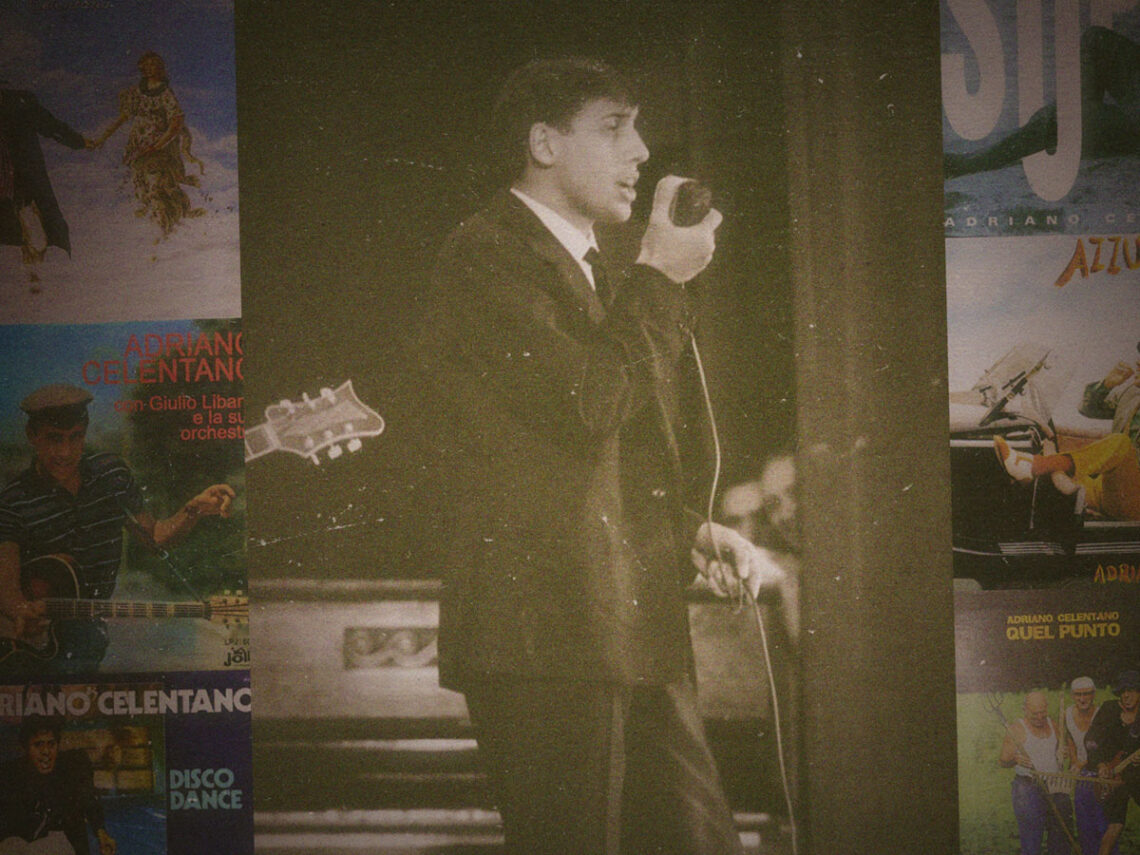
When Italian singer Adriano Celentano fucked with mainstream music
There’s nothing quite like sticking two fingers up at your own country and getting away with it.
The examples of this are countless. Bruce Springsteen turned an excoriating song about the Vietnam War into a pump-up anthem that sounded so glossily patriotic he got a shout-out from Ronald Reagan himself. The “It’s shite being Scottish!” monologue from Trainspotting. Pretty much the entire genre of grime. What can be just as interesting as critiques of your own culture, however, is finding other people tearing into their own and working out why.
One of the most enduring hits of Adriano Celentano’s career is another perfect example. Strangely enough, it’s a hit that you might just know in passing if you’ve spent any time in music circles on social media. It pops up quite a few times for the sheer novelty value of it all and for good reason. You remember that clip from the 1970s that makes the rounds every year or so, where a non-English singer sings in fake English? Yeah, that’s Adriano Celentano, and it turns out that this was much more than just a novelty song.
You see, Celentano was a megastar in his native Italy. A full-on Elvis Presley of their own, not only because of his vast back catalogue of hits, but because of his hugely successful career in movies and TV too. In fact, his own career on the silver screen might actually have the ‘King of Rock ‘n’ Roll’ beat at his own game. After all, people actually liked the stuff Celentano was doing on screen. By the 1970s, he had spent a decade at the top of the Italian rock scene, yet he still had a bone to pick with his own country.
How did Adriano Celentano hit back at Italian music?
After starting out as just another rock ‘n’ roll copyist, the B-side of his very first single was a cover of ‘Jailhouse Rock’. As Celentano grew in fame, he made something of a bold choice. He chose to keep singing in his native Italian. Something you can see in the titles of his singles discography, the vast majority of them are in Italian, and it wasn’t from lack of options either. The man could (and sometimes did) sing in English, but he just thought there was something important to keeping his native tongue alive.
Especially when throughout the whole 1960s, it seemed under threat from not only foreign artists singing in English, but Italian artists doing the same as well. By 1972, Celentano was done with this and wanted to prove a point. Celentano, along with his wife Claudia Mori, put together a song where the whole point was that it would sound like English to someone who didn’t speak English, merely to see whether their home country could tell the difference. They did not.
The song, the quite ludicrously titled ‘Prisencolinensinainciusol’, was a gargantuan hit in Italy and most of mainland Europe. Which checks out, after all, when a track means nothing, it can mean anything! The piece goes deeper than that, though. When Celentano talked about putting the song together, he spoke of a creative process that we associate more with hip-hop today. Creating a loop via assembling tapes of drum beats, then improvising over the top of them.
A sign, if one was needed, that sometimes depth can come from the least likely of places. Even a pop single where the entire point of the song is that it’s literally meaningless.