


Did Blind Lemon Jefferson die from poisoned coffee?
Few movements show the value of legend quite like the blues.
Arguably, the original style of underground music, the blues grew from a threadbare scene of juke joints and illegal parties. Where the artists fêted in them weren’t national heroes but starving scavengers, whose absolutely inhuman levels of talent made them barely survive from gig to gig.
This was a movement where only the uppermost upper crust could ever hope to have their music recorded. Even if they did, they would rarely see a cent from it, and the people who frequented those juke joints would probably never get their hands on it.
Thus, to have a hope in hell of making it as a blues musician, you needed to have a story, and it needed to be an absolute belter. Why else did Robert Johnson start telling people that his unparalleled guitar wizardry was the product of a deal with the devil and not years and years and years (and years) of practice? Because people don’t want to go and see the nerd who spent his summers shut in his room hammering away at his guitar. They want to go and see the crazy man who sold his soul to the devil.
Johnson is the obvious candidate for the greatest story the blues ever told, but Blind Lemon Jefferson isn’t far behind him. The reason for that is in his very name. A blind kid from Coutchman, Texas, who became a guitarist and singer of such technical prowess that his direct influence took something of a knock.
After all, if no one can replicate your songs or singing, then who’s going to evolve your sound? Fortunately, Jefferson’s songwriting did the hard work for him.
It also helped that his legend went far beyond that of his music, and all the way to his death.
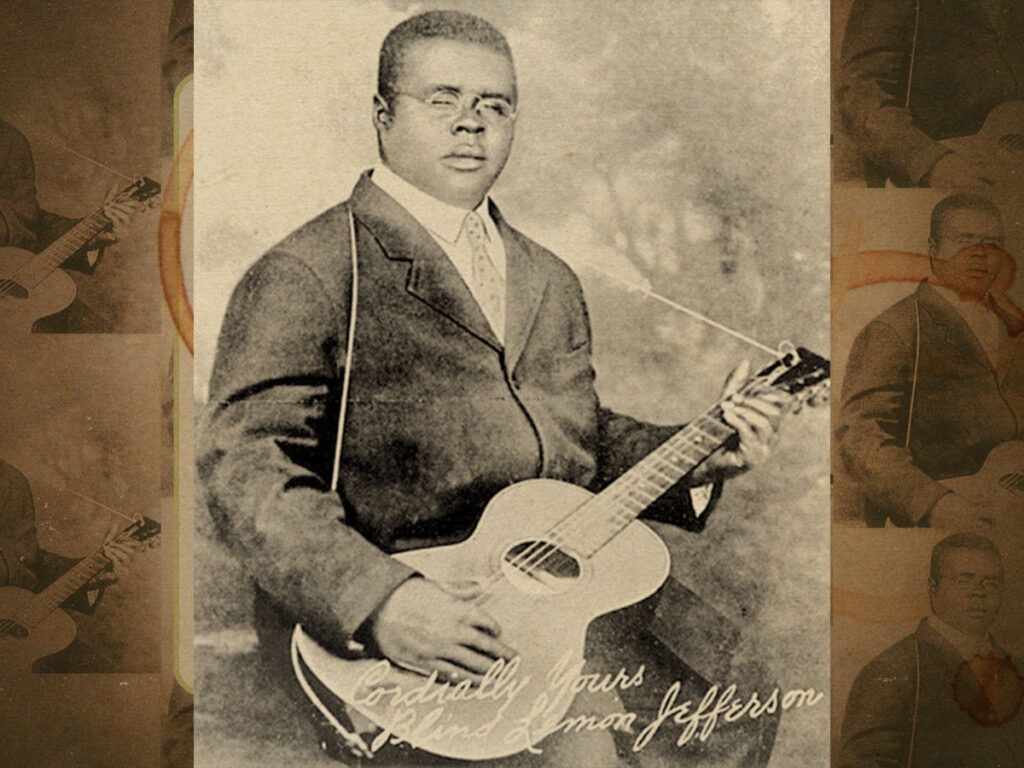
So, how did Blind Lemon Jefferson die?
This couldn’t be more grimly fitting. Just like Johnson had ‘Cross Road Blues’ which directly dealt with his legacy, Jefferson had done exactly the same without even knowing it, coming to prominence with the song ‘See That My Grave is Kept Clean’.
A year after a re-recording of that song had made Jefferson one of the first mainstream blues artists, Jefferson was found dead on Christmas Day 1929 in Chicago, Illinois, frozen to death in a back alley off Rhodes Avenue.
Immediately, the rumours began to fly of what caused Jefferson to keel over pretty much the moment he left that night’s gig. Some said that the guide escorting him to Union Station had killed him to nab a particularly large royalty payment he’d received that day. Others said that he’d been attacked by a wild dog, but the most common theory was that Jefferson had been involved with a married woman, and her jealous husband had poisoned Jefferson’s drink after his show that night.
On his way back to his hotel, the poison took effect, Jefferson passed out, and what little chance he had at living through it was snuffed out by a winter chill that was harsh even by Chicago standards. However, the doctors ruled his death as “probably” down to “acute myocarditis”, a fancy way of saying a heart attack. Which is very possible. Christmas Eve 1929 saw an absolutely brutal snowstorm rock the centre of Chicago, and he was probably caught in it, disoriented by it and in his panic, suffered from a heart attack. The cold would do the rest.
His record label paid for him to be sent back to Texas by train, where he lies in a cemetery that bears his name today. And yes, his grave is always kept clean.