


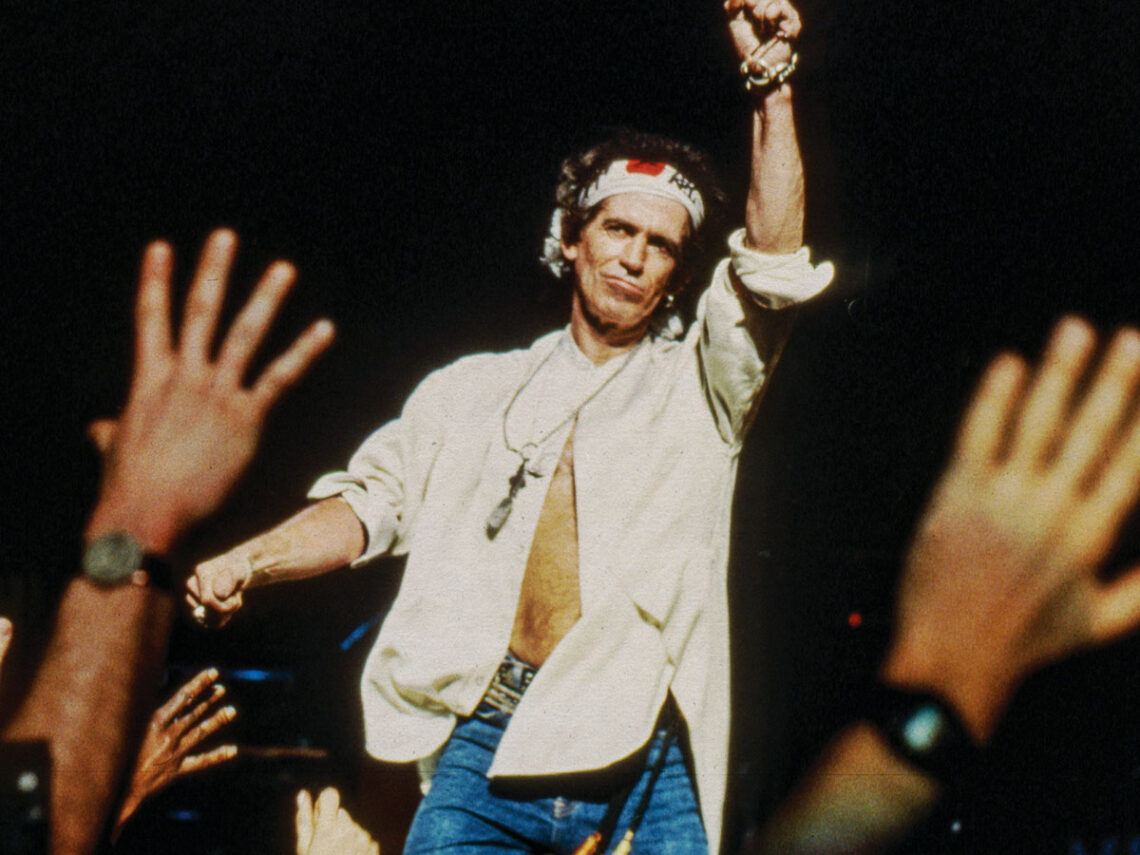
Keith Richards and ‘Main Offender’: The best Rolling Stones album of the 1990s?
For much of the 1980s, Mick Jagger and Keith Richards were on the outs. The pair were feuding over the direction The Rolling Stones’ music would take. Jagger wanted to modernise the band’s sound, while Richards wanted to stick with the blues rock formula that had already worked—and worked very well indeed—for the past three decades.
Subsequently, new music by the Stones was not forthcoming for several years, and the 1985 sessions for the desultory Dirty Work album were notably strained, with Jagger recording his vocals over the finished instrumental tracks apart from the rest of the group. It was rare that all five band members were ever in the studio at the same time.
Signed as a solo artist on the back of the Stones’ move to Columbia – CBS Records—something the rest of the group was initially unaware of—Jagger produced She’s the Boss in 1985 alongside a star-studded cast of musical luminaries that included Bill Laswell, Sly & Robbie, Jeff Beck, Nile Rodgers, Herbie Hancock, and Pete Townshend.
At the time, Richards was pissed off about what he saw as Jagger’s lack of commitment to their band. When Jagger refused to tour in support of Dirty Work, choosing to concentrate instead on his solo career, things between the Glimmer Twins deteriorated even further.
Restless at the lack of musical activity, Richards worked as a bandleader on director Taylor Hackford’s Chuck Berry documentary Hail! Hail! Rock ’n’ Roll, assembling a supergroup for two concerts that included Eric Clapton, Etta James, Linda Ronstadt, and Berry’s longtime songwriting partner, pianist Johnnie Johnson. The drummer for the band was a young musician by the name of Steve Jordan, who had played in the Saturday Night Live and Late Night with David Letterman house bands.

Richards and Jordan got along great musically – Jordan had already performed on Dirty Work – and formed the X-Pensive Winos for the purpose of recording Richards’ first solo album, the well-received Talk Is Cheap, and a support tour (documented on the Live at the Hollywood Palladium, 15 December 1988 album).
The X-Pensive Winos were put on hold when bridges were finally mended between Jagger and Richards prior to the Rolling Stones induction into the Rock and Roll Hall of Fame in early 1989. The tour in support of the Steel Wheels album was their biggest to date, seeing the Stones trekking all over the globe and raking in around $200 million. When the tour ended, Richards, feeling creatively energised, set about writing songs again with Steve Jordan that eventually became 1992’s Main Offender album.
For Main Offender, the X-Pensive Winos added guitarist Waddy Wachtel to the group. Wachtel, a musical sideman of some renown who has worked with the likes of Stevie Nicks, Linda Ronstadt, James Taylor, Warren Zevon, Bryan Ferry, and Jackson Browne, was brought in to co-produce the album with Richards and Jordan, and he co-wrote four of the album’s songs with them.
“If you’re a musician, silence is your canvas and you never want to fill in the whole thing because then you’ve just covered it all… One of the most interesting parts about music is where you don’t play.”
Keith Richards
Where Talk Is Cheap had something to prove following Richards’ musical declaration of independence, Main Offender is nothing short of pure attitude. There’s a confidence here that borders on nonchalant swagger, a record made by a man who knows exactly who he is and doesn’t give a fuck if you’re not on board. The opening riff of ‘999’ sounds like it fell out of the guitarist’s half-empty bottle of Jack Daniels. Tracks like ‘Wicked As It Seems’ and ‘Eileen’ barrel forward, soaked in open G tuning and the kind of outlaw sincerity only Keith Richards could deliver without flinching. It’s as if Richards was trying to remind everyone that rock ‘n’ roll is supposed to be dangerous, sexy, and a little bit stupid—and doing a damn good job of it.
The real trick of Main Offender is that it doesn’t try to sound “current”, even by 1992 standards. It’s defiantly analogue, defiantly live, and defiantly Keef. Steve Jordan’s drumming is razor sharp but loose where it counts, and Waddy Wachtel’s playing cuts through the mix like a rusty switchblade. There’s a feel here – grimy, intimate, and a little unhinged – that no Stones album from that period came close to touching.
Main Offender was critically acclaimed and featured some fantastic performances, but it just barely made the bottom rungs of the US album charts. The subsequent tour, however, was a big success. The X-Pensive Winos were then put on ice again when the Rolling Stones regrouped for the Voodoo Lounge album and the $320m-grossing world tour of the same name. The Winos would eventually return in 2015 for the Crosseyed Heart album.