


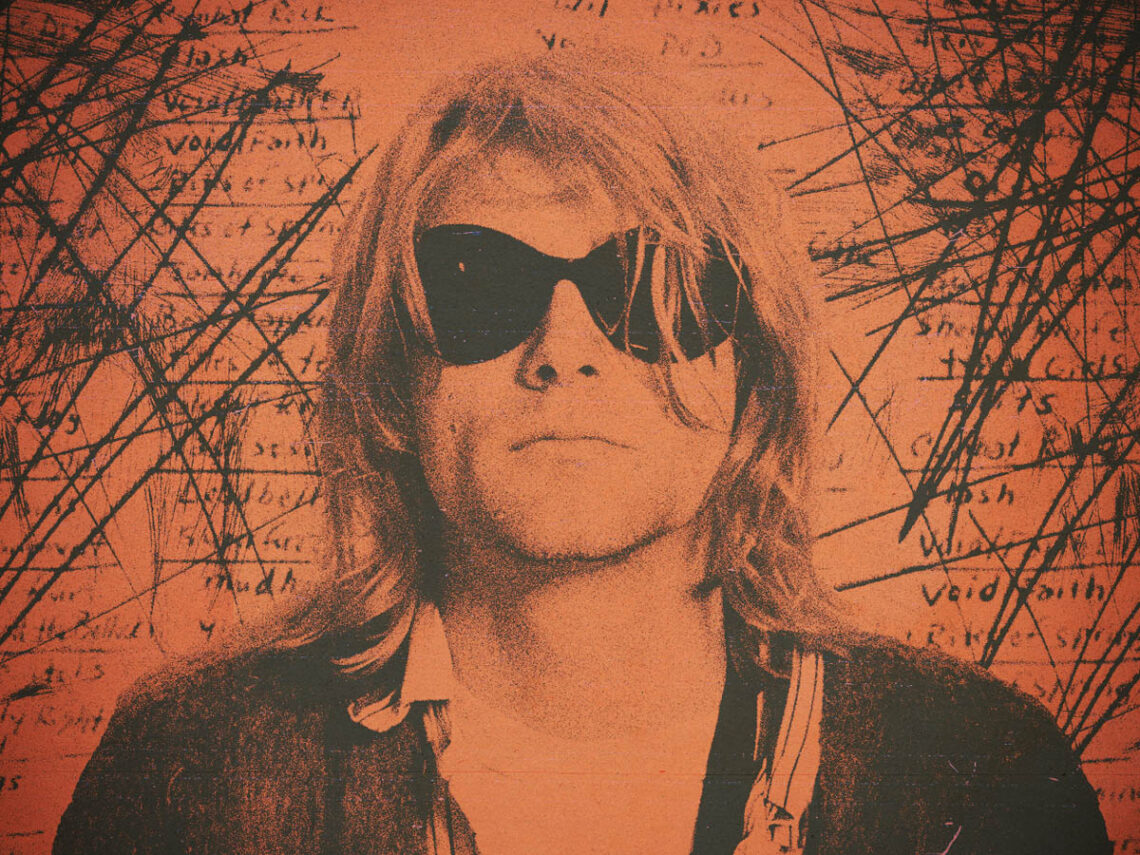
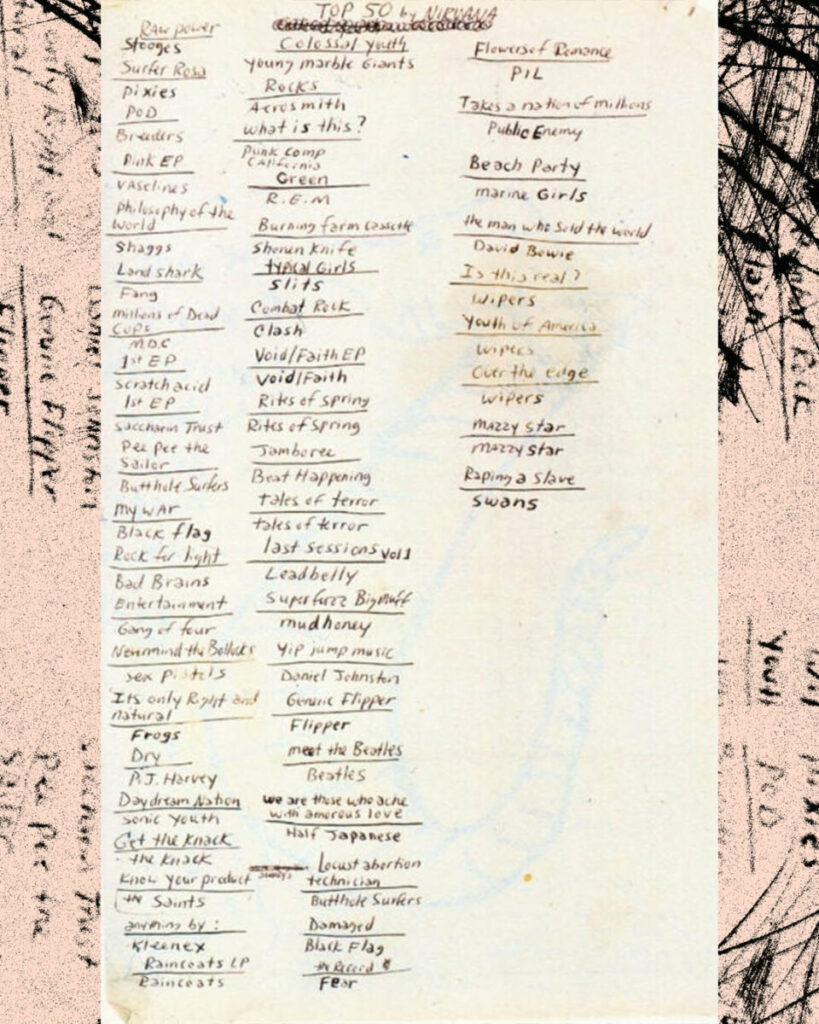
Kurt Cobain’s handwritten list of his 50 favourite albums
“Punk rock should mean freedom, liking and accepting anything that you like,” Kurt Cobain once said. “Playing whatever you want. As sloppy as you want. As long as it’s good and it has passion.”
That Cobain quote might just be the single most sincere sentence he ever uttered. Punk rock, in his world, wasn’t a sound or a fashion statement – it was a refusal. Getting behind a battered amp, playing like you didn’t give a shit, and not worrying whether it sounded rough. Cobain obsessed over chaos and authenticity. As fans who know him well, Cobain wasn’t aiming for spectacle; he was chasing honesty.
Before the buzz and the tabloids, Cobain was just a scruffy, ink-stained teenage recluse from Aberdeen who hoarded cassette tapes and scribbled lyrics on old receipts. He drifted through abandoned houses, always carrying an old guitar case and a scruffy notebook full of ideas. Never flamboyant, never polished, and terrified of fame.
His ’50 favourite albums’ list isn’t some curated playlist for public approval, it’s a personal manifesto. Ignore the prestige names. This is Cobain with his back turned to the rocking chair, hunched over cheap headphones, consuming everything from feedback squallers to whispered off-cuts from the underground.
During a 1993 interview with Rolling Stone, Cobain once commented on his relationship with the Beatles: “John Lennon was definitely my favourite Beatle, hands down,” he said. “I don’t know who wrote what parts of what Beatles songs, but McCartney embarrasses me. Lennon was obviously disturbed [laughs]. So I could relate to that.”
Cobain didn’t just admire Lennon, he felt him. Lennon’s personality was a poem in contradiction: tender one moment, ferocious the next. For Cobain, that was gold. You could love the song and still recoil at the man behind it. That duality mattered. It showed that vulnerability and rage could share a stage. Cobain respected that tension because he lived inside one himself.
“And from the books I’ve read — and I’m so sceptical of anything I read, especially in rock books — I just felt really sorry for him,” Cobain said. “To be locked up in that apartment.”
But he did caveat by saying: “John Lennon has been my idol all my life, but he’s dead wrong about revolution,” he added. “Find a representative of gluttony or oppression and blow the motherfuckers [sic] head off.”
And then there’s Iggy, the patron saint of broken-down rockers. Bowie might’ve been glam, but Iggy embodied chaos and grit. Cobain saw in him a living testament: you can crash and burn and still stand up. He famously claimed that Iggy was the only rock star he really liked before he became one. Listening to Raw Power is like getting kicked in the gut—and Cobain took that kick as a challenge: to play not just loud, but vitally loud.
Despite disliking the rock stars of a traditional, tired cliche, Cobain always respected Iggy Pop, saying, “[Meeting people] is kind of a positive side of being a rock and roll star. But actually I met Iggy Pop before we were rock and roll stars, and he is pretty much the only person that I’ve met that I really, really admire and like.”
Which makes his favourite album somewhat predictable: “I have always loved Raw Power,” Cobain said. “I like the sound – the honest sound of young guys trying to break the barrier of stilted moulded sterile rock. And they did. Great guitar and wonderful vocals from Iggy. And inspiration for young men to this day”.
The Pixies, on the other hand, showed him that restraint can hammer you just as hard. One moment a whisper, the next a scream, all wrapped in oddball pop hooks. Cobain confessed he wrote ‘Smells Like Teen Spirit’ trying to “rip off” that vibe. Not to copy, but to chase the same unsettling alchemy: dynamics that pulse between bass rumble and fragile vocal melody. He found kinship in that space of tension.
To those who have followed Cobain’s career, it should come as no surprise that the Pixies featured on his favourite albums list. The former Nirvana man once famously commented: “When I heard the Pixies for the first time, I connected with that band so heavily I should have been in that band – or at least in a Pixies cover band”.
Later, when speaking about his most famous hit, ‘Smells Like Teen Spirit’, Cobain remembered, “I was trying to write the ultimate pop song. I was basically trying to rip off the Pixies. I have to admit it [smiles].”
The Melvins and underground oddities like The Vaselines didn’t sell out arenas, but they set the emotional bar. The Vaselines proved that sweetness could be subversive. The Melvins proved that sludgy could be soulful. Cobain loved sounds that were heavy not just in volume, but in emotional weight. He didn’t chase popularity. He chased the criteria for truth. Those bands moulded his palette.
“The Melvins really influenced me because they lived in Aberdeen, and I watched a lot of their practices,” Cobain added. “I like a lot of clean pop like the Vaselines and Beat Happening.”
If you want to understand Kurt Cobain, stop reading the biographies. Start spinning his favourite records. Those albums are his real autobiography.
Kurt Cobain’s 50 favourite albums:
- Iggy & The Stooges – Raw Power (1973)
- Pixies – Surfer Rosa (1988)
- The Breeders – Pod (1990)
- The Vaselines – Dying for It (1988, listed as Pink EP)
- The Shaggs – Philosophy of the World (1969)
- Fang – Landshark! (1982)
- MDC – Millions of Dead Cops (1981)
- Scratch Acid – Scratch Acid (1984, listed as 1st EP)
- Saccharine Trust – Paganicons (1981, listed as 1st EP)
- Butthole Surfers – Pee Pee the Sailor (1983)
- Black Flag – My War (1984)
- Bad Brains – Rock for Light (1983)
- Gang of Four – Entertainment! (1979)
- Sex Pistols – Never Mind the Bollocks, Here’s the Sex Pistols (1977)
- The Frogs – It’s Only Right and Natural (1989)
- PJ Harvey – Dry (1992)
- Sonic Youth – Daydream Nation (1988)
- The Knack – Get the Knack (1979)
- The Saints – Know Your Product (1978)
- Kleenex – “anything by:” (1978–1983, collected on 1993’s Kleenex/LiLiPUT anthology)
- The Raincoats – The Raincoats (1979)
- Young Marble Giants – Colossal Youth (1980)
- Aerosmith – Rocks (1976)
- Various Artists – What Is It. (1982, erroneously listed as What Is This?)
- REM – Green (1988)
- Shonen Knife – Burning Farm (K Records version, 1985)
- The Slits – Cut (1979, listed as Typical Girls)
- The Clash – Combat Rock (1982)
- The Faith/Void – The Faith/Void (1982)
- Rites of Spring – Rites of Spring (1985)
- Beat Happening – Jamboree (1988)
- Tales of Terror – Tales of Terror (1984)
- Leadbelly – Leadbelly’s Last Sessions Volume One (1953)
- Mudhoney – Superfuzz Bigmuff (1988)
- Daniel Johnston – Yip/Jump Music (1983)
- Flipper – Album – Generic Flipper (1982)
- The Beatles – Meet the Beatles! (1964)
- Half Japanese – We Are They Who Ache with Amorous Love (1990)
- Butthole Surfers – Locust Abortion Technician (1987)
- Black Flag – Damaged (1981)
- Fear – The Record (1982)
- Public Image Ltd – The Flowers of Romance (1981)
- Public Enemy – It Takes a Nation of Millions to Hold Us Back (1988)
- Marine Girls – Beach Party (1981)
- David Bowie – The Man Who Sold the World (1970)
- Wipers – Is This Real? (1980)
- Wipers – Youth of America (1981)
- Wipers – Over the Edge (1983)
- Mazzy Star – She Hangs Brightly (1990)
- Swans – Young God (1984, erroneously listed as Raping a Slave)