


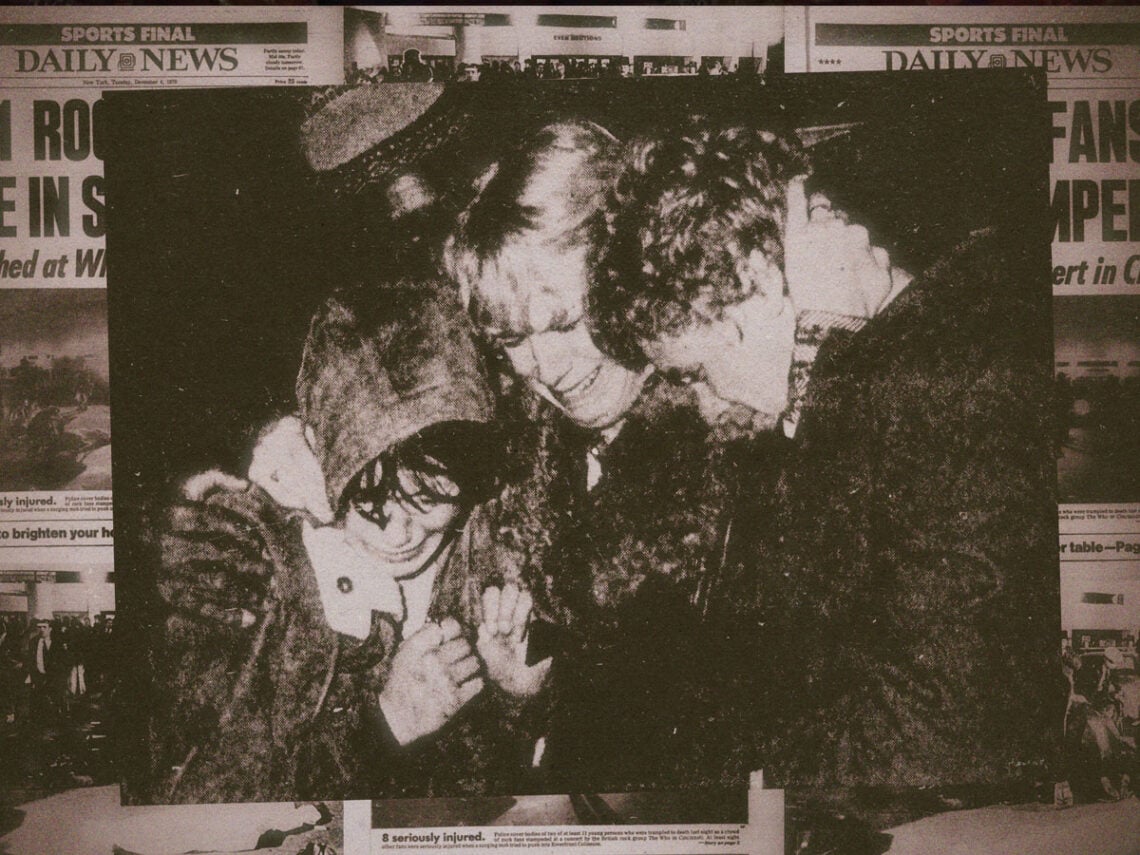
The Cincinnati disaster: The Who concert that took 11 lives in 1979
In hindsight, the late 1970s don’t feel like a banner period for The Who. In fact, quite the opposite. In the aftermath of Keith Moon’s death, it feels like the beginning of the end for the rock band, which proved to be far from accurate.
Albums like 1975’s The Who By Numbers (fitting-ass title there) and 1978’s Who Are You haven’t gone down as highlights in their back catalogue. However, there’s an argument to be made that it’s actually part of the band’s commercial peak. ‘Squeeze Box’ and ‘Who Are You’ are two of the band’s most successful singles, despite being pretty duff, and the band also played their biggest concerts at that time during that era.
The band’s first headline slot at Wembley Stadium was in 1979, when they were one of the world’s biggest draws on the live circuit. For an insight into how huge they were, an average tour stop that same year at the Riverfront Coliseum in Cincinnati, Ohio, could sell out pretty much immediately after they went on sale. 18,348 tickets in total, gone in an instant. High fives all around, right? Well, not quite. As we all know, die-hard fans can be difficult to control at the best of times. Combine that with some absolutely witless venue management, and the worst possible thing happened.
The communication around this concert, which happened on December 3rd, was amateurish. Word had gone out through local radio that the doors for general admission would open at 3pm, so two hours after that, the vast majority of the show’s nearly 20,000 ticket holders had shown up.
How many of the venue’s doors did the Riverfront Colisseums managers see fit to open as a result? Two. It’s tough to know how many more doors there were at the venue at that time, but suffice to say, 20 times that number is a conservative estimate.
Thus, 7,000 fans began being herded through a single pair of double doors. This would be bad enough, but word flooded through the crowd that The Who were either starting early, or that they were doing a public soundcheck in lieu of an opening act, or that they were screening the Quadrophenia movie instead.
The point is, those 7000 people suddenly felt like they were missing something. As a result, all of them tried to rush the long pair of doors together. And no one, not one member of staff at the arena, thought to open any of the countless other sets of doors.
11 people died of asphyxiation in the resultant crush. 29 more received serious injuries, and the fire marshals called to the concert advised The Who’s manager, Bill Curbishley, to cancel the concert. He didn’t just refuse to cancel the show; he also didn’t tell the band that 11 people were dead until after the show. Something that Pete Townshend has not minced words about ever since, saying how incredibly angry he was about playing a pop concert after the deaths of 11people.
The families of all 11 victims sued the band, the concert’s promoter and the city of Cincinnati in the aftermath. One of the victim’s families dropped out of the class-action lawsuit and settled out of court, but the remaining ten families received $750,000 between them in 1983.
The city of Cincinnati also banned unassigned festival seating at concerts there for the next 25 years. Over the next few decades, the band themselves spoke openly about how they wished they had stayed longer in Cincinnati after the event, feeling they had unfinished business in the city.
It took them 40 years, but the band did eventually play another gig in Cincinnati, which ended up being a beautiful exercise in healing. On May 15th, 2022, as part of ‘The Who Hits Back’ tour, the band played a sold-out show at the TQL Stadium that served as an epitaph to those 11 victims from four decades previously.
Most movingly of all, since a number of those victims had been students at Finneytown High School, ten students from that school accompanied the band on their climactic, triumphant run through of ‘Baba O’Riley’.