


Front 242: The controversial pioneers of Electric Body Music
Let’s be real here, ‘Electric Body Music’ just sounds amazing, no matter what the actual music sounds like.
It’s one of the great genre names and not just because of the way the words look on the page. The term comes from an evolution of a rough English translation of the German phrase Körpermusik (or body music), but what’s more, when you actually listen to the music, you can see where it’s coming from. While Kraftwerk’s Ralf Hütter may have coined the term in the late 1970s, it makes a lot more sense when applied to the music that came afterwards.
After all, Kraftwerk’s rigid rhythms and synths were never cold, but they were mechanical. The whole band played off the image of them being robots, and in the early 1980s, a wave of bands came up playing music that sounded more like the Human Resistance against the robot uprising.
Using the motorik beats of krautrock and combining it with the viscerally human sounds of punk and post-punk. Düsseldorf electro-punk forefathers D.A.F. may have started the movement in 1981, but there was another band that embodied the movement that came a little later.
Front 242 were dangerous. Forming in Aarschot, Belgium, in 1981, Daniel Bressanutti and Dirk Bergen wanted to create not only a band, but a movement. Not only did they have a musical style for the band, but they also had an aesthetic in mind, one that was radical, militaristic and provocative. In fact, it was baked into the band’s very name, with Front chosen to reflect the Fronts of organised popular uprisings.
As you can imagine, people weren’t exactly chill about this, and questions began to be asked about Front 242’s political leanings.
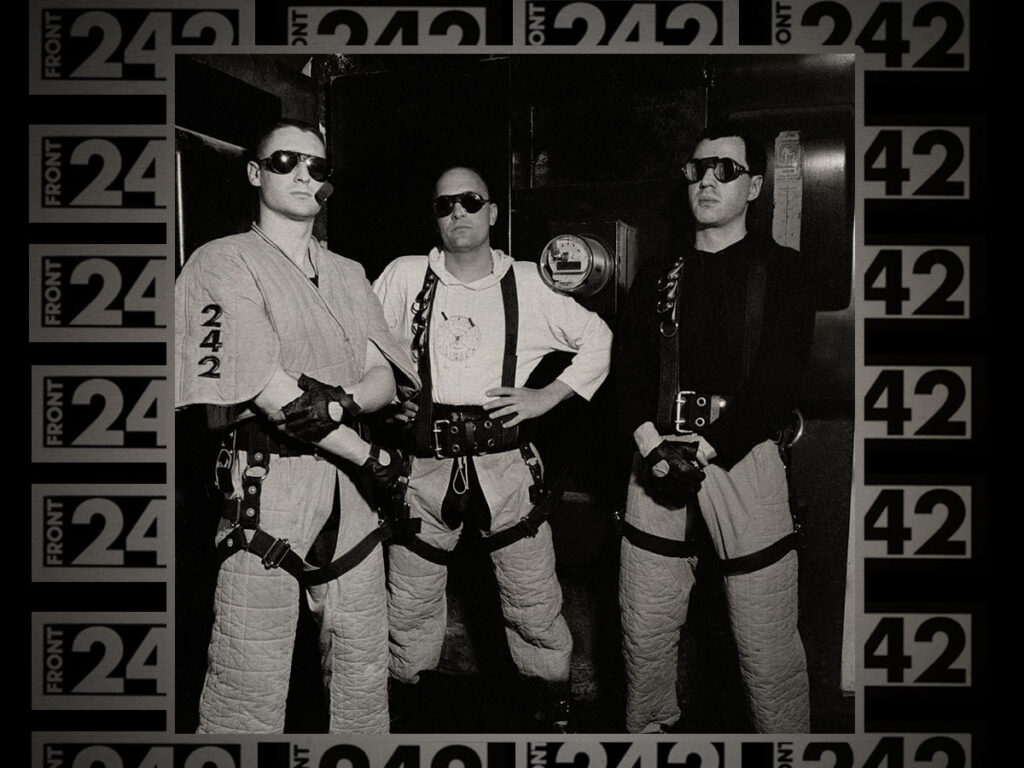
How did Front 242 pioneer Electric Body Music?
This was an especially pertinent question because Belgium in the 1980s wasn’t the most harmonious of places. 1985 saw a string of terror attacks carried out by a myriad of perpetrators, and tensions in the country were at an all-time high. A pseudo-anonymous band naming themselves after guerrilla warfare terms and playing highly aggressive music at high-intensity live shows, that projected images of urban warfare behind them? Yeah, that’s the kind of stuff that gets anyone in hot water.
The band firmly rejected any accusation that their music or their members were in any way fascist. They were merely reflecting the spirit of the age, and this was given credence by just how many people saw their world reflected in their music. Front 242 were becoming one of the biggest bands in Belgium off the back of their Electric Body Music, landing a prime support slot with Depeche Mode on their 1987 Music For the Masses tour as a result.
By the 1990s, Front 242 and their brand of Electric Body Music had gone mainstream under a different, and altogether more catchy name. One that you might have already cottoned onto when talking about taking synths and making them heavy and aggressive.
Front 242 had all but coined industrial music ten years early, and are still one of the most respected artists in that field, despite retiring from live performances earlier this year.