


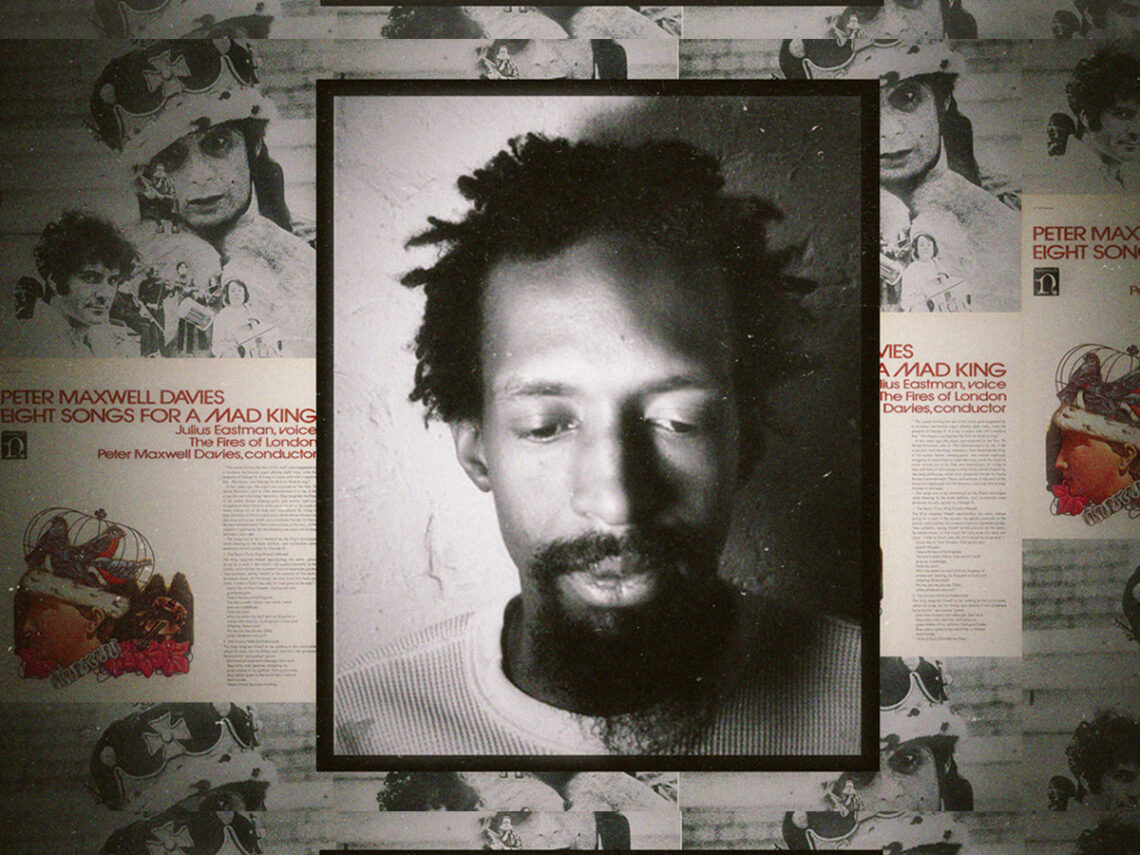
‘Eight Songs for a Mad King’: the most insane piece of music ever written
One day at the record store, I saw a used copy of Sir Peter Maxwell Davies’ Eight Songs for a Mad King and bought it on a whim. I’d gotten into the work of minimalist composer Julius Eastman and knew he’d performed what I’d seen described as a kind of weird opera, but beyond that, I didn’t know much about the piece.
The title was intriguing. What would something titled Eight Songs for a Mad King sound like? I was about to find out.
The first time I played the record, I’ll admit, I was baffled. It’s a tough listen. I didn’t quite know what to make of it, but one thing was obvious—there’s nothing else even close to Eight Songs for a Mad King in modern classical music. It’s not technically an opera, either. It’s musical theatre—a monodrama with a single vocalist. Peter Maxwell Davies, then the enfant terrible of avant-garde composition, wrote the score specifically for South African actor and renowned vocal coach Roy Hart, whose five-octave baritone the piece fully exploits. The music is arranged for a small chamber group: flute/piccolo, clarinet, percussion, piano/harpsichord, and violin/cello.
The “mad king” in the title is King George III, who famously suffered from acute mental illness. During his reign, George became increasingly unhinged—speaking for hours on end, foaming at the mouth, repeating himself endlessly. He was delusional and hallucinated frequently. It’s said he once mistook a tree for the King of Prussia. In his later years, the King tried to teach his pet bullfinches to sing, and in Eight Songs, the players (excluding the percussionist, who represents the King’s handler) musically portray these birds and engage in a kind of dialogue with their deranged monarch.
“This is theatre that crawls under your skin and into your subconscious, and whether you hear it as genius, gibberish, or just an avant-garde curiosity, it’s not something you forget”.
The songs in the piece are based on music from a miniature mechanical organ George III used to train his birds, an instrument that still exists today. There are fragments of Handel’s Messiah – a personal favorite of the King – woven into the score. Randolph Stow’s libretto draws from George III’s actual words, presented as eight monologues directed to his birds.
Eight Songs for a Mad King premiered on April 22nd, 1969, at the Queen Elizabeth Hall in London with Hart in the lead. Although it was generally well received by the audience, which included a 22-year-old David Bowie, there were smatterings of boos, heckling, and several walkouts. There is little doubt that the members of the audience had never seen or heard anything like it. Peter Brooks’ Marat/Sade is the only thing even remotely comparable, but musically that play is still somewhat conventional. Hell, even Captain Beefheart or the Residents sound conventional compared to Davies’ representation of the drooling mad monarch. This is not classical music for the faint of heart. The timid listener need not bother.
Listening to Julius Eastman perform the work on the studio recording (which was presumably paid for by director Ken Russell, who hired Davies to score his controversial film The Devils) is oddly impressive, but without the visuals it’s ultimately just confusing. It wasn’t until I saw the YouTube video of the extraordinary 2013 staging of Eight Songs with Welsh singer Kelvin Thomas – who was incredibly 92 years old at the time – that I really understood what was happening.
It makes more sense once you know the musicians were performing from inside giant bird cages, or if you can see the King flailing around in his nightshirt and acting out his psychosis. The Eastman recording is bold and technically remarkable, but without context, it sounds like someone with an exceptional vocal range making unsettling noises while a chamber ensemble clatters along. It’s not something most people would throw on for pleasure, but as a piece of theater, it hits much harder.
It’s no stretch to call Eight Songs for a Mad King one of the most terrifying pieces of 20th-century music—if not in content, then certainly in performance. Watching Kelvin Thomas claw through the role at 92, shrieking, twitching, and cackling inside a wire cage like a cross between Screamin’ Jay Hawkins and Antonin Artaud’s ghost, is a fever dream you’ll never shake. There’s one moment in the 2013 YouTube video where he suddenly howls at the musicians—his “birds”—and you don’t know whether to laugh, flinch, or cry. It’s like Werner Herzog and Goya got together to stage a feverish Christmas pageant for Satan. And somehow, it works. There’s something sacred and horrifying about it.
This is theatre that crawls under your skin and into your subconscious, and whether you hear it as genius, gibberish, or just an avant-garde curiosity, it’s not something you forget. Revisit this madness—you’ll never hear Handel the same way again.