


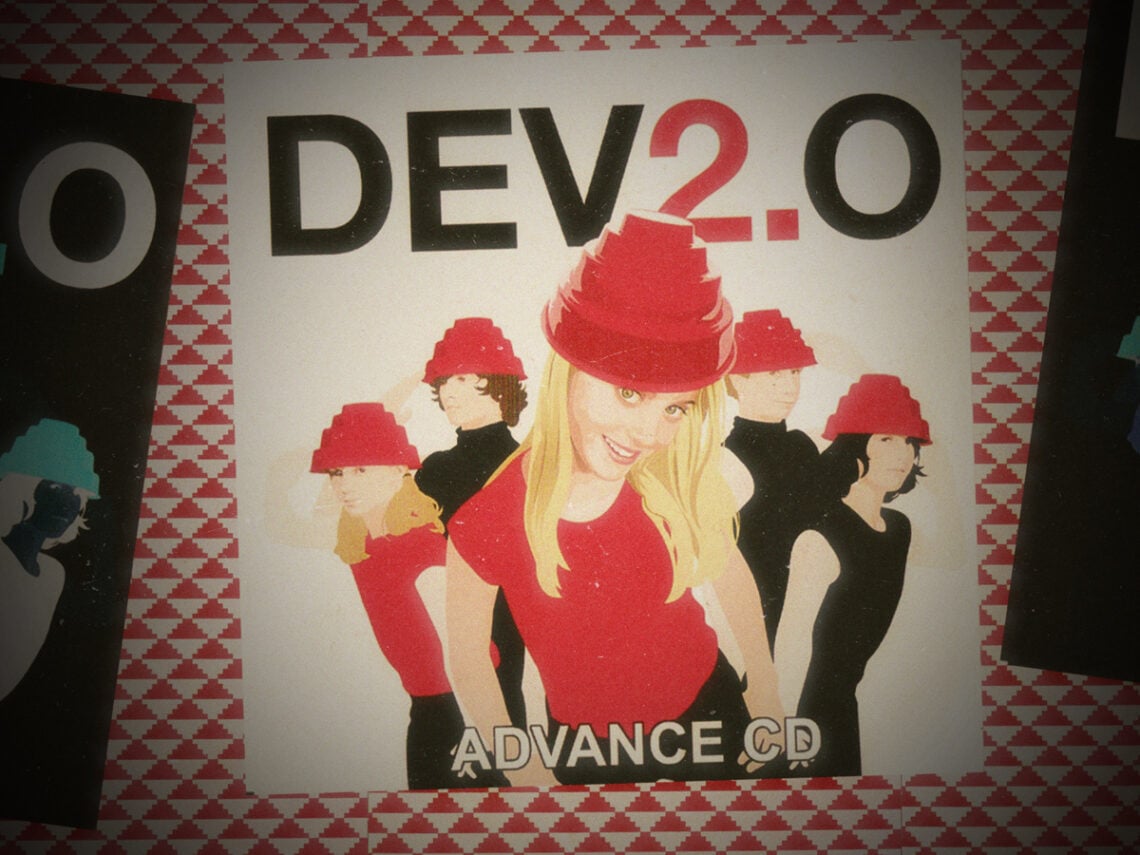
When Devo met Disney: Kids singing about sexual frustration, what could go wrong?
Are we not kids? We are Devo 2.0!
Unless you’ve got kids, are a really big Devo fan, or some pervy Nickelodeon-watching weirdo, Devo 2.0 (or DEV2.0), the 2006 reworking of some of the group’s best-loved songs for The Walt Disney Company, might’ve passed you by.
Disney? Devo? Wha?
It’s the ultimate sellout, sure, but tell me that you wouldn’t have done the same thing if Disney came a-knockin’ and you were in their shoes. Especially in their shoes! This isn’t merely the ultimate sellout. Hell, it’s perhaps one of the ultimate acts of practically real-time devolution in action.
It’s not like merchandising wasn’t always a big part of the Devo philosophy. As Mark Mothersbaugh later explained, the group had always viewed merchandise as part of the joke. Long before every band had an online store and branded coffee mugs, Devo records included merchandise pages modelled after the ads in comic books. They wanted albums to feel like Cracker Jack boxes, complete with prizes inside. What some critics interpreted as crass commercialism, Devo saw as another layer of satire. Rock and roll wasn’t supposed to be sacred; it was supposed to be fun. In that light, partnering with Disney didn’t seem quite so strange. If anything, it felt perfectly aligned with the band’s worldview.
Plus, getting kids normally seen in Honeycomb commercials to mime along to songs about sexual frustration, reverse Darwinism and corporate fascism in colourful music videos, all paid for by one of the largest media corporations in the world, must’ve seemed like a winning idea. I guess.
And that’s where the whole thing crossed over from merely weird to genuinely hilarious. Somebody at Disney had apparently signed off on 12 Devo songs without bothering to read the lyrics too closely. Which, if you’ve spent any time with Devo, is a little like greenlighting a William Burroughs adaptation after only glancing at the cover. Sure, songs like ‘Freedom of Choice’ and ‘Beautiful World’ sounded upbeat enough, but beneath the hooks lurked anxiety, alienation, sexual frustration and Devo’s trademark theory of devolution. It was only after the recordings had been made and the videos were already underway that somebody upstairs asked to see the lyrics. And that’s when the panic set in.
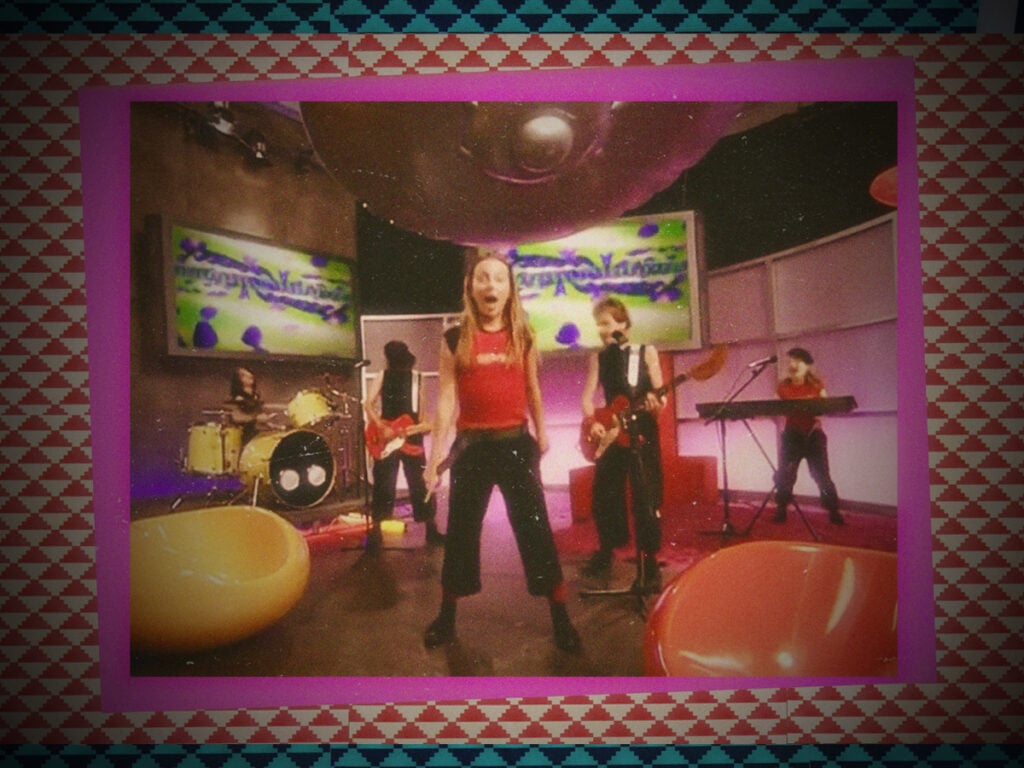
Devo’s Gerald Casale explained the entire odd situation to The Onion‘s AV Club’s Sam Adams in 2010: “The Disney people, in the beginning, go, ‘Hey, how would you like to repurpose your material for a 4-to-8-year-old audience?’ And we went, ‘Really?’ They said, ‘Yeah. We want you to do a whole DVD. What would you do?’ They gave us about a week to think about it. And I said, ‘Well, what if we did it like The Monkees? What if we cast a bunch of kids that can actually sing and play, and they will play Devo songs, and I’ll shoot videos with them, and we’ll tour them at middle schools?’”
Everything sounded just peachy.
…until somebody at Disney actually decided to read the lyrics.
“Deep into the picture, at the phase where we’ve recorded everything and we’re shooting the videos and I’m turning in a video budget, it’s at that point that somebody upstairs in the Disney Taliban would like to see all the lyrics printed out. I don’t think I’m hiding anything, so I send the lyrics”.
“Oh my God. Unbelievable, the next thing that happened, the firestorm that started.”
Suddenly, executives who had apparently loved and approved the songs started freaking out. ‘Beautiful World’ became a problem.
“It was like, ‘So listen, um, ‘Beautiful World.’ We’d really like that on the DVD, but you can’t say ‘It’s a beautiful world, but not for me.’ And it was like, ‘Oh really? Gee, that was kind of the whole point. What can we say?’ The guy goes, ‘How about ‘for me too?’”
Which, of course, misses the whole bloody point.
But things got even weirder.
One verse in ‘That’s Good’, written in 1982, suddenly took on entirely new meanings in the minds of Disney executives.
“The verse goes, ‘Life’s a bee without a buzz / It’s going great ‘til you get stung.’ Meaning, basically, you can get surprised. You can get ambushed, and that’s the point. They go, ‘You gotta take that whole verse out of there.’”
Casale was baffled.
“They go, ‘We know what you’re talking about, Casale.’ And I go, ‘What do you mean? What am I talking about?’ They go, ‘Life’s a bee’ means ‘Life’s a bitch.’ ‘Without a buzz’ means unless you’re getting high. And ‘It’s going great until you get stung,’ meaning as long as you get away with it, unless the cops pop you.’”
Casale’s response? “Who was I talking to here? P Diddy?”
And then came ‘Uncontrollable Urge’. Apparently, that title alone was simply too much.
“‘Uncontrollable Urge’ just had to come off the record. It was like, ‘What do you mean?’ ‘Well, Mark, we know what ‘Uncontrollable Urge’ is. It’s sex.’”
Mark Mothersbaugh pointed out that nowhere in the song is sex ever mentioned. This led Disney to an ingenious solution. “They said, ‘Make it about junk food, then.’ Mark just threw up his hands and walked away, and I wrote a couplet for the pre-chorus: ‘Before dinner, after lunch, I get a snack attack and I need to munch.’ And they went, ‘Now that’s great.’”
Casale couldn’t believe what he’d witnessed.
“So here was this 13-year-old girl, just on the verge of growing breasts, singing that couplet, and you wouldn’t think that anybody would let you do that. So they made it far dirtier than it was, and we thanked them.”
The amazing thing is that Disney somehow managed to make the material stranger than it already was. In their determination to protect innocent young minds from dangerous concepts like ambiguity and irony, they ended up with thirteen-year-olds singing about “snack attacks” and “munching”, while simultaneously convincing themselves that every reference to mist, bees or undefined urges was secretly code for sex and drugs. Which, when you think about it, feels suspiciously like a Devo concept in the first place. Somewhere, Bob and Gerald Casale must have been pinching themselves. They had spent decades warning about devolution, conformity and institutional stupidity, only to watch one of the world’s largest corporations inadvertently provide a perfect demonstration.
The music alone, played by members of Devo, isn’t really the full package. You have to see the videos. That’s where the whole enterprise ascends into a kind of candy-coloured nightmare. The best thing about this project, other than the fact that it exists in the first place, might just be the trippy videographics and the earnestness with which these fresh-faced kids throw themselves into material they almost certainly had no hope of fully understanding. One Amazon reviewer described the DVD as “a musical gateway drug for kids”, which is probably about right.
The whole thing remains one of the strangest footnotes in the Devo story. And let’s face it, that’s saying something. This is a band that built an entire philosophy around devolution, wore flowerpot hats, made short films, collaborated with Neil Young and somehow managed to turn ‘Whip It’ into a cultural phenomenon. Devo 2.0 sits comfortably alongside all those other beautiful oddities.
According to Gerald Casale’s Twitter account, both volumes of the long-out-of-print Hardcore Devo sets are being reissued next month. Kevin C Smith’s Recombo DNA: The Story Of Devo, Or How the 60s Became the 80s is published on May 1 by Jawbone Press.
Below, Devo 2.0’s take on ‘Freedom of Choice’. The permanently frowning tween on keyboards is Jacqueline Emerson, who later grew up to play Foxface in The Hunger Games.
Honestly, you couldn’t make this stuff up.