


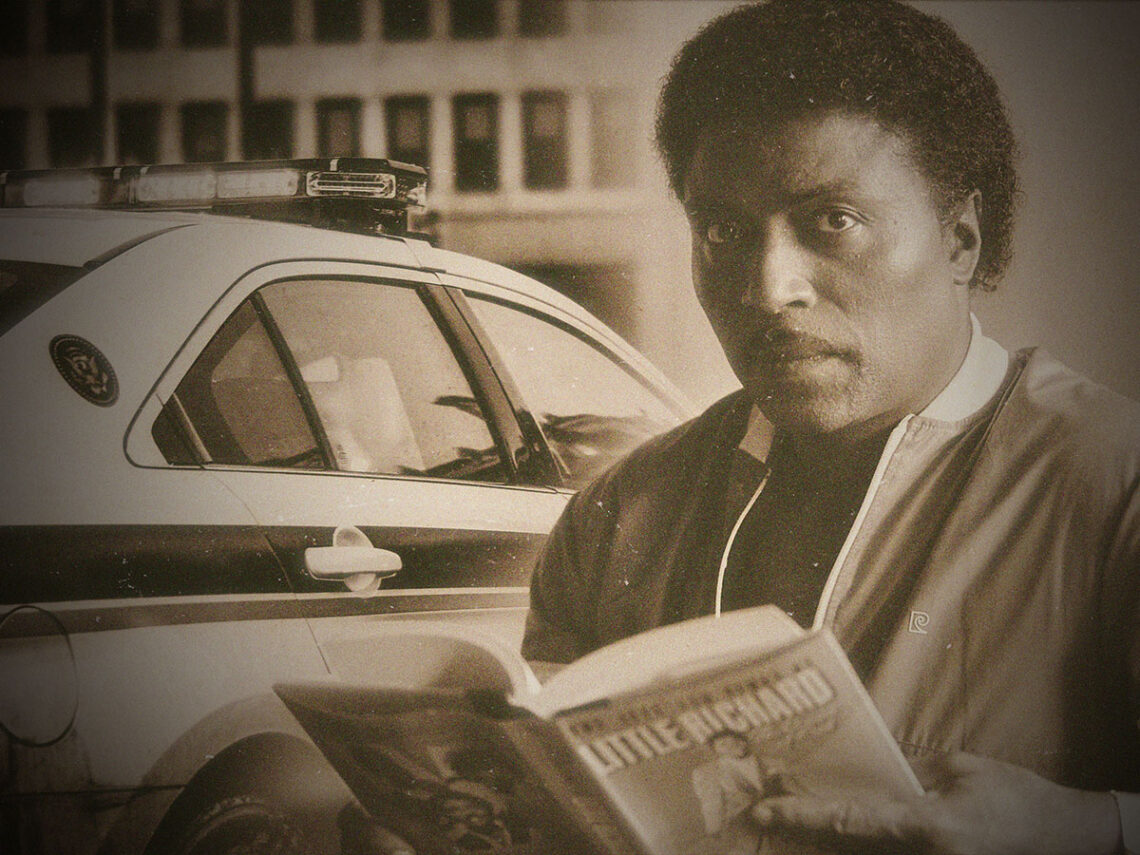
Why Little Richard was nearly shot dead mid-gig by a cop in 1965
When people talk about the danger of early rock ‘n’ roll, the kind played by the likes of Little Richard, Chuck Berry and Jerry Lee Lewis, they’re often talking about a very specific kind of danger. They’re talking about the genre being culturally dangerous, and to be fair, they had every right to think that way.
After all, moralists and tastemakers of the time were incredibly threatened by rock ‘n’ roll. They really didn’t want to know what happened when the impressionable youth of the 1950s were told that they didn’t have to listen to their parents or teachers and that they could do things their own way. That’s all well and good, but for a number of people who actually played rock ‘n’ roll, the idea of their livelihood being “culturally” dangerous was darkly funny. It was a much, much simpler kind of dangerous.
How could it not be when the early days of rock ‘n’ roll consisted of one thing and one thing only? Specifically, a number of black people put themselves in the public eye and were controversial at a time when a huge number of people wanted them dead. Not in the way they do today either, where that’s broadly speaking something racists fantasise about on 4chan (at least until they join the police), no, in the sense that lots of people were ready, willing and able to act on it.
Case in point, a gig that the aforementioned Little Richard played in 1965, three years before segregation was officially abolished in the United States. At the time, gigs worked a little differently than they do today.
Rather than go and see one band headline with one or two support slots, bands and artists played on roadshow tours where anywhere from six to eight acts would play half-hour slots on the same bill. This led to some slightly bananas line-up choices, like this one where Little Richard and The Hollies played on the same bill as the 15-piece King Curtis Orchestra.
However, Little Richard infamously didn’t play well with others. He was also by a mile the best live act on the bill. Despite this, he wasn’t booked to go on last, the orchestra was. Typically, Richard went on and absolutely smoked the joint, driving the assembled crowd wild and begging for more every time Richard threatened to end the set. The Hollies’ drummer Bobby Elliot wrote about what happened next in his memoir It Ain’t Heavy, It’s My Story: My Life in The Hollies.
He wrote that he heard raised voices after their set and poked his head out of the dressing room door to find “The sight of a group of theatre staff fronted by a tubby New York cop, pistol drawn, stopped me in my tracks.” He also heard a voice ranting that “‘Those little white girls out there love me.’ It was Little Richard. And he was in real ‘Tutti Frutti’ tantrum mode. The police officer appeared agitated and was now sticking the loaded weapon into my hero’s neck. It was tense.”
It turned out that Richard had been warned that if he kept playing, the orchestra would start playing over him. This had happened (much to the audience’s chagrin), and Richard had gone ballistic. He was ushered offstage and seemingly directly into the path of a trigger-happy NYPD officer. After a tense exchange, Richard’s manager managed to convince him to return to his dressing room, where he packed up and left.
Which is just as well, really. This was a gun-toting, white NYC cop confronted with an angry Black man in the mid-1960s. It could have gone so much worse.