


Gods of London: Alan Moore, Bauhaus and occult poetry gigs
Alan Moore is a wizard.
Now, obviously, there’s the metaphorical connotations that come with that statement, all of which, as true as a hyperbolic statement can be. From Hell, Watchmen, V For Vendetta, Whatever Happened to the Man of Tomorrow, Jerusalem, it’s enough to make you forgive a stinker like The Killing Joke. Nearly. The man is an eccentric genius, one of the greatest writers to ever come from the medium of comic books and, as much as a statement like this may make him curse my very soul into Hades itself, a national treasure.
I’m not kidding about that last point either, because there’s another side to the statement “Alan Moore is a wizard”. One that might make you scoff, but if a mind as sharp as Alan Moore’s is all in on it, it’s definitely worth a second look. The other side of the statement “Alan Moore is a wizard” is the fact that it can be said entirely literally and still work. Alan Moore is a wizard in the sense that he genuinely believes that he can use magic to alter the world around him.
Moore announced this to the world on his 40th birthday as part of what was also (sort of) a retirement speech. He announced that he would be devoting his life to ceremonial magic and that he saw it as “a logical end step to my career as a writer”. This would turn out not to be the case; he’s obviously continued his very successful writing career ever since, but he was deadly serious about the magic stuff. An interest that he first discovered while working on From Hell.
In 2001, he told The Guardian, “One word balloon in From Hell completely hijacked my life. A character says something like, ‘The one place gods inarguably exist is in the human mind.’ After I wrote that, I realised I’d accidentally made a true statement, and now I’d have to rearrange my entire life around it. The only thing that seemed to really be appropriate was to become a magician.” However, before you start thinking about cauldrons, wands and other pop-cultural detritus associated with wizardry, this is a very different kind of magic.
How did Alan Moore use magic?
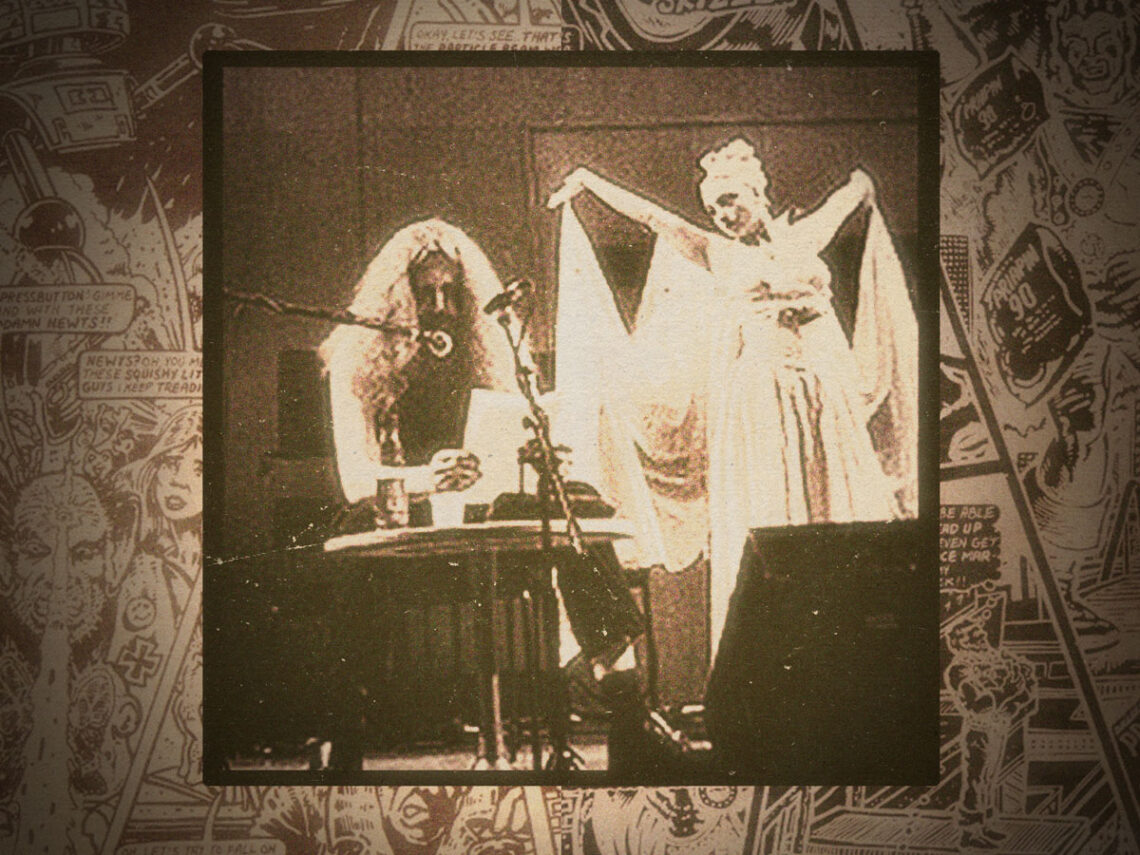
In fact, the best example of the way Alan Moore used magic came from a project he put together with Bauhaus member David J and fellow musician Tim Perkins. A project that, on the face of it, sounds less like a magical ritual and more like a performance art gig. The trio came together in 1994 and put on what they called “workings”, a combination of live music by J and Perkins, along with Moore’s prose poetry spoken over it.
The project, called The Moon and Serpent Grand Egyptian Theatre of Marvels, became a regular occurrence. Moore, Perkins and J travelled the country to put on these workings several times over the next decade. More often than not, the prose was a response to the area where working was taking place. For example, the third working took place in Highbury rock club, The Garage, and was an invocation of that specific part of London, right down to a bizarre piece Moore wrote about the nearby football club, Arsenal FC.
These gigs were recorded in full and released as albums to document them. Those albums seem to be the closest we’ll get to seeing those workings in person again, but that doesn’t mean that The Moon and Serpent Grand Egyptian Theatre of Marvels has truly died. The name these days is used for the magical books that Moore and his mentor Steve Moore are publishing, like The Moon and Serpent Bumper Book of Magic, which is perfectly apt.
Death means nothing to a good wizard after all, and what means everything is keeping the spirit of magic alive for future generations.