


‘A Little Outrageous’: How Jamie Hewlett called out the comics industry with ‘Tank Girl’
One gets the feeling that Jamie Hewlett has deeply mixed emotions about being in Gorillaz.
On the one hand, it made him a contender for the world’s most famous illustrator. His work became a centrepiece of one of the biggest and most influential bands of the 2000s, and his characters some of the most recognisable of any medium in that era. A generation of music fans can identify the likes of Murdoc Niccals, 2D, Russell Hobbs and Noodle by silhouette, let alone by sight, which has done as much (if not more) than any individual song of theirs to make Gorillaz not only a popular band, but a genuinely important one.
On the other hand, Hewlett soon discovered what Graham Coxon discovered in the mid-1990s. Which is that if you work alongside Damon Albarn, pretty soon you’ll find yourself working for Damon Albarn. As time went on in Gorillaz, Albarn’s music started taking precedence over Hewlett’s visuals, which was never the plan. The agreement was always that the music and visuals would work in tandem, but that’s Big Damo for you. The man is as much a control freak as he is a generational musician, and in his world, everyone takes a back seat to him.
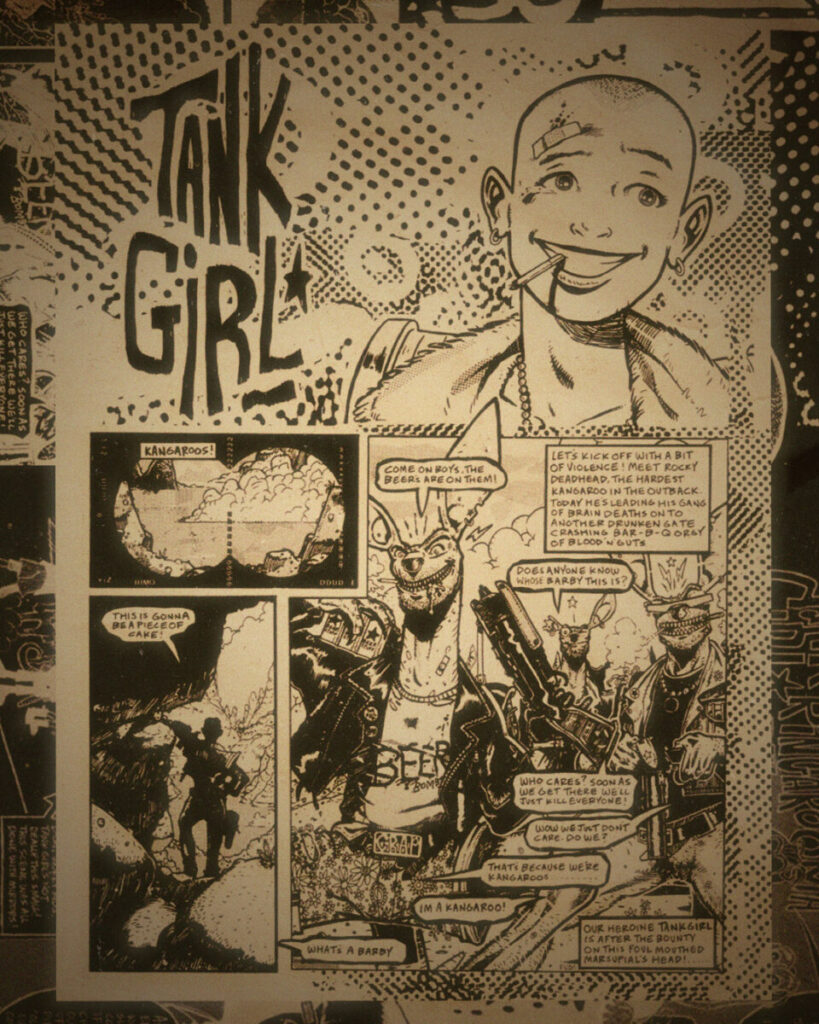
However, what might just make Hewlett OK with this is the fact that he’s never considered Gorillaz to be his magnum opus. The project he seems most proud of, instead, is the one that brought Jamie Hewlett to prominence when it was first published in the pages of Deadline in 1988. The deeply surreal, anarchic explosion of colour, violence and mutant kangaroos, Tank Girl.
Imagine a hypercharged, proudly counter-culture version of the Borderlands video game series, and you’re halfway to conceptualising what a bizarre, spectacular ride Tank Girl is.
What inspired Jamie Hewlett to make Tank Girl?
To be clear, Hewlett wasn’t alone in this. While he created the title character’s iconic look, the character of Tank Girl was created in tandem with writer Alan Martin. Inspired by (like most pieces of great art) a girl they had a crush on in Uni, the first incarnation of Tank Girl was created in the mid-1980s. Eventually, a comic strip featuring the character was pitched to the upcoming comic magazine Deadline and was chosen to be the magazine’s flagship strip, with Tank Girl herself featured prominently on the cover of the magazine’s debut issue.
Within months, Tank Girl had been adopted as a counter-culture icon, protesting against the dying days of the Thatcher government. This was absolutely the intention that Hewlett and Martin created the comic strip with, and not only as a comment on the hellscape that was British culture in the late 1980s. No, Tank Girl also existed as an extended middle finger to the comics industry, one that only got more pronounced as its commercial success grew.
Hewlett said as much in an interview with Dazed about the early days of the comic. In the interview, he says that he and Martin were writing the comic to “push the limits a little bit with that character and just be a little outrageous and say stuff that nobody said and nobody talked about and use words that nobody was allowed to use in comic books and try to get over this sort of pathetic censorship.” A censorship he illustrates by saying, “You can’t show a nipple, but you can show someone being stabbed to death or this other bullshit that we still have.”
The irony of it all is that this punk rock spirit made Tank Girl one of the most popular independent comics of the 1990s, with Hollywood going so far as to make a movie out of Tank Girl in 1995. It flopped spectacularly, but what’s more truly Tank Girl than making a bunch of suits lose millions of dollars? While Hewlett may have a more commercially successful project than Gorillaz, one can certainly understand why Tank Girl is still the project closest to his heart.