


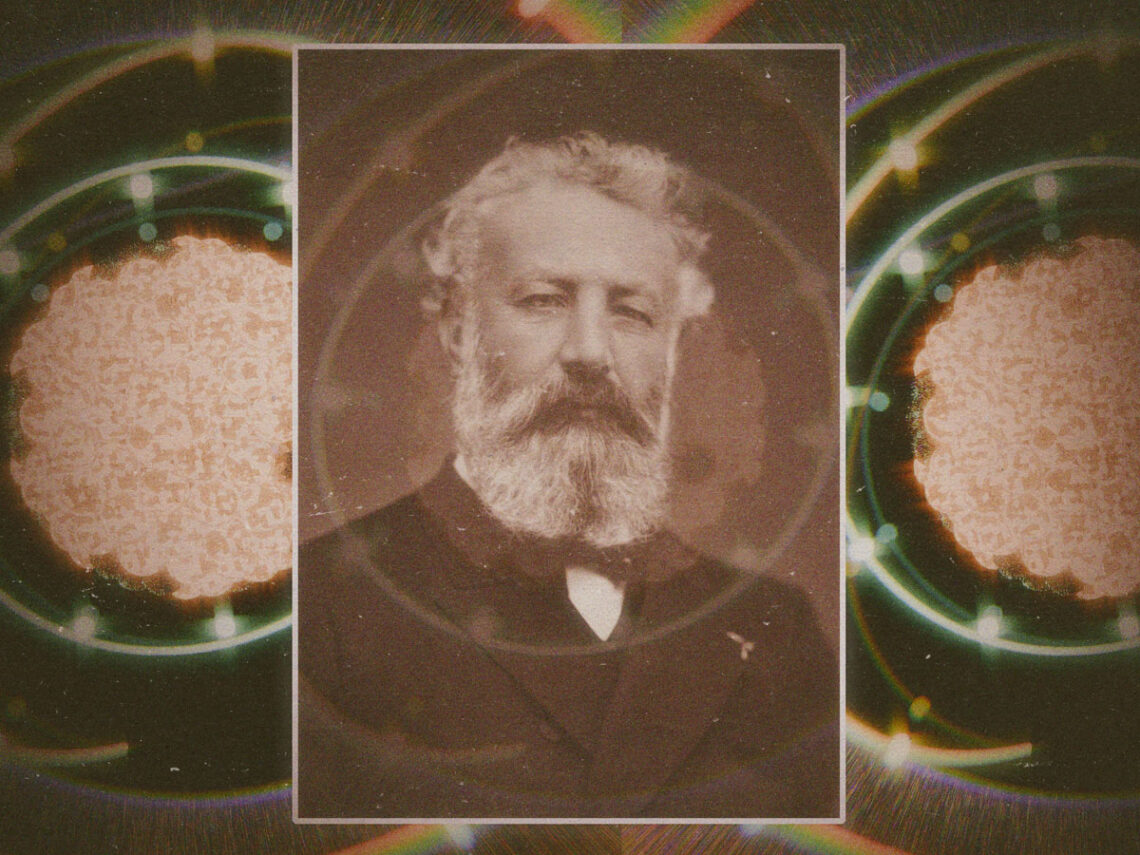
The Jules Verne novel that predicted the entire 20th century
Jules Verne proved that not only is there a difference between sci-fi and science fantasy, but it actually does matter, if only to utter dorks like me.
Science fantasy are things like Star Trek and Star Wars, where half the concepts that they’re dealing with are essentially magic but dressed up in technical language. Absolutely nothing wrong with that whatsoever, to be a 100% clear, but science fiction should deal with the world as it actually is, or indeed as it actually will be. Verne’s works deal with this in countless ways. Works like Journey to the Centre of the Earth, 20,000 Leagues Under the Seas, and Around the World in 80 Days arguably popularised the genre on the world stage.
Broadly speaking, each of those novels told stories that were hopeful about what the technology of the immediate future could. Sure, they were fantastical, but there was an optimism about what could come next that people caught on to. However, there was a Verne novel that he wrote about what was, at the time, the far future. Paris in the 20th Century was written in 1860 about what life might be like a century later in 1960, and Verne was so bang on the money it’s genuinely uncanny.
Verne paints a picture of a world in which everyone has a personal car powered by an internal combustion engine. Which is bang on the money, but most people could see where the wind was blowing and could imagine a future like that, given time. Things start getting really Nostradamian when Verne predicts the infrastructure needed for a world like that to work, with his novel featuring gas stations and paved asphalt roads.
There are also skyscrapers, fax machines, elevators, and primitive computers featuring an early version of the internet. All the stuff which, by the 1960s, was invented. One can imagine this being a wonderful vision of the future, but this is where the other shoe drops. Verne is intensely pessimistic about the world’s future. Both for good reasons (remote-controlled weapons systems, bombs capable of destroying the earth) and for bad (feminism “going too far”, the entertainment industry degrading into pornographic stage plays).

It’s accurate enough to be genuinely weird. So much so that it’s right to be suspicious about its origin. After all, it was published in 1994 after being written in 1860. One can imagine the story of it being a Jules Verne original being exactly that, a story. Not only do we know for a fact that Verne wrote it in the mid-1800s, but we also know exactly why it wasn’t released then. Verne sent the manuscript to his agent, Pierre-Jules Hetzel, who wrote back with one of the most astonishing smackdowns in the history of publishing.
Hetzel said, “I was not expecting perfection – to repeat, I knew that you were attempting the impossible- but I was hoping for something better.” Before going on to say how ludicrous and pessimistic the view of the future was. He signed off with another remark so withering that any lesser writer would hang up their pen in disgrace. “I am surprised at you… [it is] lacklustre and lifeless.”
Hetzel recommended that Verne return to the novel in 20 years once the immediate future became a little more easily read. As we can all see now, though, he didn’t need to. Instead, he shelved the project and the book wasn’t released until nearly 90 years after his death. When we could see just how unnervingly accurate his predictions were.
We could also see how horribly pessimistic they were, but maybe that’s the attitude we deserve.