


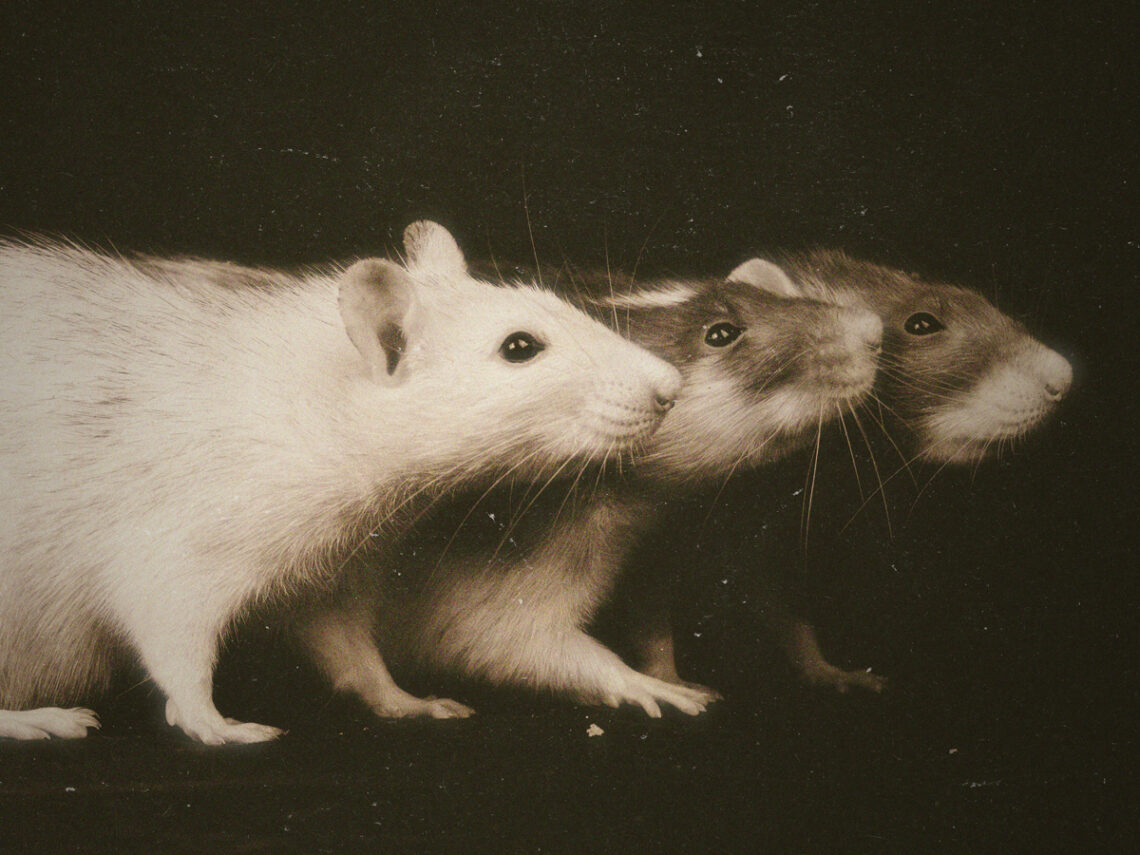
Remotely Guided Rats: Humanity’s most depraved experiment?
I can imagine that more than a few leading lights of the scientific world first discovered their passion for scientific research and discovery with a childhood viewing of Jurassic Park. After all, few people made science look cooler than Jeff Goldblum’s Dr Ian Malcolm.
Even if they weren’t drawn to palaeontology, his sheer charisma (plus how good he looked minus a shirt) made looking into what humanity was capable of look like the coolest thing on the planet. The irony is that how cool he looked distracted him from what he actually stood for in the story. Which was, lest we forget, as a warning against untrammelled scientific experimentation without a thought for the consequences. Or, to put it another way, getting “so preoccupied with whether they could, they don’t stop to think whether they should.”
There are so, so many examples of experiments like that but one of the best examples came in 2002, from Sanjiv Talwar and John Chaplin. While working at the State University of New York Downstate Medical Center, the duo managed to find a way of guiding rats through an obstacle course by, essentially, remote controlling them using a little backpack. Now, the mental image of a little rat in a backpack is one that could launch several succesful children’s books. However, this isn’t a story for kids.
You see, the backpacks were only step one of the process. They contained the mechanism that the scientists controlled but what actually made them guide the rats went a bit further than that. The device was connected to a set of electrodes that were then implanted in the rats’ brains, giving the scientists complete control over its movements.
Suffice to say, when news broke about Talwar and Chaplin achieving this, people were not happy.
Why were these experiments on rats so controversial?
It takes a hell of a lot to make people put aside the fact that they cut open a living creature and put electrodes inside its brain. However, even if they had found a “humane” way of controlling the movements of a living creature, that would still be a contradiction in terms. You can’t humanely remove a sentient creature’s agency even in the name of science. A
s a spokesperson from the Dr Hadwen Trust put it, the experiments were an “appalling example of how the human species instrumentalizes other species.”
It’s telling that the scientists responsible for this defended themselves as if the problem was inhumane treatment of the animals. Talwar said “Our animals were completely happy and treated well” and assured the scientific world that the rats were encouraged to act with the reward of pleasure, rather than compelled or forced to do anything. They also stated that their method would be unlikely to make any of the rats they experimented on act in a way that would risk their life. One wonders how they tested that hypothesis.
You could say that it was just rats. It would be callous, but understandable given their status as vermin that most would kill with a song in their hearts. However, given Elon Musk’s company Neuralink proudly implanted their first brain chip in January 2024, I think the moment the technology first developed by Talwar and Chaplin becomes readily available is coming sooner than we think. If someone is able to “encourage” a real life human being to act in a certain way with a “reward of pleasure” is that still controlling someone?
Here’s a clue, yes it is. We should all be terrified.