


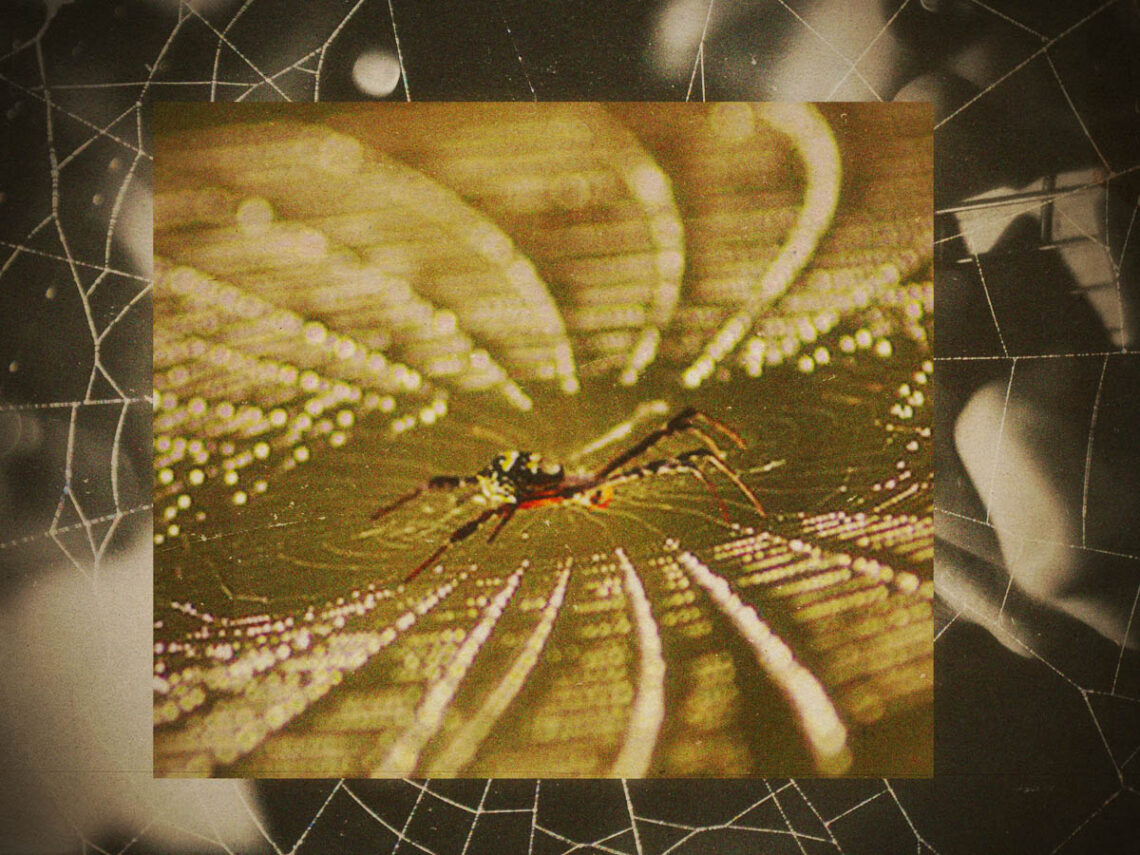
Spiders can ‘tune’ their webs like guitars to help them impress potential mates
A team of researchers from the United Kingdom and Spain demonstrated that spiders are capable of tuning their webs for the purpose of receiving information about the local environment, including the presence of prey and potential mates.
Similar to the strings of a finely tuned instrument, every strand of spider silk conveys vibrations across a wide range of frequencies over the span of a web. Spiders require a system like this to detect the presence of prey and mates, as their visual acuity is very low.
The general phenomenon has been understood by scientists for some time; what wasn’t clear were the precise characteristics of these vibrations or (more to the point) whether spiders exercised control over the practice. Researchers from Oxford University and Universidad Carlos III de Madrid, though, released a study, available in the Journal of the Royal Society Interface, that looks into the material properties of spider webs and the way that vibrations propagate through the silken strands.
The team has shown that spiders do, in fact, tune their webs to transmit specific messages. The paper’s title is ‘Tuning the Instrument: Sonic Properties in the Spider’s Web’.
The science of web tuning
The researchers used lasers to measure the tiny vibrations, isolating three particular features that allow spiders to turn their webs into data transmitters: web tension, silk stiffness, and overall web architecture. It turns out that spiders are capable of manipulating all three of these characteristics.
Spiders “tune” the waves that emanate from the web by adjusting the web’s tension and the stiffness of the web’s outer rim and spokes, also known as the dragline. In fact, spider webs are so customisable that the researchers hypothesise that some properties of silk evolved for this very purpose.
Quoting from the paper’s abstract, researchers said: “We propose that dragline silk supercontraction may have evolved as a control mechanism for these multifunctional fibres. The various degrees of active influence on web engineering reveals the extraordinary ability of spiders to shape the physical properties of their self-made materials and architectures to affect biological functionality, balancing trade-offs between structural and sensory functions”.

Unsurprisingly, the cunning evolved knowledge that a spider uses to construct its web far exceeds a simple “hope for the best“ model. Spiders actually tweak their webs to ensure the propagation of specific vibrations. The primary purpose of a web is to trap prey, but the structure of the web is optimised to capture important information about the area. Spiders construct and then fine-tune their webs to act as a multi-function device.
“Spider silk has been evolving for over 350 million years,” Beth Mortimer, a lecturer in biology at Oxford University, added. “And it’s something we haven’t been able to re-create.”
“If you think of something like a violin or a guitar,” Mortimer added, “For a certain length of string you can have different pitches that come out of your instrument.”
“The spider can actually pluck or bounce the silk strings,” Mortimer continued, “And it can monitor the echoes that come back so it can locate objects.”
So the next time you brush away a web in your garden or knock one down with a broom, spare a thought for the creature that built it, because you’ve just trashed an instrument more sophisticated than most soundboards at Abbey Road. This isn’t just some bug trap. It’s a living, vibrating architecture of intent, constantly fine-tuned to pick up on everything from lunch to lust to local weather patterns. The spider doesn’t just build its world, it scores it. Every thread is a note, every tremor a signal, every pluck a line of code in nature’s oldest analogue system. Makes our smartphones look like Fisher-Price toys.