



The video game that predicted the pandemic 15 years early
Nostalgia really is the worst, isn’t it? I never thought I’d have to put up with people rhapsodising about how great the Covid-19 pandemic was, but now it’s safely ensconced in the annals of history, here we are.
Perhaps it’s a trauma response. Our brains are constantly trying to soothe us, so maybe that’s why people choose to remember it as a months long break from work with Zoom quizzes, furlough payments and a few more cheeky glasses of wine than you’d normally have. Perhaps it’s better remembered that way than the psychological torture it actually was, one that showed the best and worst of the world’s disaster response frameworks.
After all, never, ever let it be forgotten that Covid-19 happened because people let it. There were several warning signs that, properly heeded, could have softened the blow of the pandemic and saved hundreds of thousands of lives. That was the worst of it, however, once we were well in the trenches and all those Zoom quizzes had gotten immensely old, no matter how many funny hats you wore, there were aspects of the response that were genuinely incredible. You’d never guess, but a part of that came from a truly baffling source.
After all, it came from a pandemic that had happened 15 years previously. One that had crippled the lives of millions and uncontrollably spread not only via person-to-person contact, but via animals as well… It had an entire world by the throat, and there was one entity responsible for it. Hakkar the Soulflayer, the terrifying loa worshipped by the Gurubashi trolls.
Oh yeah, I forgot to mention, this was a pandemic that happened entirely within World of Warcraft.
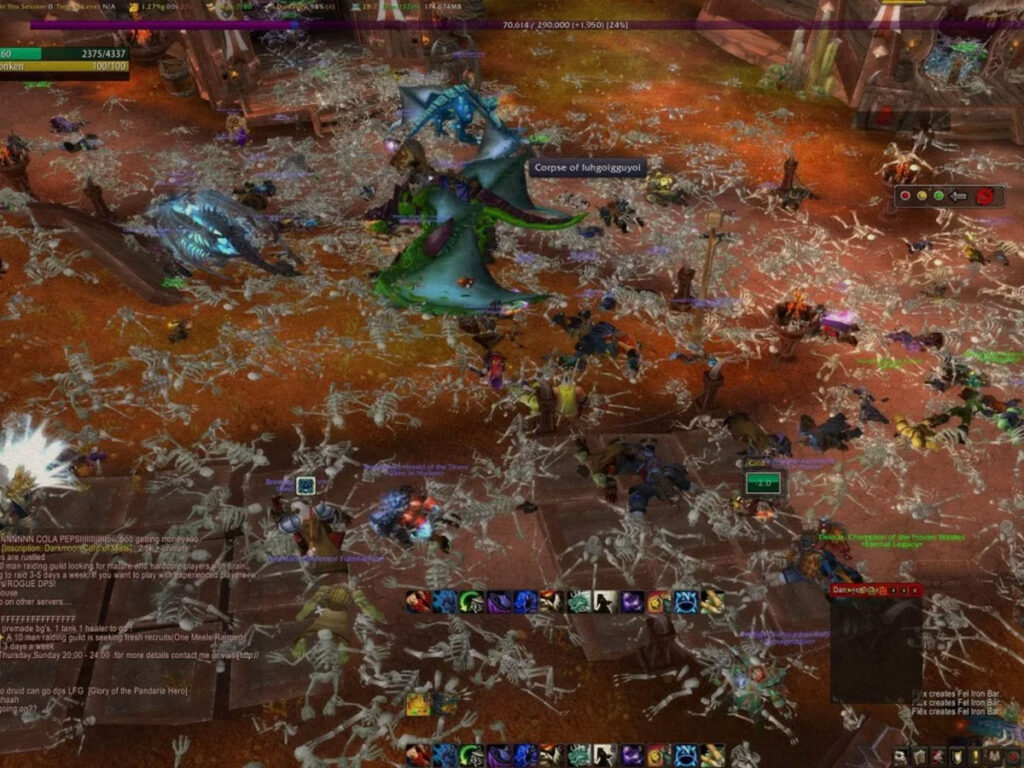
When the massively multiplayer online role-playing game added Hakkar the Soulflayer as a major boss character for players to fight, the game also added a spell for him to use called ‘Corrupted Blood’… This was a status effect that would sap the life of players, but crucially, it could be passed from player to player – the developers had intended for the effect of Corrupted Blood to only remain in the realm ruled by Hakkar the Soulflayer, but much like the people who planned the Covid response, they hadn’t accounted for one simple thing.
People are selfish idiots who don’t plan ahead and panic easily.
They haven’t planned for people to be infected with the spell, then rush away from the encounter and arrive in a densely populated part of the game in order to deal with it, infecting several others around them with the same disease. A lot of the time, even if they did dispel the curse, those players were often infected with it once more due to spreading it themselves. That was the behaviour observed from people being idiots, but that wasn’t the only thing you could find.
You could also find people infecting others for the fun of being cruel to others, you could find people waltzing up to infected areas out of sheer curiosity, or lying to others about things that could cure the disease. It wasn’t all doom and gloom; there were teams of players who would go out and heal low-level players, but they would often become spreaders of the curse themselves.
If this is all sounding horribly familiar, then you’re right to. Epidemiologists Nina Fefferman and Eric Lofgren observed the human response to the Corrupted Blood fiasco and published a study in the scientific journal The Lancet that focused on how virtual worlds could shed light on real-world epidemics. 15 years after the virtual epidemic, Fefferman was putting her hypothesis to the test in the real world as part of a team plotting the public’s response to Covid protocols.
The vast, vast majority of the behaviour exhibited in World of Warcraft was replicated in real life. The difference being that the Corrupted Blood epidemic ended with a software update.
It would have been lovely if it were as simple for us.