


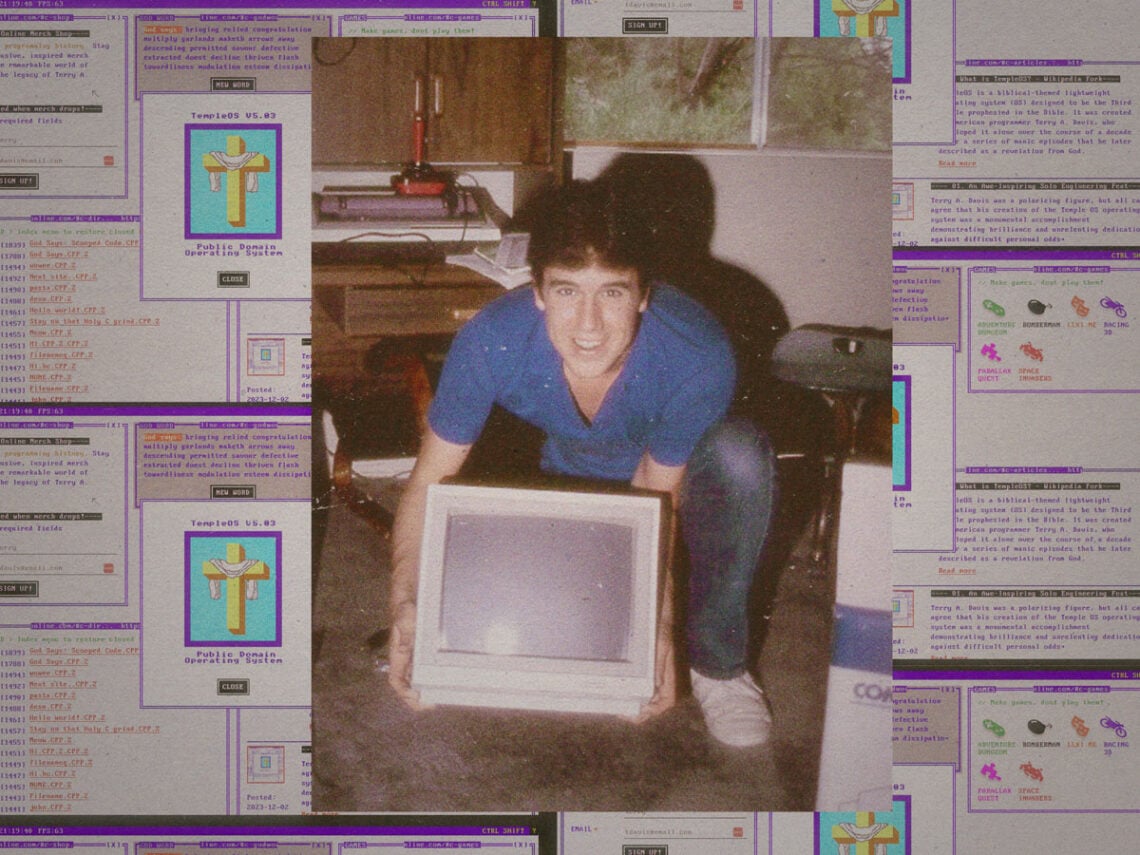
Terry Davis: the schizophrenic software engineer who changed the game
The line between art and craft is one that should be pretty well defined on the surface.
After all, for the most part, you can’t judge a piece of art on its practicality. What’s the utility of a Rothko painting? Or the last Little Simz album? Unless you start measuring the amount they emotionally affect their audience. In which case, we’re judging quality and that’s absolutely not the same thing as utility. In a strange way, it’s the opposite. Utility is undeniability. You might not like the colour of a television remote, but if it turns on the TV, you can’t deny its usefulness.
That said, when the lines start overlapping, you get some seriously brain-boiling questions. The world of ceramics is full of questions like this. A pot has a use. You store things in them, innit? Yet many pots made by ceramicists would fail to store anything because they’re not created for that; they’re pieces of art. Does naming said pot a piece of art negate it from being bad at its job, or is it the most perfect pot one that combines artistic expression with practicality?
I ask this because these are all questions raised by the work of Terry Davis; however, his work isn’t from the world of ceramics. It’s from one where the question of whether utility is king is even more pertinent. Terry Davis works in a world where the question of whether the product is art sounds kind of ludicrous on the surface, yet the more you look, the more you have to question that reaction. Terry Davis is a software designer, one whose work makes a lot more sense as art than it does as craft.
How does Terry Davis create art?
Born in West Allis, Wisconsin, in December 1969, Terry Davis had a more or less standard Generation X childhood with a few key differences. He was the seventh of eight children, and his father’s work in industrial engineering saw his family move all around the country. Other than that, it was a fairly standard, small-c Catholic upbringing. Remember that last part, it’ll be important later. From a young age, Davis started experimenting with computers, which turned into a lifelong fascination with computer programming that he turned into a career pretty early on.
By 1994, the world seemed at his feet. He’d worked for Ticketmaster for four years and completed a master’s degree in Electrical Engineering. Then, the previously atheist Davis experienced a “revelation from God.” Something which a fair few right-thinking people have had in their time, yet Davis then also started experiencing manic episodes and extreme paranoia. He was diagnosed first with severe bipolar disorder, then schizophrenia. However, just about the only topic that Terry Davis could make sense about was computers, and he never stopped working on new programs, including one in 2005 that would be considered his masterpiece in due course.
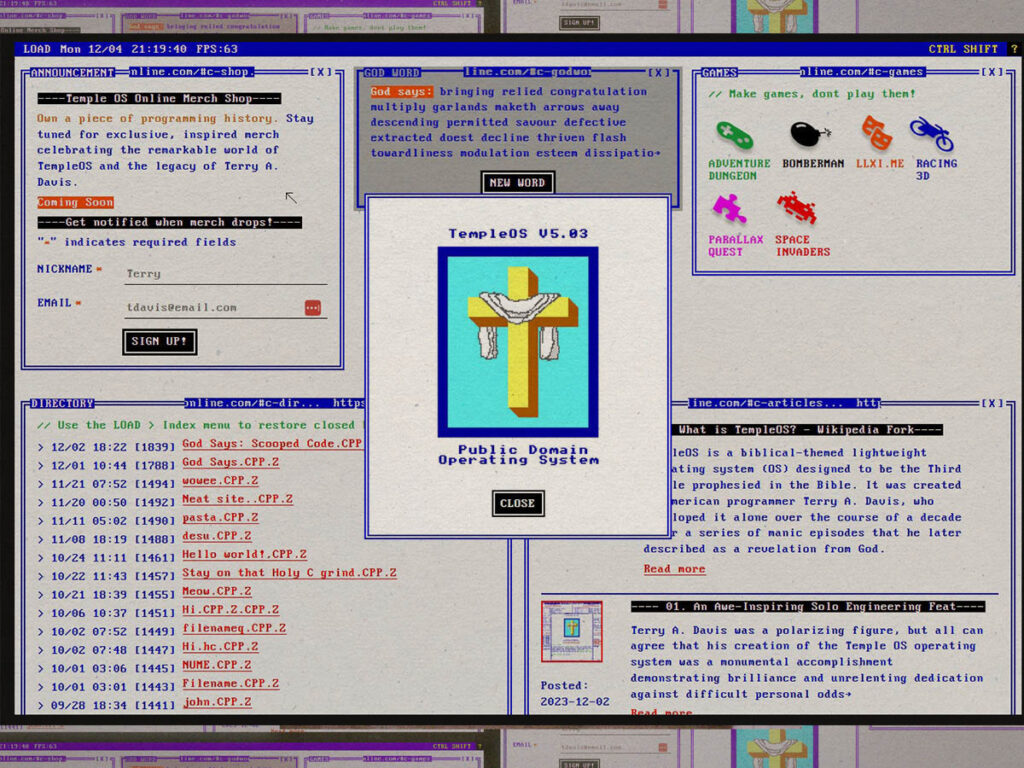
Davis created J Operating System, a then-modern form of the Commodore 64, one that Davis claimed was created under specific instructions from God. The heart of it was the program AfterEgypt, where the user travels to the burning bush described in Exodus. There, a randomised word generator would “speak” to the user in the way Davis believed that God spoke to him. According to Davis, the system was created to be a replacement for the Second Temple, which led to him renaming the system to TempleOS.
While the system was barely functional and outdated years before its release, the fact that Davis created it himself is nothing short of a miracle. Akin to one person building a skyscraper. Terry Davis died in 2018 in tragic circumstances, but despite the darkness that surrounded his entire adult life, he always has this achievement to his name. Putting aside all questions of art or craft and their utility, perhaps it’s the way we’re remembered that truly decides what we put into this world.