‘From Extreme Positions’: An exclusive interview with artist Paul Brandford
To be truly radical in our super-duper-AI-digital world, we must go back to analogue. We must write with pen on paper. Paint with brush on canvas. Carve beauty by hand. We must engage with life, not devour it as some unattainable lifestyle through a screen.
Ironic. I know. Because I write this on a blog site which you’re reading on a screen, but there we go. So much is life. To get to the point, and here it is: One of my favourite artists who examines modern life in all its marvellous chaos is Paul Brandford.
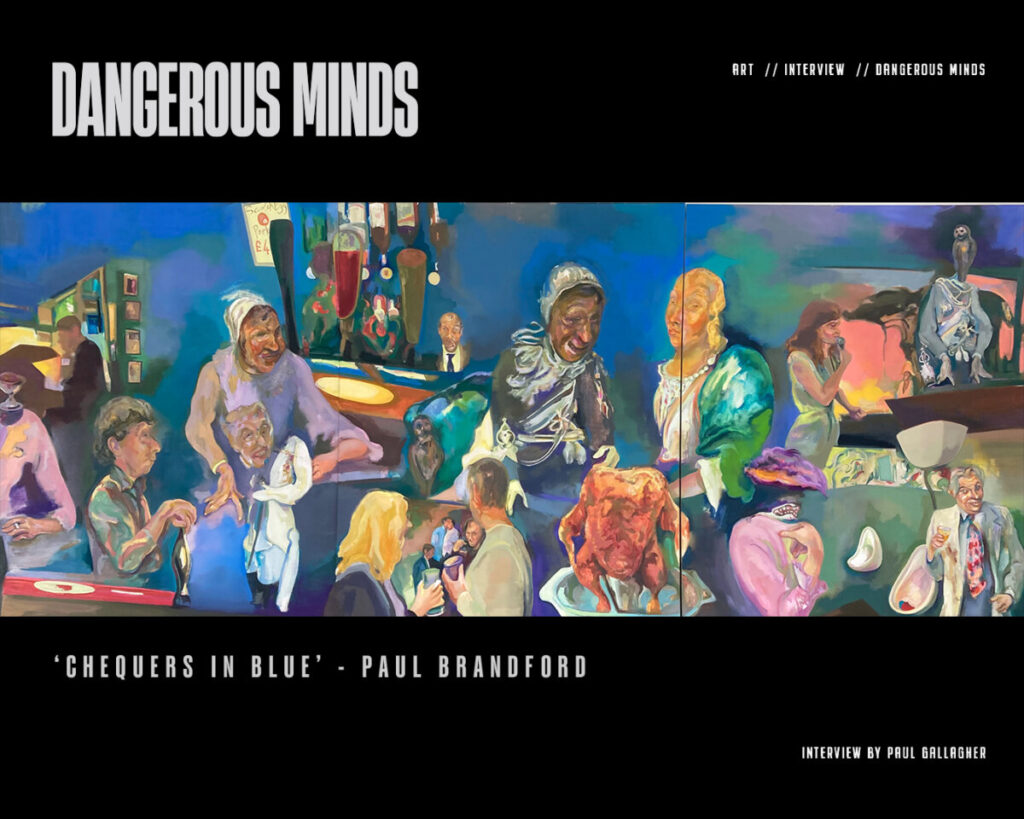
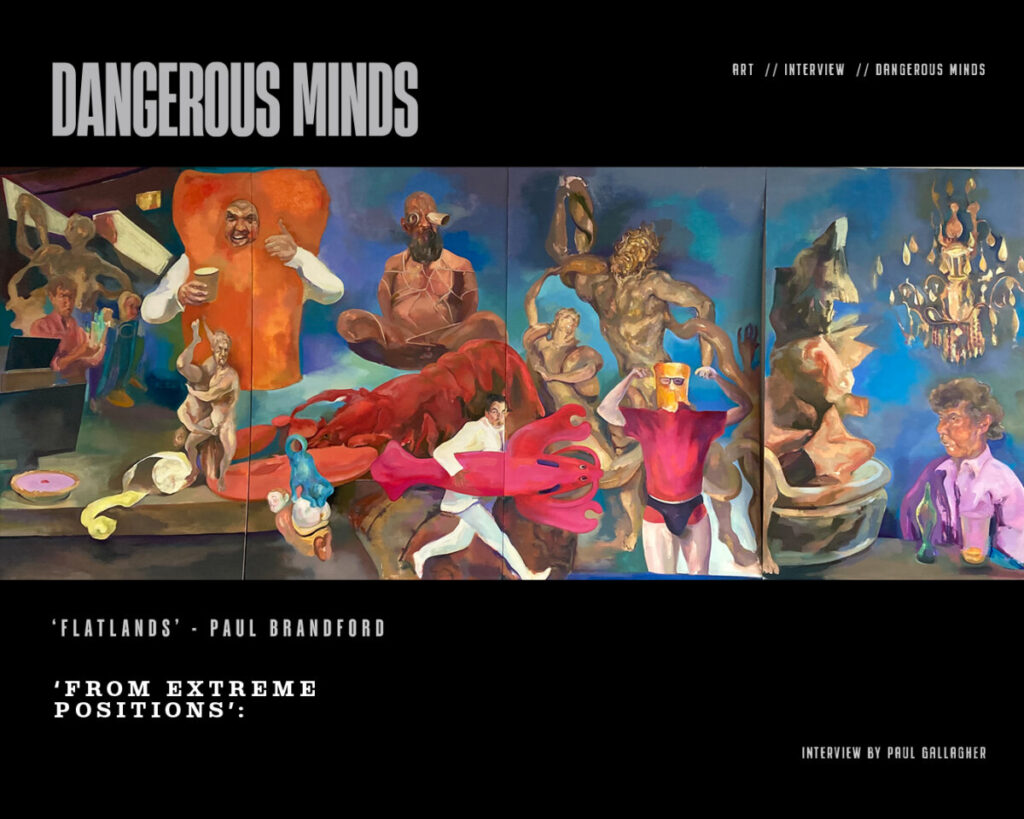
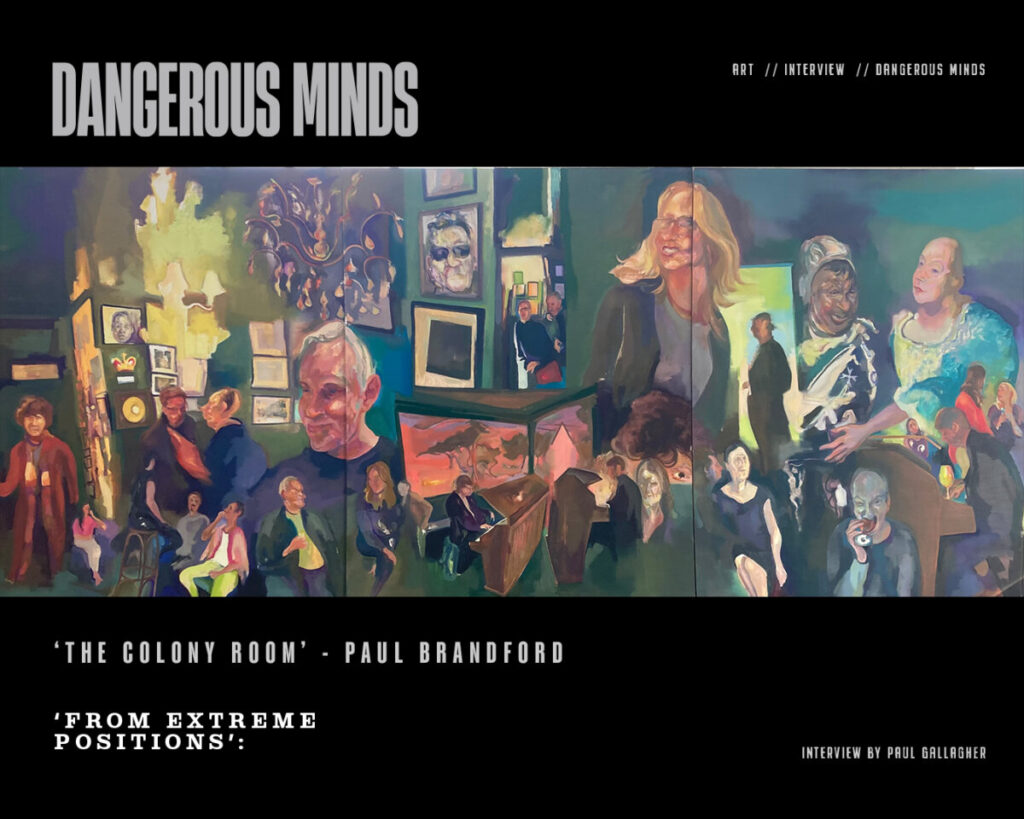
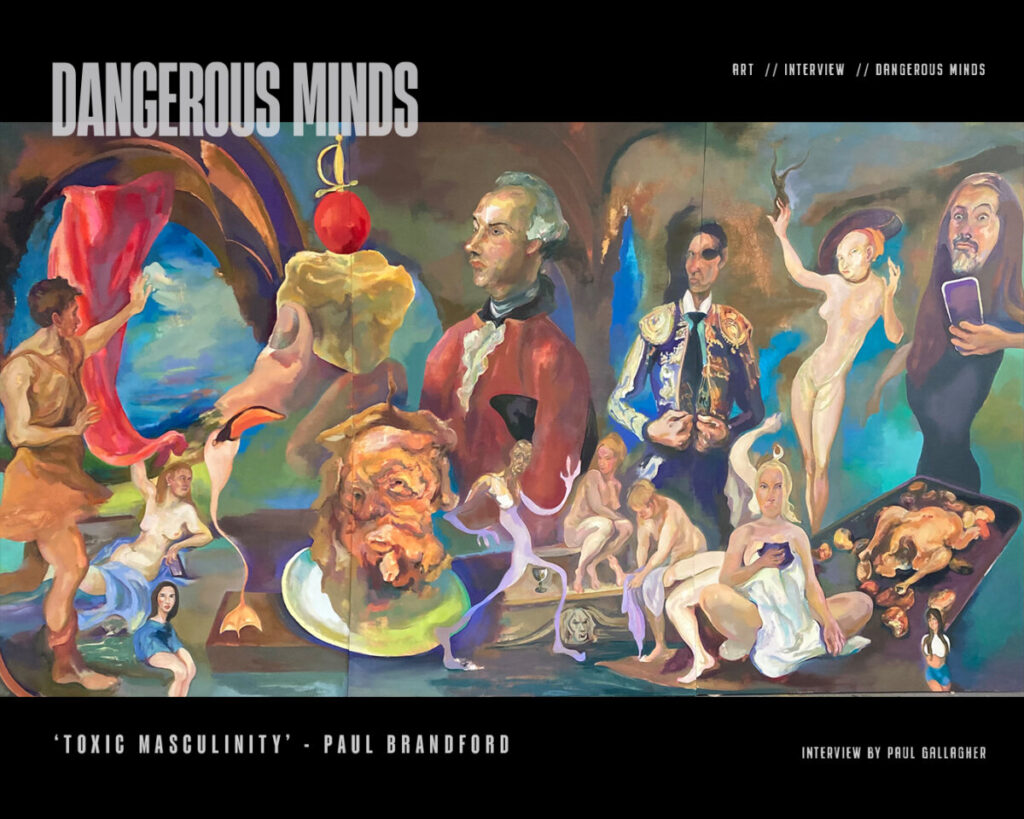
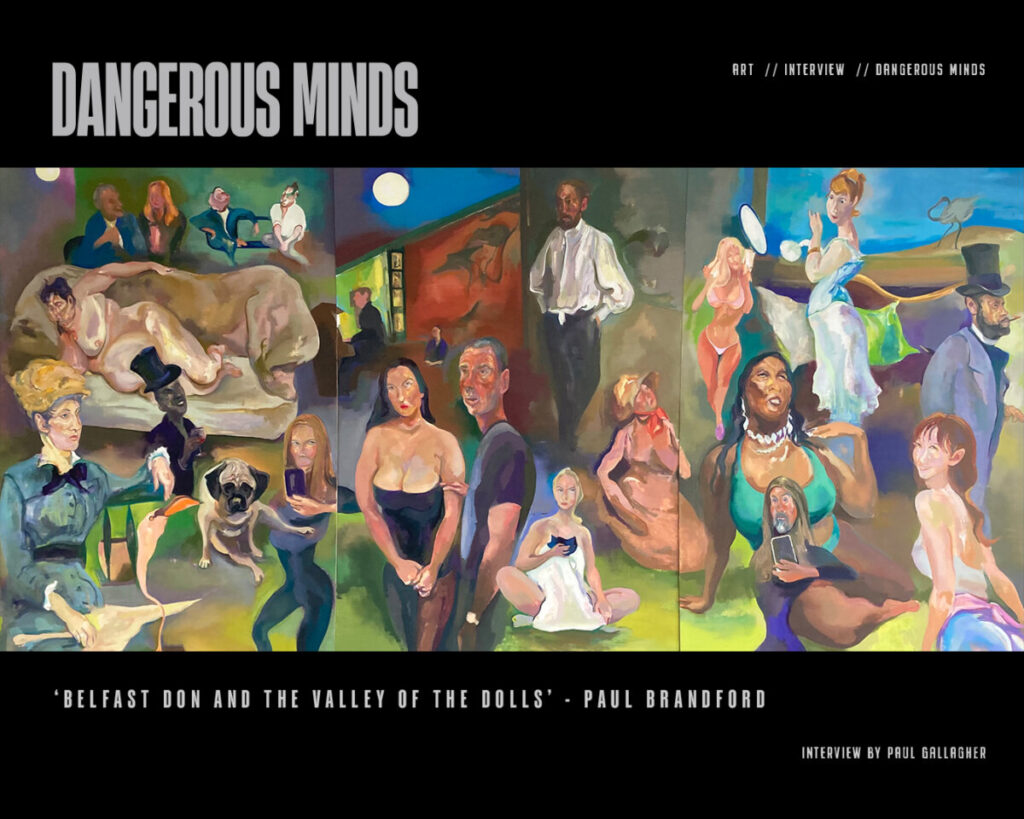
Brandford is among the most gifted and interesting artists working today. He is an award-winning figure who lives and works in London. He paints giant figurative pictures like no one else on boards six feet high by twelve feet wide. These paintings feature a collage of images culled from classical art, photography, movies, television, politics, and the random detritus posted on socials. They also feature friends and document events in celebrated locations like the Colony Room. A whole cornucopia of doomscroll, you might say. But Brandford’s work is far more than that. It is painting with subversive intent. As I have said elsewhere:
“If,” as John Berger once wrote, “Turner best represents most fully the character of the British 19th century, then Brandford best and most brilliantly represents Britain’s culture in the digital age and its endless, chaotic stream of images.
Back in 2023, Brandford exhibited his work as part of a group of artists who were attempting to “break the narrative” of art. Changing the narrative of what art can represent. In part, this idea comes from Mel Brooks’ Blazing Saddles, where a cowboy fight in a barroom bursts through the studio wall into a set where a musical is being filmed. This turns into a melee and then a pie fight.
In other words, the current narrative for art has been shattered by technology. Art with a capital A is merely a commodity for investment. Sold in auction houses, making gazillions for the dealers and galleries. You know, the usual suspects. Warhol, Picasso, Bacon, Freud. All of which stops the advancement in real Art being produced by a gazillion of as yet unknown artists.
Brandford’s thumbnail biography to date is art school, first exhibitions, first prize for drawing, group award prize, group exhibitions, and solo shows across the UK. Next? Well, I hope and know one day it will be the Tate, then the Guggenheim. Artists like Paul Brandford are a rare breed who point to a future in Art (with a capital A).
What inspired you to become an artist?
Paul Brandford: “I always sort of knew it. From a fairly impoverished early childhood when the pristine box of (undoubtedly cheap) paints arrived at Christmas, just looking at those coloured tablets transported you from harsh surroundings to who knows where.
“At Primary School, writing about what you wanted to be when you were older. I replied that I wanted to go to art school – I was probably vaguely imagining some Renaissance-type studio. But who knows? My sister was the person perceived as the art talent. She had the results back then, but I had the desire.
“Aged 15, the school took to the Tate Gallery on an art trip, we just shuffled about the place unguided – perplexed by Constructivism and a range of things that were more or less from another planet. The things I looked at stuck with me, 45 years later, I can effortlessly list them. Picasso’s Girl in a Chemise, Epstein’s Rock Drill, Giacometti’s Caroline, Hockney’s Celia Birtwell, Ossie Clark and Percy. All the ingredients were in place, but my parents wanted something else – something more respectable. Something like architecture.
“The transformative inspiration was a man called Roger Leworthy. A painter in the manner of Uglow who had somehow washed up at Herts College of Art and Design. Modest, thorough, diligent. Painting from the bottom up. An influence entirely contradictory to my upbringing, proof that making paintings could be a life. He was the same age as my dad, but nothing like him. He could see something.”
How would you describe your art, and what do you mean by ‘breaking the narrative’?
PB: “Breaking the Narrative is the name of an exhibition held in 2023, it was organised by my great friends Broughton and Birnie.
“They’re formidable artists without any need of introductions from me. They were generous enough to include three of my large paintings. The idea – a postmodern one if you like was that an artwork, in whatever medium, could be a puzzle, an experience, a dilemma of sorts, where the viewer was subjected to something contradictory, inherently conflicted with no clear single meaning or message as a direct parallel to today’s experience where digital constructs constantly pull at our sense of anchored reality.
“My work sits comfortably within the idea of that, I like to force high value culture and OF trash into the same pictorial and mental space, teabags, banana skins and old masters inhabiting the same environment. Our idea of who we think we are and what we stand for derailed by our own pathetic desires and circumstance. As always.
“I should also describe the paintings as relatively traditional in their construction; the common sense of building a picture is something that hopefully Roger might recognise. In addition to that, the anarchic swagger of collage brings something of a kick in the bollocks to the notion of how things should be done properly.”
By ‘breaking the narrative’, are you creating a new form of narrative? Of Art?
PB: “Can new forms of art be created? Can new forms of art be created using traditional materials and methods?
“I read an essay stating that every aspect of Vermeer’s painting had no inventiveness about it, no artistic breakthroughs, he was totally a product of a pre-existing environment and visual culture.
I don’t know if this is true or not, but that is what the thing stated. The proposition is that Vermeer is the Vermeer we venerate today because he pushed those pre-existing notions to their absolute limit. Not because he innovated.
“I don’t believe my paintings necessarily innovate so much. But hopefully they do come from an extreme position of sorts. I don’t think I’m doing much more than say James Rosenquist’s F-111 or Michael Andrew’s The Deer Park (both painted before I was born). The only difference is that I have the use of the internet age, whereas they did not. If my paintings appear new, it is because of this newness of context or subject matter.”
What’s it like working as an artist today?
PB: “Working as an artist no one’s heard of is a bit of a thankless task. There’s not a thriving visual arts culture here because, beyond the high-end stuff, there’s no money in the game, there’s a lot of risk and not much reward for anyone opening or running a gallery that’s not an established global brand.
“I’m not the sort of artist who wants to work with or represent or even serve a community as an activist, conduit or archivist. The notion of what an artist is and what they should be doing or what value they bring to a public is something that is widely discussed in academic terms. Public funding is very much predicated within these contexts, rightly or wrongly. I suspect I’m very much on the wrong side of all that as a man who wants to enter a room and just do some painting. All you can do is have good working habits, a strength of purpose and do what has to be done to your own mind.”
Which artists have influenced you?
PB: “I still think about the artists I found in the National Gallery in 1983. You don’t get to the bottom of those people. They haunt you. I went to an educational conference, INSEA (The International Society of Education Through Art), in Glasgow in 1997.
“Someone delivered a talk – don’t study the dead white European males. I like them, I’ve studied them more. I don’t feel excluded by their achievements – I feel galvanised by the possibilities their work unlocks. I don’t look at so much textile art or art that subverts notions of domestic activity, or that is secondary to a statement, concept or thesis. I’ve always liked painters and painting. People engaged in the activity not as an ends to something else but as a way to put across direct experience.
“Kevin and Fiona (Broughton and Birnie) have to be partly responsible for what I’ve become. I’m round at their studio more than anyone else’s, and often I’m genuinely astonished by what they’re up to. I don’t say much to them about their pictures, but behind all the drinking and mucking around, I have a very sharp look at what they’re up to. Even after ten years of knowing them, they have the capacity to surprise.
“And then there’s Jeanette. Jeanette Barnes. We know each other inside out, but despite sharing the studio, we never work together on the same day. Never. Her tenacity, her curiosity, her unceasing energy covering every surface with some graphic trace or other, her will to make the thing to her own satisfaction, her desire.
“On a daily basis, she demonstrates what an artist is. There’s a high bar set down at the studio swiping back through the phone, the exhibitions I’ve taken serious notice of over the last couple of years are, in reverse order, Jenny Saville, Noah Davis, Francis Bacon, Euan Uglow, Michelangelo, Georg Baselitz, John Singer Sargent, Frank Auerbach, Frans Hals, Nicole Eisenman and Philip Guston.”
How do you paint?
PB: “As quickly as possible. I want to hit it and quit it in three layers if I possibly can. Where does it roughly go? What is it roughly like? Then come back and nail it. It doesn’t always work out like this. The picture has to come into being through how it is made, what it is about or represents has to be secondary.
“I probably have a collage made as a prompt. It’s not the answer, it’s the question. It’s quite small, tiny compared to the painting surface. Evidence that the painting has been physically made with brushes, with fingers, with scrunched up newspaper is not hidden. That 17th-century thing, that tension between the painting’s reality and the picture’s illusion, is very important to me.
“If something becomes difficult, it’s not a problem – it’s an opportunity to find a new way. I often put items into a collage, knowing that technically I don’t have any idea as to how to actually paint that thing. The notion of disrupting one’s own know-how is something I find attractive.
“Technically the backbone of how things are made stems very much from my training, a range of colours are mixed in advance, I draw and redraw with the brush as the painting develops – I never draw a thing completely to then fill it with paint. The mood and texture of the thing have to be somehow balanced with the elements depicted. If I feel I have to (sometimes the proportions of the collage and the boards I’m using don’t roughly match up), I’ll make a drawing – a sort of freehand plan so that there is a sense of overall control or that confidence that three months’ work won’t somehow come to nothing.”
What inspires you? What hinders?
PB: “The marvellously inventive, the marvellously stupid. How we live in the 21st century provides a wealth of stimulus like never before. The question is then, what are we going to do with that? What can we make of it?
“Having to earn a bit of a living hinders me. Time can be a rare commodity. I’m painting the things I want to see. There’s no guarantee that anyone else wants to see it or pay for it. That aside, when I’m in the studio, I like to think I’m pretty focused – the studio isn’t near my home. It’s in a part of London that doesn’t excite or distract me. It exists for one thing only.”
Are artists undervalued in our social media age?
PB: “The culture of the phone or the tablet or the laptop has created new behaviours, new ways of being. Anything and everything can be found through that screen. Except for experience itself. People don’t have to inconvenience themselves; the physicality of existence has been diminished, attention spans have shrivelled. We have become less adventurous. This doesn’t just affect the appreciation of artists – it affects everything.
“In this context, are artists undervalued? It’s hard to say. Many are distinctly overvalued. You can make your own list of those at home there. You wouldn’t want everything to be fair, though. They say that societies get the artists they deserve. Whoever they happen to be.”
Is art dead?
PB: “Is art dead? Widespread interest in art is dead. The objects themselves live in the imagination. So long as one person is in front of an artwork, then the thing is still alive. Are the dead white European males dead? No, they’re only sleeping.”
What would you like to achieve with your art? What response?
PB: “What do I want to achieve? I want to have a good time making things I want to make to the highest standard possible. I want to test myself. You sense which paintings are the real achievements.
“The question is then, who measures that achievement, you? Your friends? The general public? The art critics on Instagram who post a photo of themselves as often as the artworks they’re supposedly looking at?
“Like many things, the accepted critical frameworks we used to apply to things have, for good and for bad, shattered. That particular narrative has been broken. Are ‘likes’ at the bottom of posts all that we go by now?”